wayground logo

Free Printable Worksheets

NEW

Font size

S
M
L
XL
Worksheets

Understanding Ionic and Covalent Bonds

Total questions: 35

Worksheet time: 24mins

Name
Class
Date
1.

Beryllium and sulfur will form a ____ bond

a)

Covalent

b)

Metallic

c)

Ionic

d)

Unique

2.

Water, H2O

a)

Ionic

b)

Covalent

c)

Water

3.

MgO form a(n) _____ Bond.

a)

Ionic

b)

Metallic

c)

Covalent

4.

The positive ions tend to _____________ electrons.

a)

lose

b)

gain

5.

What type of elements form cations?

a)

metals

b)

nonmetals

c)

metalloids?

6.

What is the primary difference between ionic and covalent bonds?

a)

Ionic bonds involve the sharing of electrons, while covalent bonds involve the transfer of electrons.

b)

Ionic bonds involve the transfer of electrons, while covalent bonds involve the sharing of electrons.

c)

Both ionic and covalent bonds involve the sharing of electrons.

d)

Both ionic and covalent bonds involve the transfer of electrons.

7.

Which of the following compounds is most likely to have an ionic bond?

a)

H2O\text{H}_2\text{O}

b)

NaCl\text{NaCl}

c)

CH4\text{CH}_4

d)

O2\text{O}_2

8.

Which of the following elements is most likely to form a covalent bond with hydrogen?

a)

Sodium (Na)

b)

Chlorine (Cl)

c)

Magnesium (Mg)

d)

Argon (Ar)

9.

What type of bond is present in the compound CO2\text{CO}_2 ?

a)

Ionic bond

b)

Covalent bond

c)

Metallic bond

d)

Hydrogen bond

10.

What is the chemical formula for Aluminum Iodide?

a)
Al2I6
b)
AlI3
c)
AlI2
d)
Al3I
11.

What is the chemical formula for Magnesium Chloride?

a)

MgCl

b)

MgCl2

c)

Mg2Cl

d)

Mg2Cl3

12.

What is the name of this compound CCl₄

a)
Carbon dichloride
b)
Carbon tetrachloride
c)
Chloroform
d)
Tetrachloromethane
13.

What is the octet rule?

a)
The octet rule is a principle that applies only to metals and not to nonmetals.
b)
The octet rule states that atoms can only bond with other atoms that have a full outer shell of electrons.
c)

The octet rule suggests atoms are most stable when they have eight electrons in their outermost shell.

d)
The octet rule indicates that atoms are most stable with four electrons in their outermost shell.
14.

What is the name of this compound Mg3P2?

a)
magnesium oxide
b)

trimagnesium biphosphide

c)
phosphorus trioxide
d)
magnesium phosphide
15.
This is a correct dot diagram for fluorine (F)
a)
true
b)
false
16.

This is a correct dot diagram for carbon (C)

a)

true

b)

false

17.

This could be the dot diagram of

a)

Mg

b)

Cl

c)

C

d)

O

18.
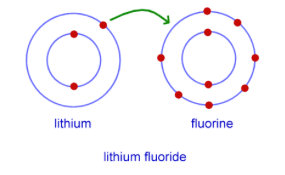
What type of bond is this?
a)
ionic
b)
covalent
19.
This picture shows a...
a)
Ionic Bond
b)
Covalent Bond
c)
Both bonds
d)
Neither bond
20.

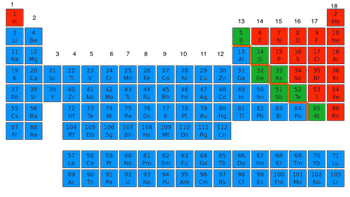
Where are metals located on the periodic table?

a)

right side of the staircase

b)

on the staircase

c)

left side of the staircase

21.

What is the formula of this molecule?

a)

CH

b)

HC4

c)

CH4

d)

C4H4

22.

How many ATOMS in this molecule

a)

1

b)

2

c)

3

d)

4

e)

5

23.

What is the chemical formula for dinitrogen pentoxide?

a)

N2O4

b)

N2O3

c)

N2O5

d)

N5O2

24.

What compound is this S2F2

a)
Sulfur tetrafluoride
b)
Disulfur trifluoride
c)
Sulfur difluoride
d)
Disulfur difluoride
25.

When writing chemical formulas, what is the purpose of subscript?

a)
To indicate the number of atoms of each element in a chemical compound.
b)
To indicate the color of the chemical compound.
c)
To represent the state of matter of a substance.
d)
To show the charge of an element in a compound.
26.
How do the following two elements bond together?
Al3+  O2-         
a)
AlO
b)
Al2O3
c)
Al3O6
d)
Al3O2
27.
Beryllium will ____ valence electrons when forming an ionic bond.
a)
lose 4
b)
gain 4
c)
lose 2
d)
gain 2
28.

Which of the following is a characteristic of ionic compounds?

a)
They have high melting and boiling points.
b)
They are composed of only nonmetals.
c)
They have low electrical conductivity in solid form.
d)
They are always soluble in water.
29.
In the process of ionic bonding, ions come together because
a)
opposite charges repel
b)
positive and negative ions attract
c)
salt is magnetic
d)
like charges attract each other
30.

What is the purpose of using the criss-cross method in chemistry?

a)
To determine the correct formula for ionic compounds by balancing charges.
b)
To predict the reaction rates of chemical reactions.
c)
To identify the physical state of substances.
d)
To calculate the molar mass of compounds.
31.
What happens when an atom loses an electron?
a)
It becomes Negatively Charged
b)
It remains neutral because the proton also leaves.
c)
It becomes Positively Charged
d)
It stays the same.
32.

Why is group 18 of the periodic table non-reactive?

a)
Group 18 elements are highly reactive with water.
b)
Group 18 elements have incomplete electron shells.
c)
Group 18 elements readily form compounds with metals.
d)
Group 18 elements are non-reactive due to their full valence electron shells.
33.

If a compound has the chemical formula of Ca3X2 , which of the following elements could X represent?

a)

He

b)
Cl
c)

F

d)
N
34.

A compound of Strontium and Fluorine would form what kind of bond?

a)
Covalent bond
b)
Ionic bond
c)
Metallic bond
d)
Hydrogen bond
35.

A compound of Carbon and Phosphorus would form what kind of compound?

a)
Ionic compound
b)
Metallic compound
c)
Organic compound
d)
Covalent compound