
 Worksheets
Ecosystem and Food Chains Quiz
Total questions: 50
Worksheet time: 17mins
Which of the following best describes a food chain?
A complex network of feeding relationships in an ecosystem
The physical characteristics of an environment
A linear sequence of organisms showing who eats whom
The process of energy transfer between trophic levels
In a food web, which organisms are considered primary producers?
Herbivores
Carnivores
Decomposers
Photosynthetic organisms
Which of the following is NOT a biogeochemical cycle?
Carbon cycle
Nitrogen cycle
Oxygen cycle
Food cycle
What is the primary role of decomposers in an ecosystem?
To produce oxygen through photosynthesis
To consume other organisms for energy
To break down dead organisms and return nutrients to the environment
To regulate the population of predators
In the carbon cycle, where is the largest reservoir of carbon found?
Atmosphere
Oceans
Fossil fuels
Living organisms
Which biome is characterized by low-growing plants and permanently frozen subsoil?
Savanna
Temperate deciduous forest
Desert
Tundra
Which of the following is an example of a biogeochemical cycle?
Water cycle
Rock cycle
What is the primary role of bacteria in the nitrogen cycle?
They consume nitrogen directly from the air
They convert nitrogen into forms usable by plants
They release nitrogen back into the atmosphere
They store nitrogen in their bodies for long periods
Which terrestrial biome has the highest biodiversity?
Tundra
Temperate grassland
Tropical rainforest
Taiga
What is the main difference between a food chain and a food web?
Food chains only include plants, while food webs include animals
Food chains show energy flow, while food webs don't
Food chains are linear, while food webs show interconnected feeding relationships
Food chains are found in aquatic ecosystems, while food webs are found in terrestrial ecosystems
Which of the following is a characteristic of freshwater ecosystems?
High salinity levels
Presence of coral reefs
Limited biodiversity
Low salt concentration
What is the primary producer in most marine ecosystems?
Kelp
Phytoplankton
Zooplankton
Seagrass
Which aquatic biome is characterized by slow-moving or standing water?
River
Estuary
Pond
Coral reef
What is the term for the area where a river meets the ocean?
Estuary
Wetland
Lagoon
Fjord
Which of the following is NOT a freshwater biome?
Lake
Stream
Wetland
Marine Inland

Look at the food chain. How do foxes get energy?
from eating rabbits
from eating grass
from the sun
from eating other foxes
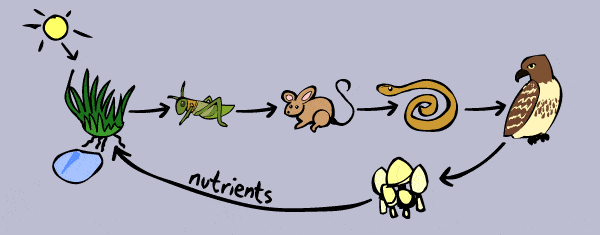


Discuss the role of decomposers in the nutrient cycle of an ecosystem.
Decomposers produce energy for primary consumers.
Decomposers break down dead organic matter, returning nutrients to the soil.
Decomposers are primary producers in the ecosystem.
Decomposers compete with primary consumers for food.
What do we call an animal that eats plants?
Carnivore
Omnivore
Herbivore
Insectivore
What do we call animals that eat both plants and meat?
Carnivores
Herbivores
Omnivores
Decomposers
What do we call the sequence of who eats whom in a biological community?
Food chain
Food web
Food circle
Food square
Which of the following best describes a food chain?
A network of interconnected food webs
A linear sequence of organisms through which nutrients and energy pass
A group of organisms that share the same habitat
A cycle of nutrient recycling
What is the primary source of energy for most ecosystems?
Water
Sunlight
Soil
Wind
What is at the very bottom of the food chain?
Lions
Plants
Humans
Bears

What process will remove carbon from the ecosystem?
cellular respiration
photosynthesis
decomposition
combustion
What is the largest reservoir for nitrogen?
the ocean
rocks and minerals
the atmosphere
bacteria
Which cycle DOESN'T have an atmosphere component (part)?
carbon
nitrogen
phosphorus
water
Too much phosphorus in waterways (rivers, lakes) can lead to___________.
eutrophication
Nothing
Death
diseases

How does the burning of fossil fuels affect the cycle shown?
It releases ozone into the atmosphere.
It removes carbon from the atmosphere.
It both releases and removes carbon from the atmosphere.
It releases carbon into the atmosphere.

Organisms require nitrogen to make which of the following?
glucose and starch
lipids and nucleic acids
proteins and nucleic acids
carbohydrates and proteins


Name the correct trophic level for level 1.
Tertiary
Consumer
Producer
Quatemary
In a food chain, which organisms are typically at the second trophic level?
Primary producers
Primary consumers
Secondary consumers
Tertiary consumers

Name the trophic level in Level 2.
Primary
Tertiary
Consumer
Secondary

