
 Worksheets
Unit 1
Total questions: 237
Worksheet time: 4hrs 32mins
Change from Liquid to Solid is called ...
fusion
Freezing
sublimation
evaporation
Change from liquid to gas is called....
expansion
evaporation
condensation
sublimation
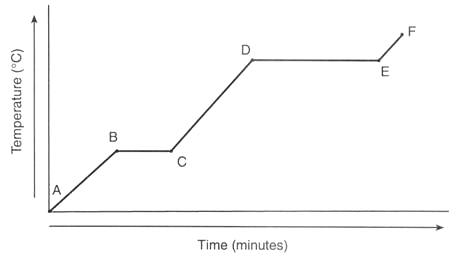
What state/phase is the object likely from points A to B?
Solid
Liquid
Gas
Plasma
What is happening to the particles in the substance between points D and E?
Melting
Freezing
Vaporizing
Sublimating

Where on the graph are phase changes taking place?
1
2
3
4
5
Which statement is NOT true about gases?
Gases flow.
Gases spread out.
Gases cannot be held.
None of these.


Does air have weight?
no
sometimes
yes
of course not
The phase change when a solid becomes a liquid.
freezing
sublimation
melting
condensation
During a PHASE CHANGE, like freezing, temperature...
increases.
decreases.
does NOT change.
varies.
The phase change when a liquid becomes a gas.
melting
boiling
sublimation
evaporation
The phase change when a gas becomes a liquid.
condensation
evaporation
deposition
sublimation

condensation

Which process could cause a material to change state from gas to liquid?
Adding heat
Adding energy
Removing particles
Removing energy


What must happen for molecules to move slower?
Kinetic energy is not changing. Temperature decreases.
Kinetic energy and temperature depend on the molecules.
Kinetic energy is decreasing and temperature is decreasing.
Kinetic energy is decreasing and temperature is increasing.

What phase is A?
Solid
Liquid
Gas
Plasma
What phase is C?
Solid
Liquid
Gas
Plasma
What phase is E?
Solid
Liquid
Gas
Plasma
What phase is D?
Melting
Freezing
Vaporization/Evaporating
Condensing
What phase is F?
Melting
Freezing
Vaporization/Evaporating
Condensing
What phase is B?
Melting
Freezing
Vaporization/Evaporating
Condensing
What phase is G?
Melting
Freezing
Vaporization/Evaporating
Condensing
What is true about point D?
The molecules are slowing down and getting closer together
The molecules are slowing down and getting further apart
The molecules are speeding up and getting closer together
The molecules are speeding up and getting further apart
What is true about point F?
The molecules are slowing down and getting closer together
The molecules are slowing down and getting further apart
The molecules are speeding up and getting closer together
The molecules are speeding up and getting further apart
What is true about point B?
The molecules are slowing down and getting closer together
The molecules are slowing down and getting further apart
The molecules are speeding up and getting closer together
The molecules are speeding up and getting further apart
What is true about point G?
The molecules are slowing down and getting closer together
The molecules are slowing down and getting further apart
The molecules are speeding up and getting closer together
The molecules are speeding up and getting further apart

Which of the following is true about the lines on the phase change diagram?
The diagonal line represents a phase change of matter
The flat line represents the phase of matter
The diagonal line shows a change in temperature
The flat line shows a change in temperature
Which of the following is true about the lines on the phase change diagram?
The diagonal line represents the phase of matter
The flat line represents the phase of matter
The diagonal line shows no change in temperature
The flat line shows a change in temperature
Which of the following is NOT true about the lines on the phase change diagram?
The diagonal line represents the phase of matter
The flat line represents a change in the phase of matter
The diagonal line shows a change in temperature
The flat line shows a change in temperature
Which of the following is NOT true about the lines on the phase change diagram?
The diagonal line represents the phase of matter
The flat line represents a change in the phase of matter
The diagonal line shows a change in temperature
The flat line shows no change in time
Which of the following is true about the lines on the phase change diagram?
The flat line on the graph demonstrates that the temperature does not change until the phase change is complete
The flat line represents a change in the phase of matter
The flat line shows a change in temperature
The flat line shows no change in time
What is needed for a solid to change to a liquid?
Thermal energy needs to increase the molecules need move further apart this is called melting
Thermal energy needs to decrease the molecules need to move closer together this is called freezing
Thermal energy needs to increase the molecules get closer together this is called melting
Thermal energy needs to decrease the molecules get further apart this is called freezing
Thermal energy needs to increase the molecules get further apart this is called vaporization
What is needed for a liquid to change to a solid?
Thermal energy needs to increase the molecules need move further apart this is called melting
Thermal energy needs to decrease the molecules need to move closer together this is called freezing
Thermal energy needs to increase the molecules get closer together this is called melting
Thermal energy needs to decrease the molecules get further apart this is called freezing
Thermal energy needs to decrease the molecules get closer together this is called condensation
What is needed for a liquid to change to a gas?
Thermal energy needs to increase the molecules need move further apart this is called vaporizing
Thermal energy needs to decrease the molecules need to move closer together this is called freezing
Thermal energy needs to increase the molecules get closer together this is called vaporizing
Thermal energy needs to decrease the molecules get further apart this is called freezing
Thermal energy needs to decrease the molecules get closer together this is called condensation
What is needed for a gas to change to a liquiid?
Thermal energy needs to increase the molecules need move further apart this is called vaporizing
Thermal energy needs to decrease the molecules need to move closer together this is called freezing
Thermal energy needs to increase the molecules get closer together this is called vaporizing
Thermal energy needs to decrease the molecules get further apart this is called freezing
Thermal energy needs to decrease the molecules get closer together this is called condensation

What term goes on the y-axis? (A)
Heat(Energy)
Temperature
Phase
Type of Matter
What phase of matter exists in part C of the graph?
Gas
Liquid
Solid
Plasma
What phase of matter exists in part D of the graph?
Gas
Liquid
Solid
Plasma
What phase of matter exists in part E of the graph?
Gas
Liquid
Solid
Plasma
What phase change occurs when you start at D and end at E?
Freezing
Melting
Condensing
Vaporization
What phase change occurs when you start at D and end at C?
Freezing
Melting
Condensing
Vaporization
What phase change occurs when you start at E and end at D?
Freezing
Melting
Condensing
Vaporization
What phase change occurs when you start at C and end at D?
Freezing
Melting
Condensing
Vaporization
On which parts of the graph does the temperature remain the same?
Between C and D
Between D and E
At C, D, or E
On both flat sections
On which parts of the graph does the temperature change?
Between C and D
Between D and E
At C, D, or E
On both flat sections
The temperature changes the most during a phase change.
True
False
What phase change occurs when you start at D and end at C?
Freezing
Melting
Condensing
Vaporization
What phase change occurs when you start at E and end at D?
Freezing
Melting
Condensing
Vaporization
What phase change occurs when you start at C and end at D?
Freezing
Melting
Condensing
Vaporization
On which parts of the graph does the temperature change?
Between C and D
Between D and E
At C, D, or E
On both flat sections
What phase of matter exists in part E of the graph?
Gas
Liquid
Solid
Plasma
What phase of matter exists in part D of the graph?
Gas
Liquid
Solid
Plasma
How would you describe the way molecules move when the molecules are gas?
the molecules are moving in place.
the molecules are moving around each other.
the molecules are moving away from each other.
the molecules are not moving
What happens to molecules when the temperature drops or lowers?
The molecules get closer together
The molecules start moving faster.
The molecules stop moving.
The molecules become smaller.


The state of matter that has particles close together and vibrating.
liquid
solid
gas
water
Temperature MEASURES...
the movement of particles.
how hot it is.
how cold it is.
weather.
Which of the following are characteristics of a gas? (Check all that apply)
Definite Shape
Indefinite Shape
Definite Volume
Indefinite Volume
Ionized
Which of the following are characteristics of a liquid? (Check all that apply)
Definite Shape
Indefinite Shape
Definite Volume
Indefinite Volume
Ionized

Identify the following phase of matter.
Solid
Liquid
Gas
Plasma
Which of the following statements are TRUE about states of matter and kinetic energy? (more than one answer)
Fewer particles means there is more kinetic energy
As temperature increases so does kinetic energy
As temperature decreases particles move closer together
As the number of particles increases so does kinetic energy

Which substance has the most energy?
Ice water
Ice
Tap water
Lightning
How does plasma, the fourth state of matter, differ from a gas?
Plasma has indefinite shape and volume; gas does not.
Plasma has definite shape and volume; gas does not.
Plasma cannot conduct electricity; gas can.
Plasma has electrically charged particles like the Northern Lights; gas does not.
Phase changes always involve changes in
matter.
space.
color.
energy.

Measures how fast or how slow molecules are moving
Density
Temperature
Heat
All of them
How are plasma and gas different?
Plasma has a definite shape, but gas does not.
Gas is hotter than plasma.
Electrons separate from atoms in plasma and plasma is hotter.
Gas has a definite volume, but plasma does not.
This is the most abundant state of matter in the Universe!
Gas
Plasma
Solid
Liquid
Which state of matter would be described as having highly energized, charged particles which move extremely fast?
solid
liquid
plasma
gas
SELECT ALL THAT APPLY
When you add energy to matter...
...the particles move faster.
...it might change state.
...the temperature will increase.
...you remove cold energy.
All of the above.
What term goes on the x-axis? (B)
Heat(Energy)
Temperature
Phase
Type of Matter
What term goes on the y-axis? (A)
Heat(Energy)
Temperature
Phase
Type of Matter
As an ice cube melts, its molecules
absorb heat energy and move farther apart
release heat energy and move farther apart
absorb heat energy and move closer together
release heat energy and move closer together
Which state of matter is described below?
1. Particles are packed closely together
2. Particles vibrate
3. Strong molecular attraction between particles
solid
liquid
gas
plasma
Which state of matter is described below?
1. Particles are less densely packed
2. Particles slide around past each other
3. Not a strong molecular attraction between particles
solid
liquid
gas
plasma
Which state of matter is described below?
1. Particles move freely
2. High energy
3. Very weak molecular attraction between particles
solid
liquid
gas
plasma
A hot air balloon rises because its ___.
particles are less attracted by gravity when heated
particles move slower and closer together when heated
particles move faster and farther apart when heated
particles become charged and repel each other when heated
The three states of matter are different. However, liquids and gases do have some things in common. One of these is ____.
the liquids and gases are both more dense than solids
the liquids and gases both take the shape of their container
that liquids and gases have the same densities as solids
that liquids and gases do not take the shape of their container
The change from a liquid to a solid state is called ___.
freezing
melting
condensing
vaporizing
What are the 3 parts of kinetic molecular theory?
Matter is made up of tiny particles called atoms
The phase is dependent on the kinetic energy of the particles
Atoms are in constant random motion.
All matter has mass and takes up space.
When an item is heated up it becomes a gas
The unit for mass is...
Newton
grams
mililiters
centimeters

What is this tool called....
Ruler
Thermometer
Beaker
Graduated Cylinder

A graduated cylinder is used to measure...
Volume
mass
weight
density
The unit for volume is. (there is more than one right answer)
grams
milliliters (mL)
Newton
Centimeters Cubed
What two types of measurements make up DENSITY?
Volume and Weight
Temperature and Mass
Mass and Volume
What is the density of water?
34 g/mL
1 g/mL
29 g/mL
6 g/mL

Measuring the volume of a block uses which equation
Length ×Width×Height
(radius)2×Length×π
What is the unit for density ?
g/ mL
g
cm3g
cm4


10.0 ml
15.0 ml
20.0 ml
25.0 ml

18.0 ml
6.0 ml
38.0 ml
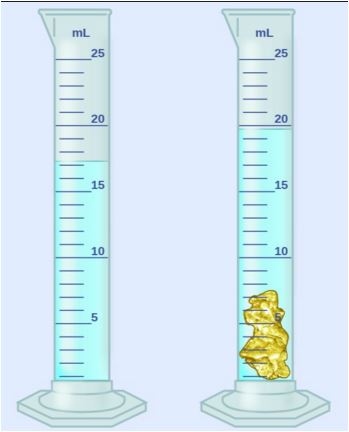

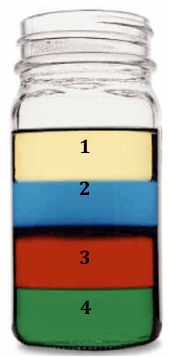

Which box has a higher density?
A
B
They are the same
Calculate the density in the following question: A flower pot has a mass of 95 g and a volume of 92 mL.
1.03 g/mL
0.97 g/mL
1.01 g/mL
0.99 g/mL
An object has a volume of 6 cm3 and a mass of 42 g. What's it's density?
7 g/cm3
48 g/cm3
42 g/cm3
6 g/cm3

The amount of water displaced is the same as the volume of the object. What is the VOLUME of the object?
An object is is placed into 45 mL of water. The water rises to 48 mL. What is the volume of the object?
3 mL
93mL
8 mL
83 mL


The density of a material is 2 g/cm3. The volume is 24 cm3 . What is the mass?

If an object has a density of 6 g/mL and you put it into water, will it sink or float?

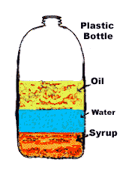
Using the picture, tell me which object is the least dense and why?
The fish because he is in the middle
The cork because it is floating at the top of the water
The rock because it is at the bottom
The cork and the rock because they have the same about of atoms.

#14 Show all your work on your answer document. D=m/v
10 g/cm3
0.14 g/cm3
7 g/cm3
60 g/cm3

#15 Show all your work on your answer document. m=D⋅V
0.25 g
3 g
4 g
5 g

#16 Show all your work on your answer document. m=D⋅V
0.625 g
1.6 g
10 g
7 g


As part of a classifying elements lab Joe was finding the density of different samples. One sample had a mass of 26.4 and a volume of 12 mL. What element is it?
Sulfur
Carbon
Boron
Krypton

The mass of the jade is 13g, what is the density?
1.3 g/mL
0.81 g/mL
1.24 g/mL
0.77 g/mL
What is the formula for Mass?
Mass/Volume
Density x Volume
Mass/Density
What is the formula for Volume?
Mass/Volume
Density x Volume
Mass/Density
Which of the following values would represent the pH of a strong base?
1
8
7
13
Which of the following are the characteristics of a BASE?
Very bitter in taste
Liberate OH- ions when dissolved in water
Have pH of less than 7
Turns blue litmus red
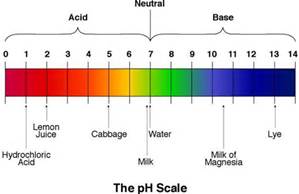
According to the pH range given in the image,which substance is more acidic than lemon juice?
Hydrochloric acid
Cabbage
Milk
Milk Of Magnesia
Which of the following word pairs correctly completes the sentence below?
_______ are corrosive substances characterized as having a strong smell, a sour taste, and a _______.
acid pH less than 7
acid pH greater than 7
base pH less than 7
base pH greater than 7
The pH of a solution is tested, and it is found to be a basic solution. Of the following choices, what could the pH have been?
3
7
9
5
When using pH paper, the pH of a solution can be determined by looking at the _______ of the paper
texture
mass
colour
length
What would be considered the weakest base?
8
7.8
11.6
14
Pure water has a pH of 7. Pure water _______.
is a base
is a neutral substance
could be either an acid or a base
is an acid
pH is the measure of the concentration of ______.
Acids
H+ ion
OH- ion
Base
If a solution is basic which ion will be more present?
H+
K+
OH-
H-
Stronger acids have a pH closer to...
7
14
0
9
A pH level of 7 indicates
acid
base
neutral
non of the following
A substance is found to have the following characteristics:
Very bitter taste
Feels slippery to the touch
Produces OH- ions when dissolved in water
In what category would the substance be classified?
acid
base
enzyme
fatty acid
Which of these pH values represent an acid?
4
8
10
12

Milk is a very weak acid. What might its pH value be?
6.5
7.8
4.2
12.2
When an acid is dissolved in water, it turns red litmus paper blue.
True
False
Which of the following are properties of acids?
They conduct electricity when dissolved in water
They taste sour
They react with metals to produce hydrogen gas
All of the answer choices are correct
An acid is a solution that contains __________ ions dissolved in water.
positive
negative
The higher the concentration of negative (hydroxide) ions in the solution, the stronger the base is.
True
False
Which of the following pH values represents a base?
2.1
4.6
6.8
8.1
The strongest bases have pH values close to
0
14
7
5
Which of the following is a base?
baking soda in water
orange juice
vinegar
lemonade
Ocean water is only slightly basic. What might its pH value be?
5
8
12
2
Bases turn blue litmus paper red.
True
False
Blue color: Chemical or Physical Property
Reacts with acid: Chemical or Physical Property
Sour taste: Chemical or Physical Property
Melting point: Chemical or Physical Property
Reacts with water: Chemical or Physical Property
Boiling point: Chemical or Physical Property
Odour (smell): Chemical or Physical Property
Which one of these is a chemical property?
Melting point
Boiling point
Color
Toxicity
Properties that can be observed without changing the identity of the substance
Properties that describe how a substance changes into a completely different substance

is the ability of a substance to dissolve in a liquid
malleability
luster
oxidation
solubility

the ability of a material to bend or be hammered into other shapes without breaking.
Ductility
Malleability
Toxicity
Solubility

the ability to pass electricity or heat through a substance
conductivity
ductility
oxidation
malleability
the ability of a substance to be drawn into thin wires
Conductivity
malleability
ductility
flammability
Properties that can only be observed or measured by changing the chemical identity of a substance.
Physical Properties
Combustible Properties
Chemical Properties
Changeable Properties
How easily a substance reacts with Oxygen.
reactivity
oxidation
combustibility
solubility
Which of the following is a Chemical Property?
solubility
flammability
viscosity
melting point
Which of the following is a Chemical Property?
radioactivity
boiling point
solubility
viscosity
Which of the following is a Chemical Property?
viscosity
melting point
solubility
toxicity
How easily a substance will set on fire.
oxidation
reactivity
combustibility
chemical property
How easily a substance reacts, usually with an acid or a base
reactivity
solubility
oxidation
flammability
Which of the following creates rust on vehicles?
oxidation
solubility
combustibility
reactivity
The way something looks, feels, smells, and tastes are physical properties.
True
False

Ability of substance to dissolve into another substance:
magnetism
malleability
solubility
appearance

The final product of any physical change is still composed of the same matter.
True
False
The amount of light that bounces off of an object
solubility
conductivity
reflectivity
magnetism
A chemical property describes how matter __________.
smells
reacts with another type of matter
looks under a microscope
dissolves when made into a solution

color
physical property
chemical property

flammable
physical property
chemical property

odor/smell
physical property
chemical property

tarnish/rust
physical property
chemical property

taste
physical property
chemical property

texture
physical property
chemical property
Which of the following is true?
A physical property can only be seen.
A physical property describes how matter can change when exposed to air.
A physical property is something that can be observed about the substance by itself.
A physical property can only be observed when two types of matter interact.

Which of the following are physical properties of the matter pictured?
Check all that are true
reacts to oxygen
smooth
malleable (bendable)
reddish-brown
shiny
Which of these would NOT be chemical properties of oxygen?
Check all that are true.
has no color
reacts to moisture and iron to form rust
helps many substances burn
has no odor

Jack leaves solid butter near a warm surface. When Jack returns, the butter has turned into a liquid. Jack's friend Elijah insists this is a chemical change. Is Elijah right?
no, because no new matter was formed
yes, because the matter changed states
no, because the butter didn’t have enough time to go through a chemical change
yes, because melted butter is a new type of matter
What is an example of a physical change?
having less ash than the paper that was burned to form it
ice forming and then melting back into water
rust having a different identity than the iron it forms on
the irreversible reaction of vinegar and baking soda
The Statue of Liberty is made of copper that has turned green because it has undergone a change. What can be said about this change?
The change is a physical change because the copper in the statue is still there.
The change is a physical change because a new chemical is formed on the outside of the statue.
The change is not a physical change because the color of the statue has changed.
The change is not a physical change because a new chemical is formed on the outside of the statue.
A scientist is examining an unknown solid. Which procedure would most likely help determine a chemical property of the substance?
heating it to find the temperature at which it melts
exposing it to a flame to see if it catches on fire
hitting it with a hammer to determine if it breaks or bends
placing it in water to find out whether or not it dissolves
Which of the following would be a Chemical Property?
Size
Flammability
Color
Density


Chemical or Physical:
A characteristic of matter that can be observed with your 5 senses is a ____________ property.
Chemical
Physical
Chemical or Physical:
A characteristic of matter that can only be observed when matter is changed into a new kind of matter.
Chemical
Physical

