
 Worksheets
Year 10 Plate Tectonics and Earthquakes
Total questions: 25
Worksheet time: 24mins
What is an earthquake’s epicenter?
the place on the surface directly above the focus
a spot halfway between the focus and the surface
the spot below the focus
any spot along the nearest fault
Where do most earthquakes occur?
in the mountains of Africa
around the edge of the Pacific Ocean
around the edge of the Atlantic Ocean
on the western lowlands of Europe
What measurement for earthquake do scientists use most often today?
seismic scale
Richter scale
moment magnitude scale
epicenter magnitude scale
Earth’s thin, rocky outer layer is its
core
mantle
crust
outer core
A tool used to measure and record earthquake activity
laser beams
Richter scale
seismograph
tiltmeter
Where do most earthquakes and volcanoes happen?
mid-ocean ridges
plate boundaries
in the mantle
rift valley
An earthquake is
The movement of magma in the crust.
The sudden vibration of the earth's crust.
The wearing away of crustal rock.
Folding of rock by compression
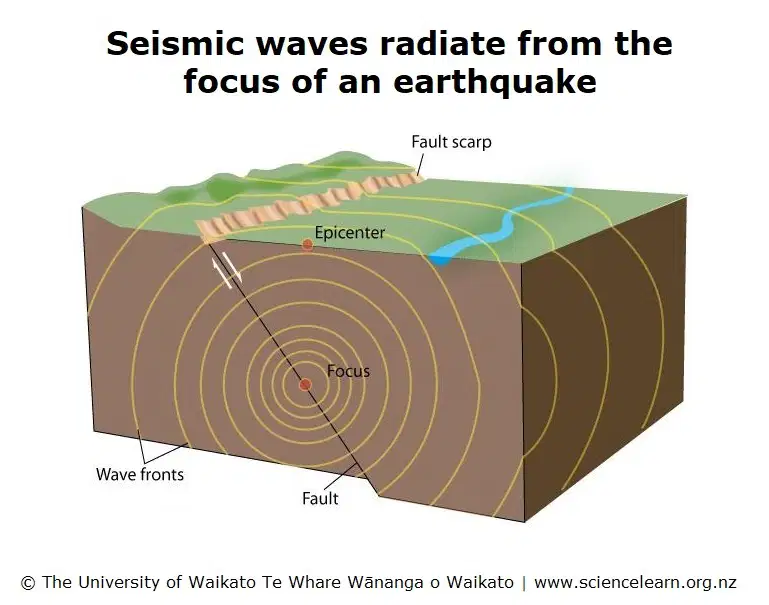
The point where the earthquake originates is called
The Epicenter
The Fault line
The Wave front
The Focus
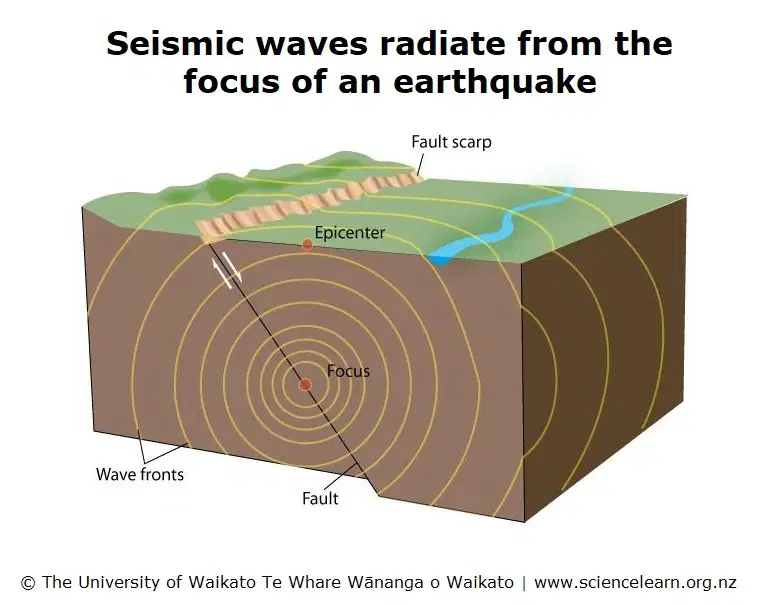
The point on the surface above the place the earthquake originated is
The Fault line
The Epicenter
The Focus
The Wave fronts

Earthquakes happen every day. Most are too small for humans to notice.
True
False
Which one is the odd one out?
Crust
Inner Core
Outer Core
Mantle
Subduction Zone
What features are found at a destructive plate boundary?
Subduction Zone
Fold Mountains
Volcanoes
Magma Sinks
Which of these features is NOT found at a constructive plate margin?
Subduction Zone
Rising Magma
Plates moving apart
Volcanoes

The movement of tectonic plates is caused by:
The Earth's rotation
The gravity of the iron-nickel core
The Moho discontinuity.
Convection currents
Which of the following is where one plate slides under another plate?
submarine zone
divergent zone
subduction zone
lower zone
When is a natural event a hazard?
When the natural event is very large.
When the natural event impacts on people and human activities.
When the natural event is caused by people and human activities.
All natural events are hazards.
Tectonic hazards are most likely to occur where?
At 'hot spots' in the Earth's crust.
In the middle of an ocean
In the center of tectonic plates
On tectonic plate margins
At which type of plate margin does subduction occur?
Destructive plate margin
Constructive plate margin
Conservative plate margin

What type of plate boundary does the diagram illustrate?
Destructive
Constructive
Conservative
Collision

What layer of the earth is number 3?
inner core
mantle
crust
outer core
Tectonic plates move because of .........................currents.
convection
conduction

What is the name of this plate margin?
Constructive
Destructive
Collision
Conservative

What is the name of this plate margin?
Constructive
Destructive
Collision
Conservative

In which layer of the Earth would you find convection currents?
(a)

