
 Worksheets
Final Exam Review
Total questions: 55
Worksheet time: 52mins
Something that transports energy without transporting MATTER!!!!!
Waves
Energy
Particles
Work
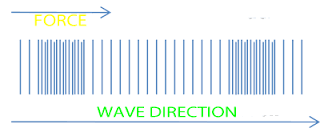
The direction in which a wave is traveling is called
Propagation
Equilibrium
Horizontal
Perpendicular
A wave that causes mater to move perpendicular to wave propagation is called
Transverse waves
Longitudinal waves
The number of crest that pass through in one second is called ...... The property of a wave that remains unchanged when it travels then transferred to another string with a different density
Frequency
wavelength
Amplitude
Waves transfer
matter
energy
particles
water
What is the speed of a wave that has a wavelength of 2 m and a frequency of 6 Hz?
3 m/s
8 m/s
12 m/s
24 m/s
What is the frequency of a wave if the wave has a speed of 12 cm/s and a wavelength of 3 cm?
4 Hz
8 Hz
24 Hz
36 Hz
The transfer of energy from a wave to a medium.
Absorption
Reflection
Pitch
Hertz
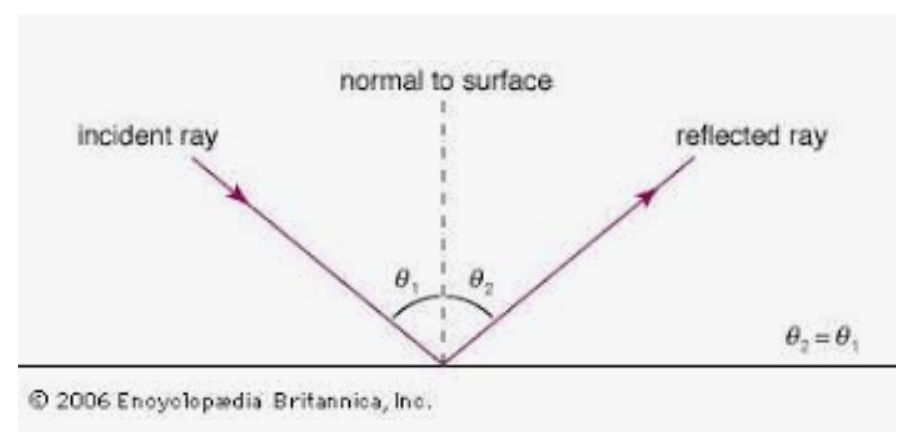
The image is depicting
reflection
refraction
rarefaction
rarefractflection
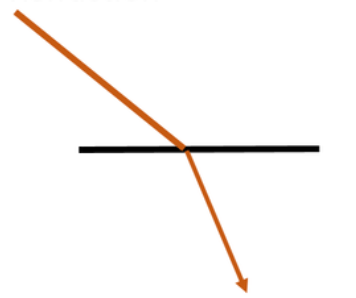
The image is depicting
reflection
refraction
rarefaction
rarefractflection
Waves that refract are experience a change in their ______
medium
light
intensity
velocity
As a wave transitions from solid medium to liquid , which change is the most possible?
Faster wave speed with shorter wavelength.
Slower wave speed with longer wavelength.
Faster wave speed with higher frequency.
Slower wave speed with reduced amplitude.
As a mechanical wave passes through a medium with rising temperature, which effect is correct?
Wave speed decreases due to increased molecular activity.
Frequency increases with stronger molecular vibrations.
Wave speed increases as density decreases.
Amplitude remains constant despite temperature changes.
Loudness of sound depends on
Frequency
Amplitude
Wave length
Velocity

The amplitude measures from
Crest to Crest
Crest to Rest Position
Crest to wavelength
Crest to Trough


What is the top of the wave?
Amplitude
Crest
Trough
Wavelength


Which statement is correct about the wave shown in the diagram?
It is a transverse wave because the particles are moving perpendicular to the motion of the wave.
It is a transverse wave because the particles are moving parallel to the motion of the wave.
It is a longitudinal wave because the particles are moving perpendicular to the motion of the wave.
It is a longitudinal wave because the particles are moving parallel to the motion of the wave.
Sound waves are caused by the (a) of particles that but when the source stops the wave continues to travel and gradually loses energy.
A sound can only be heard if a sound source is:
Staying at rest positing
Vibrating both ways pst rest position
Big enough to see vibrations
Moving toward the receiver
Imagine you're standing under the bright, warm sun. Your body starts to heat up as it soaks in the sun's rays. Can you guess what type of wave movement is happening here?
Reflection
Refraction
Absorption
Transmission

True or false? During the outward movement of the speaker cone, air pressure in the region of compression decreases
True
False
X-rays fall between ultraviolet light and ____ rays in the electromagnetic spectrum
Gamma
Visible
Infrared
Microwave
Which has the SHORTER wavelength?
GAMMA RAYS
X-RAYS
Most insolation striking a smooth, light-colored, solid surface is
refracted
transmitted
reflected
absorbed

In the diagram, which letter represents the angle of incidence?
A
B
C
D

The top two waves met and formed the bottom wave. This is called:
Constructive Addition
Constructive Superposition
Destructive
Addition
Destructive Superposition
When waves ADD up to make a LARGER amplitude
constructive
destructive
productive
addictive
When waves add up to make a SMALLER, or zero, amplitude
constructive
destructive
productive
addictive

What type of interference is represented in this diagram?
Constructive
Destructive

What type of interference is represented in the diagram?
Constructive
Destructive

What part of the ear is pointed by the arrow number 6?
ear drum
cochlea
ossicles
ear canal
True or False: The cilia in your cochlea can grow back if they die off.
True
False
True or False: There is a small amount of water in the cochlea and semicircular canals.
True
False
What are the small hairs in your cochlea called?
hair
fur
cilia
durma
brushes
What are the three smallest bones in your body?
hammer, anvil, and stirrup
pinna, canal, and cochlea
Eustachian, pinna, and ear canal
femur, tibia, and teeth
Which section of the ear is the hammer found in?
outer ear
middle ear
inner ear
part of the ear that sends signals to the brain.
inner ear
outer ear
middle ear
pinna

