
 Worksheets
Psych 100 Review Session 1
Total questions: 40
Worksheet time: 44mins
What is the independent variable (IV)?
The variable that we are measuring
The variable that we are defending
The variable that we are changing
The variable that we are creating
What does the hippocampus do?
Senses
Encodes memories
Regulate emotions
Connects hemispheres of brain
Which part of the neuron receives signals from other neurons and transmits them to the cell body?
Dendrites
Axons
Synapse
Axon Terminal
Correlation implies causation.
True
False
What is the main difference between neuroplasticity and neurogenesis?
Neuroplasticity refers to the brain's ability to form new neurons, while neurogenesis is the brain's ability to reorganize its structure.
Neuroplasticity refers to the brain's ability to reorganize and adapt by forming new neural connections, while neurogenesis is the creation of new neurons.
Neuroplasticity and neurogenesis are the same, both referring to the brain's capacity to regenerate neurons after injury.
Neuroplasticity refers to the growth of brain tissue, while neurogenesis refers to the repair of damaged neurons.
What is the sympathetic system responsible for?
Fight or flight
Rest or digest
If a scientist wanted to determine the relationship between studying and test scores which research design would this be?
Naturalistic
Correlational
Experimental
Case study
What does the hindbrain do?
Control higher mental functions
Control basic functions
Control balance
What part of the brain does the right visual field get processed by?
Left occipital lobe
Right occipital lobe
What part of the brain is responsible for quick literal interpretations of language?
Left hemisphere
Right hemisphere
Which of the following best describes inattentional blindness?
The inability to recall information due to damage in the hippocampus
Failure to notice an stimulus in your field of vision because attention is focused on something else
A visual impairment caused by selective attention overload
The ability to focus on multiple tasks simultaneously without distraction
What is the relationship between a hypothesis and a theory in psychological research design?
A hypothesis is a broad explanation for a phenomenon, while a theory is a specific prediction tested in an experiment.
A hypothesis is an educated guess or prediction that is tested in research, while a theory is a well-supported explanation based on multiple studies.
A theory is only needed if the hypothesis is proven wrong.
A hypothesis and a theory are essentially the same, used interchangeably in research.
What is change blindness in the context of selective attention?
The enhanced ability to detect changes when selectively focusing on an object
Difficulty in switching attention between two tasks
The inability to notice small details in a cluttered environment
A phenomenon where people fail to notice large changes in a visual scene when attention is focused elsewhere
What is the primary function of the autonomic nervous system?
It controls voluntary muscle movements like walking and talking.
It is responsible for processing sensory information from the environment.
It regulates involuntary bodily functions, such as heart rate, digestion, and breathing.
It controls decision-making and problem-solving in the brain.
What is the dependent variable (DV)?
The variable that we are changing
The variable that we are measuring
The variable that we are defending
The variable that we are creating
What happens during an action potential in a neuron?
The neuron's membrane rapidly depolarizes, allowing sodium ions to enter the cell, followed by repolarization as potassium ions exit the cell.
The neuron stays at its resting potential without any change in charge.
The neuron releases neurotransmitters into the synaptic cleft before depolarization occurs.
The action potential only occurs in the dendrites, not in the axon of a neuron.
What is the para-sympathetic system responsible for?
Rest and digest
Fight or flight
Deep processing, unlike shallow processing, uses which of the following
Maintenance rehearsal-repetition
Encoding
Elaboration
Semantic processing
What is the key difference between the concepts of "survival of the fittest" and "survival of the friendliest"?
"Survival of the fittest" focuses on physical strength, while "survival of the friendliest" emphasizes cooperation and social bonding as key to survival.
"Survival of the fittest" refers only to survival of the species, while "survival of the friendliest" applies only to individual success.
"Survival of the fittest" means that the most intelligent individuals survive, whereas "survival of the friendliest" suggests that survival is based on genetic fitness.
"Survival of the fittest" implies that competition is the key to success, while "survival of the friendliest" suggests that emotional intelligence has no role in survival.
What is the myelin sheath responsible for?
This is part of the neuron that receives messages
This is what sends signals and relays them
This is what protects/encases the axon to help signals send
This is the layer on the outside of the brain, also known as gray matter
What is the difference between agonists and antagonists?
Agonists block the production or release of a neurotransmitter and antagonists do this to the receptor
There is no difference between the two, they just work with different chemicals in the brain
Antagonists are responsible for increasing the neurotransmitter’s action will agonists do the opposite
Agonists are responsible for increasing the neurotransmitter’s action while antagonists do the opposite
What was the first idea or concept called that influenced modern psychology and focused on the conscious and introspection?
Empiricism
Functionalism
Structuralism
Pragmatism
Spacing in studying helps with …..
Elaboration
Encoding
Storing and being able to retain the information
Making associations
Which of the following sits below the thalamus and is responsible for directing signals in the brain?
Amygdala
Hypothalumus
Hippocampus
Cerebellum
What type of brain imaging takes a bunch of of images to make up a scan of the brain?
EEG
Transcranial Magnetic Stimulation
CAT Scan
Lesioning
Which type of psychology focuses on conditioning and learned interactions?
Behaviorism
Psychopathology
Cognitive psychology
Gestalt psychology
Researchers learn about the brain by studying?
Images of the brain created by computers
People with head injuries
The effects of electrical stimulation on the brain
All of the above
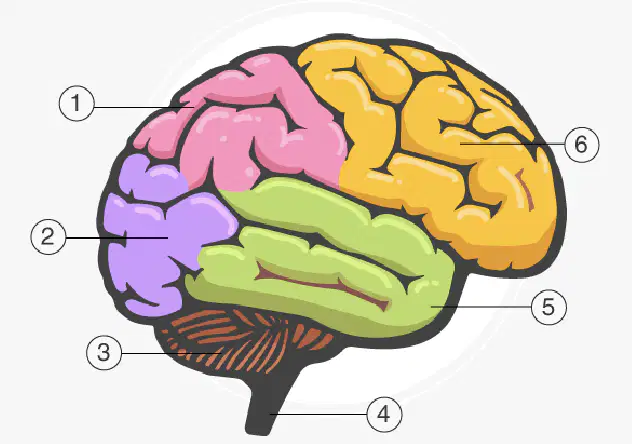
Which number is the temporal lobe?
1
6
2
5
What are the things that should be used in an experiment to make it show causation?
Experimental group and control group
A hypothesis
Single blind/double blind
Placebo effect
The biopsychosocial model describes the way that social, psychological, and biological factors impact human behavior and mental processes.
True
False
Which is the main goal of basic research?
Developing new technologies
Solving practical problems
Understanding fundamental principles
Creating new products
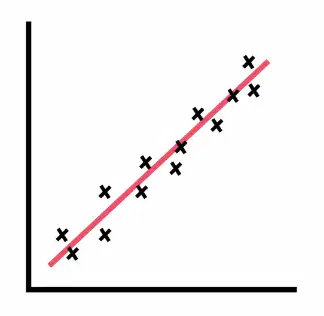
Does this graph represent positive correlation, negative correlation, or there is no correlation present?
Positive
Negative
No correlation
When does neurogenesis typically occur?
Early life
End of life
Adulthood
Young adulthood
Which is an example of sampling bias when giving a survey?
Having only your favorite people take the survey
Having a wide variety of people take the survey
Having only one gender take the survey
What is the primary function of the neurons in the nervous system?
To produce hormones
To store nutrients
To regulate body temperature
To transmit electrical signals
Based on the evolutionary psychology approach, what is the primary focus of human behavior?
The influence of cultural trends
The impacts of social media
To adapt for survival and reproduce
The pursuit of happiness
What are tiny sections of DNA that code for specific proteins?
Chromosome
Gene
Cell
Protein

What number is pointing to the terminal buttons?
1
7
3
5
The electrical reaction happens inside the neuron and the chemical reaction happens outside of the neuron.
True
False

