
 Worksheets
Pro vs. Eu, Cell Cycle, & DNA Quiz
Total questions: 18
Worksheet time: 18mins

An illustration of how a particular DNA mutation will most likely affect the polypeptide produced is shown. What type of mutation is illustrated?
Insertion
Translocation
Substitution
Deletion

A partial DNA segment and an mRNA codon chart are shown. 3′ TCATGCATG 5′
What amino acid sequence is encoded in the partial DNA segment?
Serine – Threonine – Tyrosine
Serine – Serine – Tyrosine
Serine – Threonine – Methionine
Serine – Alanine – Methionine


How is information for a specific protein carried on the DNA molecule?


Scientist observe the traits of cells on four microscope slides and record their observations in a table. Based on the scientists' observations, identify the eukaryotic cell slides/
Click on the hot spot boxes for the eukaryotic cells in the image.
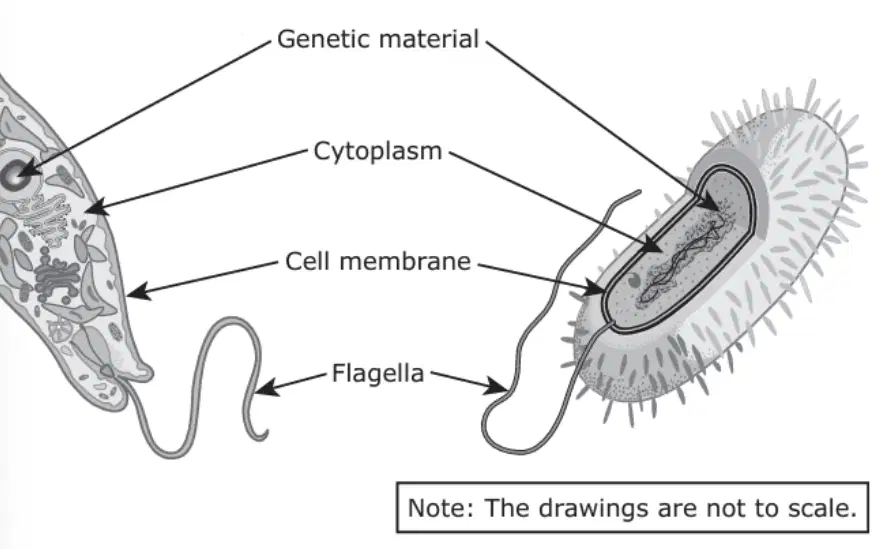
A prokaryotic cell and a eukaryotic cell are shown.
Which characteristics best distinguishes these cells are either prokaryotic or eukaryotic?
The organization of the genetic material
The location of the cytoplasm
The role of the cell membrane
The function of the flagella

Students use a microscope to look for structures present in four different cells. The students placed an X for each structure that was viewed for each cell on the table shown. Which cell in the table is a prokaryotic cell? (a)

A student groups different types of cells as shown.
Which table headings should the student use for the two groups?


Students created note cards comparing characteristics of eukaryotic and prokaryotic cells. Which set of note cards most accurately compares these cells?


Match the following stages of the cell cycle with their description
Interphase
G1 + S + G2
S-Phase
DNA is replicated
Mitosis (M-Phase)
Cell prepares to divide
Cytokinesis
Actual cell division
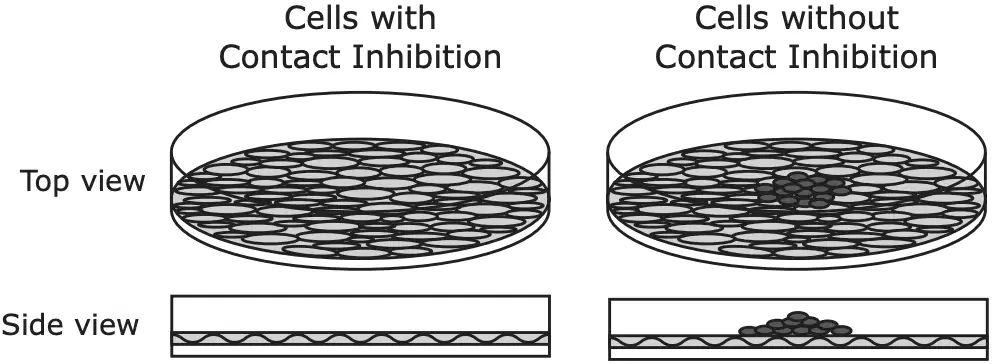
Normal cells have a contact inhibition feedback mechanism that prevents the cells from replicating when other cells are touched. A diagram of cells with contact inhibition and cells without contact inhibition is shown. Which statement best describes what will happen to cells in an organism that lack contact inhibition?
The cells will continue to grow, causing a tumor in the body.
The cells will replicate normally, replacing body cells that die.
The cells will replicate until the food supply for each cell is used, causing each cell to die.
The cells will stop replicating once one layer is produced, as other body cells will crowd them out.
What part of the diagram is Interphase?
Where is the information coded in DNA?
The nitrogen bases
The sugar molecule
The sugar-phosphate backbone
The phosphate group


