
 Worksheets
Physical Science Test over Scientific Method, Graphing and Measurements
Total questions: 28
Worksheet time: 15mins
Name
Class
Date
1.
A series of steps used by scientists to solve a problem or answer a question.
a)
Scientific Method
b)
Data Collection
c)
Recipe
d)
Metric System
2.
A testable explanation to a problem that has not yet been tested.
a)
Experiment
b)
Hypothesis
c)
Observation
d)
Analyze Data
3.
This variable in an experiment is the one being changed by the experimenter.
a)
Dependent
b)
Controlled
c)
Independent
d)
causation
4.
A hypothesis uses a ____
a)
If, Then statement
b)
a quantitative and qualitative
c)
reliable source
5.
The summary at the end of an experiment that explains the results.
a)
Observation
b)
Conclusion
c)
Hypothesis
d)
Experiment
6.
The name of the information that you get from your experiment (you organize it into charts and graphs).
a)
data
b)
variables
c)
conclusion
d)
hypothesis
7.
In the experimental Group, what variable would you measure?
a)
Control
b)
Independent
c)
Dependent
8.
If I read this question carefully, then I will answer it correctly. What is the dependent variable?
a)
Reading or not reading carefully
b)
likelihood of a correct answer
c)
independent variable
9.
If I study for my scientific method test, then I will have a better test score. What is the independent variable?
a)
studying
b)
test score
c)
scientific method
d)
dependent variable
10.
Label the following data as Qualitative or Quantitative: " The substance changed from blue to yellow. "
a)
Qualitative
b)
Quantitative
11.
Label the following data as Qualitative or Quantitative: "The plant grew 12 cm in 14 days"
a)
Qualitative
b)
Quantitative
12.
Label the following data as Qualitative or Quantitative: " The room temperature is 32 degrees Fahrenheit."
a)
Qualitative
b)
Quantitative
13.
Label the following data as Qualitative or Quantitative: "The substance is bubbling."
a)
Qualitative
b)
Quantitative
14.
What is the part of the experiment that is left alone or “natural", and is used to compare back to?
a)
Independent
b)
Dependent
c)
Control
d)
causation
15.
Select the correct order of the scientific method steps.
a)
Research, Experiment, Analyze Data, Form a hypothesis, Observation/Questions, conclusion
b)
Observation/Questions, Research, Form a hypothesis, Experiment, Analyze Data, Draw Conclusions/Repeat
c)
Observation/Questions, Analyze Data, Form a hypothesis, Experiment, Research, Draw Conclusions/Repeat,
16.
What is the term for describing how close you come to the correct result?
a)
Accuracy
b)
Precision
17.
What is the term for describing how consistently you can get that result using the same method?
a)
Accuracy
b)
Precision
18.

The X's represent where the arrows landed. Which is a true statement?
a)
Archer A is accurate but not precise.
b)
Archer B is accurate but not precise.
c)
Archer A is both accurate and precise.
d)
Archer B is both accurate and precise.
19.
Convert 27.5 liters to milliliters using the given metric chart and scratch paper. KHD u dcm
a)
275 milliliters
b)
27500 milliliters
c)
0.0275 milliliters
d)
2.75 milliliters
20.
Convert 173 km to m using the given metric chart and scratch paper. KHD u dcm
a)
173000 m
b)
0.173 m
c)
1.730 m
d)
173,000,000 m
21.

What is the volume of the liquid in this graduated cylinder?
a)
40 ml
b)
30 ml
c)
35 ml
d)
38 ml
22.
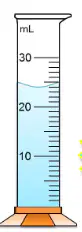
What is the volume of the liquid in this graduated cylinder?
a)
20 ml
b)
25 ml
c)
22 ml
d)
24 ml
23.

What is the temperature according to the thermometer in Celsius?
a)
76 C
b)
24 C
c)
22 C
d)
73 C
24.
Use your ruler to measure the line on the paper in centimeters (cm). Type your answer.
(a)
25.
What type of graph best represents data over a set period of time?
a)
Bar Graph
b)
Line Graph
c)
Circle Graph
26.

What is the independent variable in the graph?
a)
Time in months
b)
Height of the tree's growth
c)
Bradford Pear Tree
27.

What is the dependent variable in the graph?
a)
Time in months
b)
Height of the tree's growth
c)
Bradford Pear Tree
28.
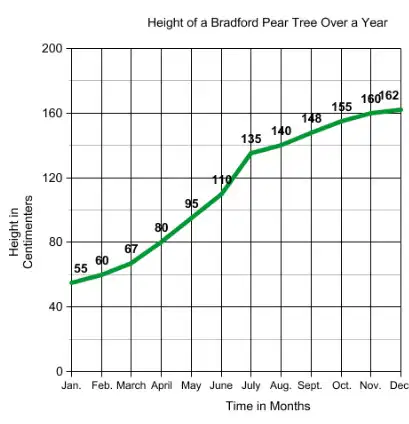
What months did the Bradford Pear Tree grow the most?
a)
January to February
b)
June to July
c)
November to December
100 %

