
 Worksheets
Skeletal/Muscular Test
Total questions: 70
Worksheet time: 42mins

What do the bones make?
veins
cartilage
red blood cells
bone marrow
Tissue found in some bones that makes blood cells
bone marrow
joints
tendons
ligaments
The _________________ gives the body its shape and supports and protects the internal organs.
nervous system
skeletal system
muscular system
body system

What is the name for the connector that attaches bone to bone?
ligament
tendon
joint
cartilage

What is the name for the connector that attaches muscle to bone?
ligament
tendon
joint
bones

What is the place where two bones meet?
bones
tendons
ligament
joint
What is a flexible connective tissue that is found in your nose and ears?
cartilage
joints
ligaments
cranium
What is the purpose of the rib cage?
Helps us to think
make blood for the body
Protects our brain
Protects our vital organs like heart and lungs
True or False: Skeletal bones provide shape, support, protection and movement to your body.
True
False
What two minerals are bones primarily made up of?
Carbon and Nitrogen
Calcium and Phosphorus
Gold and Silver
Red bone marrow produces...
Fat
Energy
Blood Cells
Yellow Bone Marrow stores...
Blood Cells
Fat
We keep some of our cartilage to prevent our bones from...
breaking
rubbing up against each other
strong
healthy
Which joint allows little to no movement?
All joints
Immoveable joints
Moveable joints
How are moveable joints held together?
Tendons
Bones
Cartilage
Ligaments
Warming up prevents all of the following except...
Sprains
Strains
Dislocations
Concussions
Muscles you can control are called ________.
voluntary muscles
involuntary muscles
True or False:
Skeletal muscles and tendons work together to move your skeleton.
True
False
Cardiac Muscles is found in your _______.
Lungs
Heart
Stomach
Your bones work with your _________ to allow you to move.
digestive system
muscles
bladder
kidney


Babies are born with more bones than adults because some of their bones haven't _____________ yet
fused
calcified
ossified
developed
Bones can grow back together if they get broken.
True
False
Bones are living things.
True
False
Which system is responsible for creating red blood cells?
skeletal
muscular
respiratory
nervous

Where is new blood cells created?
In the scapula
In bone marrow, located inside the bone
In the patella
In bone marrow, located inside the muscle tissue
Calcium
an element; a nutrient that most living things need to sleep
an element; a nutrient that most living things do not need
an element; a nutrient that most living things need for strong bones and teeth

What bone is highlighted?
Femur
Cranium
Ribs
Skull
Soft rubbery tissue that keeps bone from rubbing together
cartilage
marrow
ligament
vertebrae
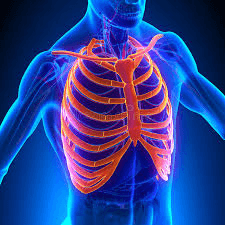
What bone is highlighted?
Ribs
Cranium
Clavicle
Femur

What bone is highlighted?
Vertebrae
Femur
Cranium
Spine
What is the largest and strongest bone in the body?
skull
vertebrae
femur
ribs
What is the purpose of the rib cage?
Helps us to think
make blood for the body
Protects our brain
Protects our vital organs like heart and lungs

What bone is highlighted?
Skull (Cranium)
Mandible
Femur
Scapula
How many types of muscle tissue are there?
2
3
Where is cardiac muscle located?
Heart
Arm
Stomach
Where are smooth muscles located?
Heart
Arm
Stomach
Where is skeletal muscle located?
Heart
Arm
Stomach
True or False: Movement is not a function of muscles
True
False
True or False: Posture is when you sit or stand up straight and your muscles are contracting to help you do this.
True
False
True or False: Everyone has the same body shape
True
False

What muscle is highlighted?
Trapezius
Lats
Pectorals
Deltoids

What muscle is highlighted?
Lats
Abdominals
Pectoralis
Quads

What muscle is highlighted?
Hamstrings
Quads
Calves
Gluteus

What muscle is highlighted?
Hamstrings
Quads
Calves
Gluteus

What muscle is highlighted?
Hamstrings
Quads
Gastrocnemius
Gluteus

What muscle is highlighted in the picture?
Triceps
Biceps
Quads
Deltoids

What muscle is highlighted in the picture?
Triceps
Biceps
Quads
Deltoids



