
 Worksheets
Unit 2 Chem 1 Test Review CTJ
Total questions: 40
Worksheet time: 26mins
These states of matter cannot be compressed: ____________________ and ____________________
solid, liquid
gas, plasma
plasma, liquid
gas, solid
A ____________________ is the same thing as a homogeneous mixture.
solution
compound
element
suspension
A container of Gatorade is a type of ____________________.
solution
beverage
drink
liquid
List the 4 states of matter from most dense to least: ______________ ______________ ______________ ______________
solid, liquid, gas, plasma
plasma, gas, liquid, solid
gas, liquid, solid, plasma
liquid, solid, plasma, gas
These states of matter take the shape of their container: ____________________ and ____________________
liquid, gas
solid, plasma
plasma, liquid
solid, gas
What type of change involves a change of color or gas formation when two chemicals are mixed? ____________________
chemical
physical
mechanical
electrical
Ductility and malleability are examples of ____________________ properties.
physical
chemical
biological
electrical
Luster is how ____________________ a metal is and is a ____________________ property.
shiny, physical
dull, chemical
bright, chemical
opaque, physical
A piece of ice melting to liquid water is an example of a ____________________ change and is also a ____________________ change.
physical, phase
chemical, phase
physical, chemical
chemical, chemical
Table salt (sodium chloride or NaCl) is a __________________________.
compound
element
mixture
solution
An ____________________ property depends on the amount of matter and an ____________________ property is useful for identifying matter.
extensive, intensive
intensive, extensive
chemical, physical
physical, chemical
A type of matter with one type of atom is an __________________________.
element
compound
mixture
solution
Which are physical properties? Choose all that apply.
unreactive
flammability
malleable
density
mass
Which are chemical properties? Choose all that apply.
yellow
unreactive
density
oxidizes
flammability
Which is an extensive property - depends on the amount and varies sample to sample? ____________________
mass
temperature
density
color
How are pure substances different from mixtures? Name the 2 types of pure substances.
Pure substances have a fixed composition, while mixtures do not. The two types of pure substances are elements and compounds.
Pure substances can be separated by physical means, while mixtures cannot. The two types of pure substances are solutions and suspensions.
Pure substances are always homogeneous, while mixtures are always heterogeneous. The two types of pure substances are metals and non-metals.
Pure substances have variable composition, while mixtures have fixed composition. The two types of pure substances are acids and bases.
What is a heterogeneous mixture? Name the one type of heterogeneous mixture.
A mixture with uniform composition; solutions
A mixture with non-uniform composition; suspensions
A mixture with uniform composition; suspensions
A mixture with non-uniform composition; solutions
A homogeneous mixture is also known as a _________. Which of the following is an example of a homogeneous mixture?
Solution; Saltwater
Colloid; Milk
Suspension; Muddy water
Emulsion; Mayonnaise
Black pen ink is a mixture of three colors: . What is the best way to separate this mixture? __________________________ What type of mixture is this before separating?
Filtration; Homogeneous
Distillation; Heterogeneous
Chromatography; Homogeneous
Evaporation; Heterogeneous
Two clear liquids are mixed together in a test tube. Upon mixing, the liquid in the test tube becomes cloudy and yellow. a. What type of reaction occurred? __________________________ b. What is the cloudy product called? __________________________
a. Precipitation reaction; b. Precipitate
a. Combustion reaction; b. Ash
a. Decomposition reaction; b. Gas
a. Neutralization reaction; b. Salt

Which of the following diagrams represents a solid element?
Diagram A
Diagram B
Diagram C
Which of these types of mixtures are heterogeneous?
Solution
Suspension
Colloid
Homogeneous mixture
Describing the potassium chlorate as white and crystalline is an example of an intensive or extensive property?
Intensive property
Extensive property
When potassium chlorate is melted, is this an example of a physical or chemical change.
Physical
Chemical
Which of the following is an indicator or evidence of a chemical reaction? Choose all that apply.
Formation of a precipitate
Change in temperature
Emission of light
Emission of gas
Change in color
How would you separate a mixture of water, sand, and salt?
By using a magnet
By filtration and evaporation
By distillation
By decantation
Are solutions substances or mixtures?
Substances
Mixtures
Are colloids substances or mixtures?
Substances
Mixtures
Are solutions homogenous or heterogenous? Are colloids homogenous or heterogenous?
Solutions are homogenous, colloids are homogenous
Solutions are homogenous, colloids are heterogenous
Solutions are heterogenous, colloids are homogenous
Solutions are heterogenous, colloids are heterogenous
Table salt dissolves in water. Is this a physical or chemical change?
Physical
Chemical
Solubility, the ability to dissolve, is a physical or a chemical property?
Physical
Chemical
Are compounds, elements or mixtures are made of 2 or more types of elements chemically combined.
Compounds
Elements
Mixtures
Are compounds, elements or mixtures are made of 1 type of atom.
Compounds
Elements
Mixtures

Put the following in order from LOWEST density to HIGHEST density.
wood
water
milk
maple syrup
steal nut
Which TWO variables do you need to solve for Density?
mass
length
volume
height

What type of matter is shown in this particle diagram?
Pure Substance
Homogeneous Mixture
Heterogeneous Mixture
Element
Label the following image
Liquid
Gas
Solid

The atomic structure of the substance pictured is a (a) in what phase of matter: (b)
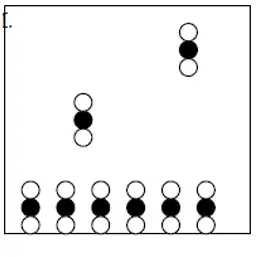
The atomic structure in the picture represents a (a) in the (b) phase of matter.

The atomic structure of the substance pictures represents a (a) consisting of (b) in the (c) state of matter.

