
 Worksheets
VCE PE Unit 2 AOS 1 (Chapter 13 textbook)
Total questions: 27
Worksheet time: 14mins
What percentage of Australian adults exercises at very low levels or not at all?
10%
20%
30%
40%
What percentage of adults meet the 'sufficiently active' recommendation?
43%
50%
60%
70%
Which part of the T.A.K. method helps in understanding the type of information?
Title
Axis
Key
Index
Which age group is the most active in terms of physical activity?
18-24
25-34
45-54
75 and over
How does the level of physical activity change with age?
It increases
It remains constant
It declines
It fluctuates
Which age group shows a decline in physical activity participation compared to the previous age group?
18-24
25-34
35-44
75 and over
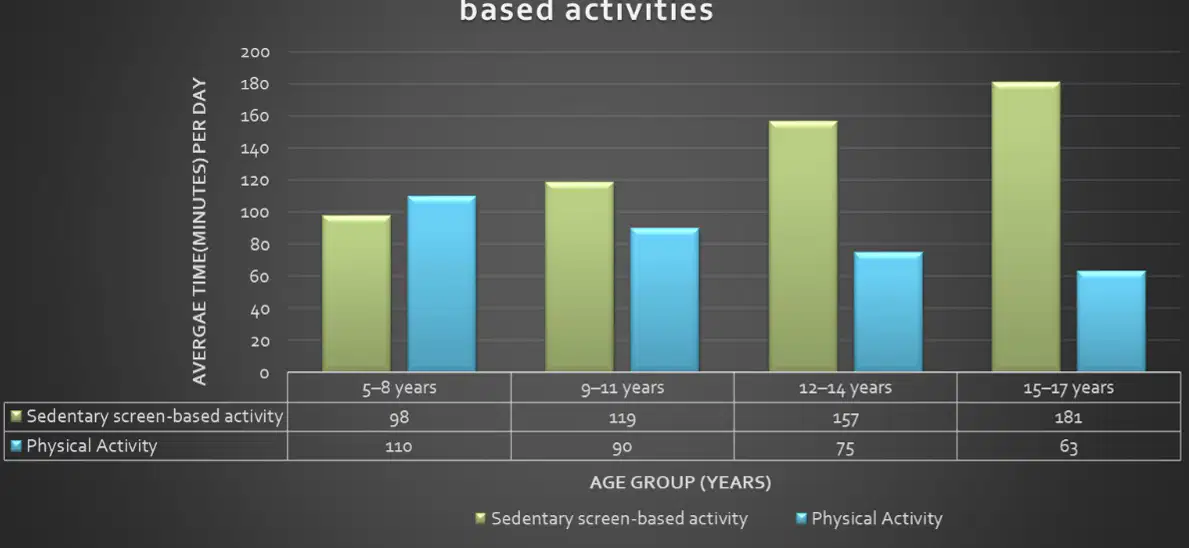
What is the average time spent on physical activity by 15-17 year olds?
63 minutes
75 minutes
90 minutes
110 minutes

Which age group spends the most average time on sedentary screen-based activities?
5-8 years
9-11 years
12-14 years
15-17 years

How many minutes per day do 5-8 year olds spend on physical activity on average?
98 minutes
110 minutes
119 minutes
157 minutes

For the age group 45-54, how many average minutes are spent on moderate physical activity per week?
23
19
37
41

In the age group 25-34, how many average minutes are spent on walking for fitness, recreation, or sport?
47
58
75
80

What is the average number of minutes spent on walking for transport per week for the age group 55-64?
83
73
53
94

For the age group 65-74, how many average minutes are spent on moderate physical activity per week?
29
22
41
37

In the age group 45-54, how many average minutes are spent on walking for fitness, recreation, or sport?
75
58
47
80
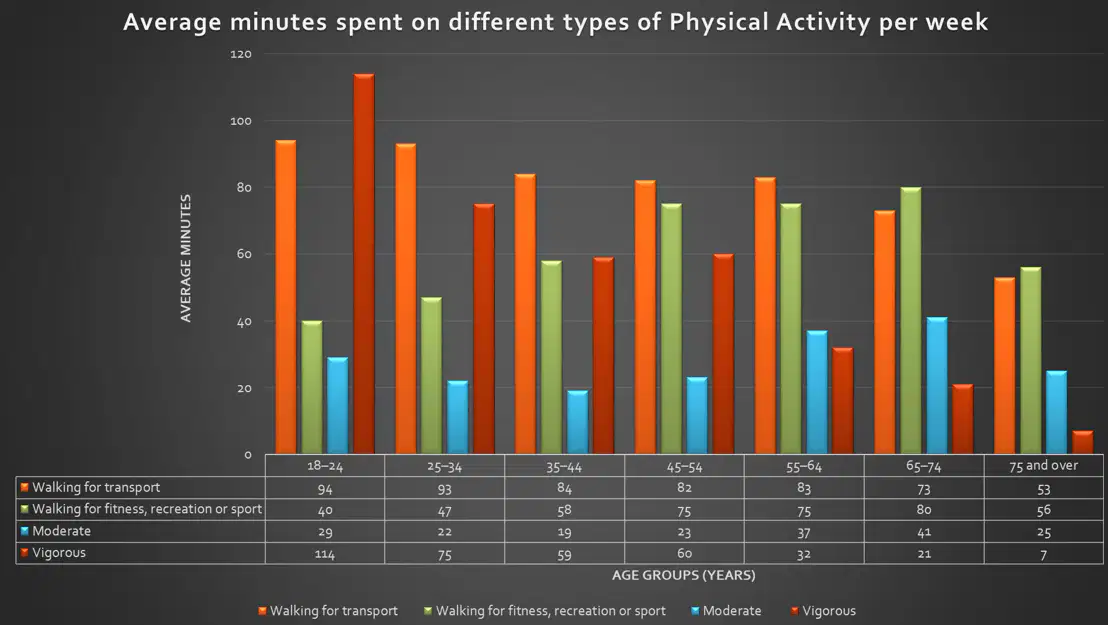
What is the average number of minutes spent on vigorous physical activity per week for the age group 35-44?
15
25
35
45

Which age group has the highest percentage of individuals meeting the 'sufficiently active' recommendation?
18-24
25-34
35-44
55-64

How many average minutes are spent on moderate physical activity per week by the age group 55-64?
75
32
37
23

What is the average number of minutes spent on vigorous physical activity per week for the age group 55-64?
32
21
41
37

For the age group 35-44, how many average minutes are spent on walking for transport physical activity per week?
93
58
84
82

Which age group spends the least average time on sedentary screen-based activities?
5-8 years
9-11 years
12-14 years
15-17 years

What is the average number of minutes spent on moderate physical activity per week for the age group 18-24?
114
40
29
22
Which age group has the lowest percentage of individuals meeting the 'sufficiently active' recommendation?
18-24
35-44
55-64
65-74

How many average minutes are spent on sedentary screen-based activities per day by 9-11 year olds?
98 minutes
119 minutes
90 minutes
181 minutes
What are some of the trends according to the ABS in relation to the Physical Activity?
1 in 5 Australian adults exercises at very low levels, or not at all (<20% participate in 60+ mins per day on average
The average Australian adult does 12 hours of yoga every day, significantly reducing the need for sleep.
Swimming is no longer considered a form of physical activity by the ABS, with most students opting for other activities like board games instead.
The ABS reports that less than 5% of Australian students engage in any form of physical activity, as most prefer to remain sedentary.
What are some of the trends according to the ABS in relation to the Physical Activity?
Only 43% of adults meet the ‘sufficiently active’ recommendation (59% of males & 48% of females)
Most Australian students now meet their physical activity requirements by watching sports on TV, which the ABS categorizes as an acceptable form of exercise.
The ABS reports that physical education in schools is optional for students, with most choosing to focus on academic subjects instead.
45% of students achieve their daily physical activity requirement by walking between classrooms, as school campuses have been expanded to promote walking.
What are some of the trends according to the ABS in relation to the Physical Activity? (Two answers are correct)
18 – 24 year olds are the most active (males average 46 minutes & females 32 minutes per day)
72% of 18-24 year old females report that their main form of physical activity comes from shopping, which counts for an average of 32 minutes of walking each day.
Levels of PA generally decline with increasing age
Older people are the most active group because they engage themselves in water aerobics and walking every day
What are some of the trends according to the ABS in relation to the Physical Activity?
Sedentary levels have increased over the past 10 years from 34% in 2004 to 41% in 2012
Sedentary behavior in 18-24 year olds has risen sharply, with 45% of students now meeting their daily exercise goals through "active" sitting, such as bouncing their legs while sitting at desks.
41% of 18-24 year olds now count watching TV shows as a form of physical activity, contributing to the rise in sedentary behavior over the last decade.
Older people are the most active group because they engage themselves in water aerobics and walking every day

