
 Worksheets
Justifying Statements and Angle Pairs
Total questions: 48
Worksheet time: 48mins

What is the relationship between angle 1 and angle 5?
Corresponding Angles
Alternate Interior Angles
Same Side Exterior Angles
Vertical angles

What is the relationship between angle 1 and angle 7?
Same Side Exterior Angles
Alternate Interior Angles
Alternate Exterior Angles
Same Side Interior Angles

What is the relationship between angle 4 and angle 5?
Vertical Angles
Alternate Exterior Angles
Alternate Interior Angles
Corresponding Angles

What is the relationship between angle 8 and angle 6?
Corresponding Angles
Same Side Interior Angles
Same Side Exterior Angles
Vertical Angles

What is the relationship between angle 3 and angle 5?
Same Side Interior
Vertical Angles
Alternate Interior Angles
Same Side Exterior Angles

What is the relationship between angle 1 and angle 8?
Same Side Exterior Angles
Same Side Interior Angles
Alternate Interior Angles
Alternate Exterior Angles
Angles that add to be 180° are called ...
Vertical Angles
Similar Angles
Supplementary Angles
Corresponding Angles
Angles with the same measure are called ...
Congruent
Similar
Supplementary
Transversal
A line that intersects at least two other lines is called a ...
Supplementary Angle
Parallel Line
Transversal
Tarantula

What is the value of x?
x = 45
x = 135
x = 90
x = 35

Find the value of x.
x = 130
x = 31
x = 44
x = 180
If a transversal intersects two parallel lines, then same side interior angles are ____________.
Supplementary
Congruent
If a transversal intersects two parallel lines, then alternate interior angles are ___________.
Supplementary
Congruent
Vertical angles are always _________.
Supplementary
Congruent

Use the image to answer the question.
A
B
C
D

Supply the second reason.
Linear Pair Postulate
Alternate Interior Angles Theorem
Vertical Angles Theorem
Corresponding Angles Postulate

Supply the third reason.
Vertical Angle Theorem
Corresponding Angles Postulate
Alternate Interior Angles Postulate
Same Side Interior Angles Theorem

The last statement is <4 = <6. What is the last reason
Prove
Definition of congruent angles
Transitive Property
Alternate Interior Angles Theorem

Which statement represents what you have to prove from the question?


What is the relationship of ∠4 and ∠7?
Corresponding Angles
Alternate Interior Angles
Alternate Exterior Angles
Consecutive Interior Angles
Linear Pair
If you know that angles 1 and 2 are vertical, what else do you know?
Angles 1 and 2 are congruent
Angles 1 and 2 are supplementary
Angles 1 and 2 are right angles
Angles 1 and 2 are corresponding angles
then RX + XT = RT


Are these vertical angles (yes/no)
yes
no

4) What is the reason for Statement 3
Corresponding Angles Postulate
Angles that form a Linear Pair that sums 180°
Same-side Interior Angles Theorem
Vertical Angles Theorem

11) What is the reason for Statement 2?
Vertical Angles Theorem
Corresponding Angles Theorem
Alternate Exterior Angles Theorem
Converse of Corresponding Angles Theorem

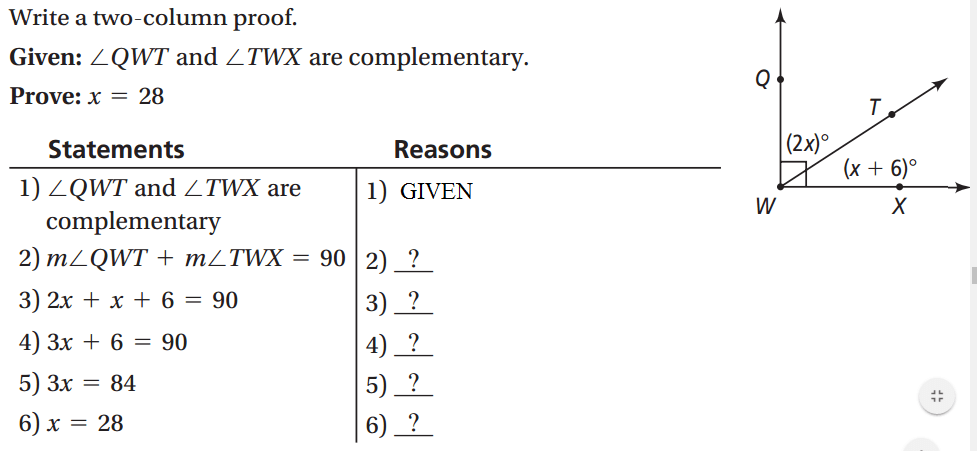
What is the reason for number 5
Transitive Property
Substitution
Definition of Supplementary Angles
Supplementary Theorem

Supply the first statement.
m ll n
< 4 = < 6
Given
Definition of parallel lines



If it is given that the indicated lines are parallel and that segment SF bisects ∠TSE, select ALL correct statements that could be used.
∠1 ≅ ∠5 by the corresponding angles postulate
∠2 ≅ ∠4 by the alternate interior angles theorem
∠1 ≅ ∠2 by the definition of an angle bisector
∠3 and ∠5 are supplementary by the consecutive interior angles theorem

If it is given that p ∥ q, what are ALL correct statements that can be made?
∠1 ≅ ∠3 by the corresponding angles postulate
∠2 and ∠3 are supplementary by the linear pairs postulate
m∠2 + m∠3 = 180° by the linear pairs postulate
∠1 ≅ ∠2 by the alternate exterior angles theorem

If ∠2 is supplementary to ∠3, which of the following can be used to determine lines are parallel?
Corresponding Angles Converse
Alternate Interior Angles Converse
Alternate Exterior Angles Converse
Interiors on Same Side Converse
None of the above
If ∠8 ≅ ∠6, then ________.
line b is parallel to line a
line c is parallel to line a
line b is parallel to line d
line c is parallel to line d
Cannot determine 2 lines to be parallel.
If ∠8 ≅ ∠6, which of the following can be used to determine lines are parallel?
Corresponding Angles Converse
Alternate Interior Angles Converse
Alternate Exterior Angles Converse
Interiors on Same Side Converse
none of the above
If ∠1 ≅ ∠3, then ________.
line c is parallel to line d
line a is parallel to line b
Cannot determine 2 lines to be parallel.
line c is parallel to line a
line b is parallel to line d
If m∠5=65˚ and m∠9=115˚, then ________.
line b is parallel to line a
line c is parallel to line a
line b is parallel to line d
line c is parallel to line d
Cannot determine 2 lines to be parallel.
What does a proof always start with?
Theorems
Given Statement(s)
Postulates
Reasons
What property states that if
a = b and b = c then a = c?
Equality Property
Reflexive Property
Transitive Property
Associative Property
What property states that something is congruent to itself?
Symmetry Property
Congruence Property
Reflexive Property
What is the difference between a theorem and a postulate?
A postulate is a statement that is assumed true without proof while a theorem is a true statement that can be proven.
A theorem is a statement that is assumed true without proof while a postulate is a true statement that can be proven.

If the ray HK is bisecting ∠GHJ, then what reason would you use to say ∠GHK is congruent to ∠KHJ?
Definition of Midpoint
Definition of Angle Bisector
Definition of Congruent
Definition of Segment Bisector
Name the property of equality that the statement illustrates.
If m∠A + m∠B = 70° and m∠B=40°, then m∠A + 40° = 70°
Substitution Property of Equality
Transitive Property of Equality
Definition of Complementary Angles
Transitive Property of Congruence
Name the property of equality that the statement illustrates.
If ∠S and ∠P are supplementary, then m∠S + m∠P = 180°
Definition of Supplementary Angles
Definition of Complementary Angles
Definition of Linear Pair
Definition of Vertical Angles

Which Postulate/Definition would you use to find HG?
Segment Addition Postulate
Angle Addition Postulate
Definition of Segment Bisector
Definition of Angle Bisector

