
Font size
 Worksheets
Unit 3 Review
Total questions: 49
Worksheet time: 29mins
Who wrote the book Utopia about an ideal society where there were no rich or poor?
Martin Luther
Machiavelli
John Calvin
Thomas More
Which English humanist was beheaded because he refused to recognize King Henry VIII as the head of the Church of England?
Martin Luther
Erasmus
John Calvin
Thomas More
Which book, written by Thomas More, describes an ideal society where there were no rich or poor?
The Praise of Folly
Utopia
Ninety-Five Theses
The Divine Comedy
Which Renaissance figure wrote The Book of the Courtier, which describes how nobles should behave at a royal court?
Castiglione
Leonardo da Vinci
Erasmus
Thomas More
Which courtier to the royal family of the city-state of Mantua wrote a guide that describes how a courtier should act while serving at court?
Machiavelli
Castiglione
Cosimo de' Medici
Cesare Borgia
Which book, written by Baldassare Castiglione, describes how nobles should behave at a royal court?
The Praise of Folly
Utopia
The Book of the Courtier
The Divine Comedy
Which Renaissance figure, considered the founder of modern political science, wrote The Prince, which describes how a strong ruler obtains and keeps power?
John Calvin
Machiavelli
Castiglione
Plutarch
Which Italian Renaissance thinker believed that Italy needed strong, even ruthless, leaders and wrote The Prince to show how rulers can keep power?
Cesare Borgia
Erasmus
Cosimo de' Medici
Machiavelli
Which book, written by Niccolò Machiavelli, describes how a strong ruler obtains and keeps power?
The Prince
Utopia
The Book of the Courtier
The Praise of Folly
Why was Leonardo da Vinci considered a true “Renaissance Man”?
He was a renowned artist, clever inventor, and brilliant scientist whose accomplishments spanned many fields of interest.
He was a brilliant author and poet whose literary works made people think about art and science.
He devised new ways of recording information that could be shared with ordinary people.
His paintings set new standards in art, and they were painted during the Renaissance.
Why was Leonardo da Vinci considered a true “Renaissance Man”?
He was born as the Renaissance began and lived to see most of the era's accomplishments.
His accomplishments spanned many fields of interest, and he was a renowned artist, clever inventor, and brilliant scientist.
He taught his art students to present the world in religiously inspiring ways.
His books cover many topics from advice for rulers to religious theories.
Which characteristics made Leonardo da Vinci a true “Renaissance Man"?
He was the first painter to use oils, the first printer to use moveable type, and the first scientist to promote natural law.
He was born as the Renaissance began, died in the last years of the Renaissance, and was a brilliant sculptor.
He was talented in many areas, accomplished in many fields, and interested in many things.
He refused to use religious themes in his art, used his talents to promote peace, and was devoted to one area of accomplishment.
Which philosopher and Christian humanist, wrote a book entitled The Praise of Folly, which criticized the focus on greed and worldly power by monks, priests, cardinals, and other church officials?
Leonardo da Vinci
Erasmus
Cesare Borgia
Catherine de' Medici
Which Dutch monk criticized Catholic Church officials for focusing on money and power instead of the spiritual needs of individuals?
Cesare Borgia
Pieter Bruegel
Erasmus
Albrecht Dürer
Which book, written by Desiderius Erasmus, criticized Catholic Church officials for focusing on money and power instead of the spiritual needs of individuals?
The Book of the Courtier
The Prince
The Divine Comedy
The Praise of Folly
Which Renaissance figure was a valued advisor to her husband, the ruler of Mantua, and took charge of the court after he retired?
Teresa of Avila
Isabella d'Este
Catherine de' Medici
Catherine of Aragon
Which dedicated patron of the arts made the Italian city-state of Mantua a center of learning and was considered a “Renaissance woman”?
Teresa of Avila
Isabella d'Este
Catherine de' Medici
Catherine of Aragon
Which Renaissance figure ably ruled the city-state of Mantua while her husband was a prisoner of the Venetians and eventually secured his release?
Teresa of Avila
Isabella d'Este
Catherine de' Medici
Catherine of Aragon
Which statements accurately describe how Renaissance ideas spread beyond Italy?
Choose all answers that are correct.
Italian armies marching into foreign lands brought their scholarship and art with them.
Leonardo da Vinci moved to the French court and took with him Renaissance ideas, as well as styles of art and architecture.
Italian merchants traveled all over Europe carrying printed classical Greek and Latin texts, as well as Italian art.
Wealthy Italian families opened schools for the fine arts in countries north of the Alps.
Which descriptions of how Renaissance ideas spread beyond Italy are correct?
Choose all answers that are correct.
When foreign armies invaded Italy, they took Italian artwork and ideas home with them.
Merchants who journeyed throughout Europe spread the word about Italian accomplishments.
Scholars and artists in northern European countries traded their work for Italian works.
Ships sailing for the Americas carried Italian works of art and classical texts to sell in foreign ports.
Which statements describing how Renaissance ideas spread beyond Italy are true?
Choose all answers that are correct.
Pilgrims on their way to the Holy Land often stopped in Italy, where they saw Renaissance artwork and learned Renaissance ideas.
Writers such as Machiavelli and Castiglione traveled to northern Europe to lecture at the universities there.
Scholars traveled from monastery to monastery carrying Italian ideas and books with them.
Merchants exported classical Greek and Latin texts printed in Venice, as well as contemporary works such as Machiavelli's The Prince.
Which are Renaissance ideas that influenced northern European art, religion, and thought?
Choose all answers that are correct.
new admiration for the classics
rejection of organized religion
curiosity about human abilities
demand for democracy
Which phrases describe ideas from the Italian Renaissance that spread to northern Europe?
Choose all answers that are correct.
returning to the value of unquestioning obedience
abiding faith in human potential
turning away from Christian beliefs
love of lifelike painting and sculpture
Which phrases accurately describe Italian Renaissance ideas that influenced northern European art, religion, and thought?
Choose all answers that are correct.
increasing acceptance of religious toleration
new interest in the art and literature of the classical world
new principles of architecture
desire for an end to monarchy
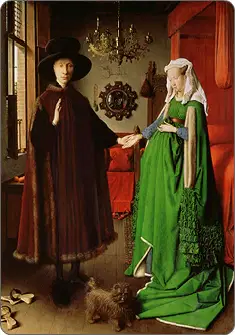
Which northern European artist of the Renaissance painted Giovanni Arnolfini and His Bride on a wood panel using slow-drying oil paints, which allowed him to add much wonderful detail?
Albrecht Dürer
Pieter Bruegel
Jan van Eyck
Hans Holbein, the Younger
Which Renaissance painter from northern Europe was one of the earliest artists to paint on wood panels with colors mixed in oil as shown in this painting?
Albrecht Dürer
Pieter Bruegel
Jan van Eyck
Hans Holbein, the Younger
Who used the technique of mixing colors in oil and applying the paint to a wood panel to create the painting shown here?
Albrecht Dürer
Pieter Bruegel
Jan van Eyck
Hans Holbein, the Younger
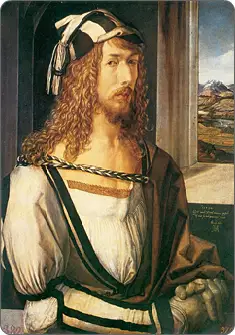
Which German artist, known as the “Leonardo of the North,” painted this self-portrait?
Albrecht Dürer
Pieter Bruegel
Jan van Eyck
Hans Holbein, the Younger
Which artist of the northern European Renaissance, shown in this self-portrait, was also a block printer and engraver?
Albrecht Dürer
Pieter Bruegel
Jan van Eyck
Hans Holbein, the Younger
Which German painter, shown here, was also famous for his copper engravings from which printers could make many copies?
Albrecht Dürer
Pieter Bruegel
Jan van Eyck
Hans Holbein, the Younger
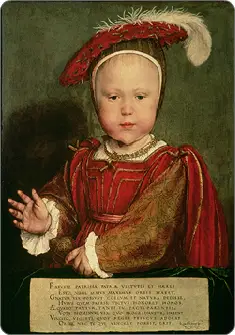
Which German-born artist was commissioned by King Henry VIII to paint this portrait of his only son, Edward VI?
Albrecht Dürer
Pieter Bruegel
Jan van Eyck
Hans Holbein, the Younger
Which painter of the northern European Renaissance was famous for his portraits that captured accurate likenesses and seemed to reveal each subject’s personality?
Albrecht Dürer
Pieter Bruegel
Jan van Eyck
Hans Holbein, the Younger
Which northern European artist was famous for his realistic portraits including the one shown here?
Albrecht Dürer
Pieter Bruegel
Jan van Eyck
Hans Holbein, the Younger
Which statement best describes the Reformation?
the spread of Renaissance ideals in science and mathematics that brought new understanding of the laws of nature
the movement to change and improve the Catholic Church that resulted in divisions in Christianity
Which term refers to the movement to change and reform the Catholic Church that ultimately led to divisions in the Christian religion?
Romanticism
Revolution
Reformation
Renaissance
Which statement best describes the Reformation?
It was a movement that questioned the authority and integrity of the Catholic Church and led to a split in the Christian religion.
It was an attempt by scholars to improve education in Europe that unintentionally started a debate about human sinfulness.
It was a crusade led by scientists studying the laws of nature to prove the existence of God through experimentation and observation.
It was an effort by Christian bishops to reorganize the Catholic Church that resulted in wars between Christians and Muslims.
Which was not an issue that led to the Reformation?
Some people began to read the Bible for themselves and decided the Church was wrong in some of its practices.
Many scholars criticized the sale of indulgences as a means of raising money for the pope's use.
Clergy and lay people believed that Church leaders were more concerned with money and power than the spiritual needs of the people.
Several reformers believed that the only way to gain salvation was by buying indulgences and converting other people.
Which does not describe a cause of the Reformation?
the refusal of the Church to end its wars against Muslims in the Holy Land
the Church leaders' concerns with money and power instead of the needs of the people
the sale of indulgences to raise money for the pope's use
the belief among some people that the Church was wrong in some of its practices
Which was not a factor that helped bring about the Reformation?
Some Church leaders ignored their people's needs and pursued wealth and power.
Many Christians in western Europe began converting to Greek and Russian Orthodox Christianity.
As more people were able to read the Bible themselves, there was disagreement on its meaning.
The sale of indulgences to raise money for the pope's use angered many people.
Which statement accurately describes John Calvin?
a Dutch humanist who criticized the Church and the materialism of many Europeans
the author of several texts that attempted to prove the existence of God
the friar who sold indulgences to raise money for the pope
a French scholar who turned the city of Geneva into a center of Protestantism
Which description of John Calvin is correct?
He was a Protestant leader who said churches should be run by a board of “elders” chosen from the congregation.
He was an English humanist who criticized the pope and was excommunicated.
He was a bishop who urged officials to sell indulgences for money to rebuild St. Peter's Basilica.
He was the German translator of the Bible into the language of the people.
Who was John Calvin?
He was a German monk whose Ninety-Five Theses became the basis of the Reformation.
He was a charismatic friar who traveled through Germany preaching and selling indulgences.
He was a French scholar who turned the city of Geneva into a center of Protestantism.
He was an English humanist at the court of Henry VIII who was later imprisoned in the Tower of London.
Which statements describe ways in which the Catholic Church responded to the Reformation?
Choose all answers that are correct.
The Church eliminated the outright sale of indulgences.
The Church created a list of Forbidden Books to stop the spread of Protestant ideas.
The Church decided to base all its teachings on the Bible and not on any decisions by church councils.
The Church put an end to the Inquisition.
Which statements about the Catholic Church's response to the Reformation are true?
Choose all answers that are correct.
The Church strengthened and expanded the Inquisition.
The pope called the Council of Trent to clarify the Church's teachings and address abuses.
Most bishops who were accused of abuses in their leadership were tried and excommunicated.
Church leaders encouraged people to read and interpret the Bible for themselves.
Which statements accurately describe the Catholic Church's response to the Reformation?
Choose all answers that are correct.
The pope hired scholars to translate the Bible and Church rites into the various languages of Europe.
Church leaders issued a statement encouraging Christians everywhere to interpret the Bible for themselves.
The Church established guidelines for educating priests.
The pope encouraged the faithful to become monks and nuns and devote their lives to caring for the sick and helping the poor.
Which descriptions of Martin Luther are accurate?
Choose all answers that are correct.
He was a charismatic friar who traveled through Germany preaching and selling indulgences.
He was a monk who criticized the Church for selling indulgences, and he translated the Bible into German.
He was a professor of biblical studies who publicly posted 95 theses that led to the Protestant Reformation.
He was the Roman Catholic pope who brought bishops together at the Council of Trent.
Which statements accurately describe Martin Luther?
Choose all answers that are correct.
the German monk whose Ninety-Five Theses started the Protestant Reformation
a French scholar who spread Protestant ideas to the Netherlands, Scotland, and central Europe
the pope who needed money to rebuild St. Peter's Basilica and urged officials to sell indulgences
a critic of some of the Church's practices who thought people should read the Bible for themselves
Which statements describing Martin Luther are true?
Choose all answers that are correct.
He was a professor of biblical studies who criticized some Church practices and translated the Bible into German.
He was the Roman Catholic pope who brought bishops together at three Church councils.
He was a German monk who posted 95 statements of criticism and belief which led to the Reformation.
He was a French scholar who turned the city of Geneva into a center of Protestantism.
Label the four nations of Europe in the 1500s

