
 Worksheets
American Revolution
Total questions: 64
Worksheet time: 1hrs 6mins

* Harbor closed
* Governor had to approve meetings
The above are punishments on Boston because of what event?
What Act placed a tax on all paper items in the colonies?
Sugar Act
Stamp Act
Townshend Act
Intolerable Acts
Identify the series of laws intended to punish the people of Boston for the Boston Tea Party:
The Sugar Act
The Proclamation of 1763
The Boston Massacre
The Intolerable Acts/The Coercive Acts
What set of laws were in response to the Boston Tea Party?
The Sugar Act
The Quartering Acts
The Intolerable Acts/The Coercive Acts
The Stamp Act
Which Act required colonist to house British soldiers?
Stamp Act
Quartering Acts
Townshend Acts
Sugar Act
Who was among the casualties at the Boston Massacre?
John Adams
Crispus Attucks
George Washington
Samuel Adams

This famous engraving/image shows the event that was called the
Boston Party
Boston Tea Party
Boston Massacre
Boston Brutality

What was the primary reason Parliament passed these acts?
To promote the growth of the cottage industry
To encourage foreign trade with the colonies
To recover the cost of defending the colonies
To fund the establishment of new colonies

Which of the following best completes this diagram
Colonists sought military support to France
Colonists organized boycotts of British goods
Colonists signed the Declaration of Independence
Colonists duped tea into the Boston Harbor
British colonists object/dislike the Proclamation Line of 1763 because
It Forces English troops to live in their homes
The Law doesn’t allow them to expand west
Colonists Want less taxes
Colonists want to trade with other countries
Finish the phrase: NO TAXATION WITHOUT -
REPRESENTATION
LEGISLATION
HESITATION
MEDITATION
After the Boston Tea Party…British troops were forced to live with colonists. This phrase is called
Protest
Grievance
Quartering
Civil Disobedience

What was the name of the group that met to discuss what the colonists should do about unfair laws like the Intolerable Acts?
The First Continental Congress
The House of Burgesses
The Sons of Liberty
The Boston Tea Party
The economic policy that made the "mother country" rich by not letting colonies trade with anyone else was known as...
Salutary Neglect
Free Market System
Capitalism
Mercantilism
Navigation Acts
A person or company who sells goods/products (merchandise)
In: goods coming into a country
Exit: goods going out of a country (selling)
The specific laws passed by England to control the trade
What was the British government's philosophy towards the colonies for many years?
Salutary neglect
Strict control
Complete independence
Colonial exploitation

The delegates at the First Continental Congress voted to ______ British trade.
boycott
increase the value of
sell more
all of the above
George Washington became the __________________________ of the American army in 1775.
Commander in Chief
President
Major
"With England 3,000 miles away, political and legal matters couldn’t wait for word from England."
Which of the following reasons matches the description?
Distance
Rights and Traditions of Englishmen
Salutary Neglect
Self-Governing Colonies

Which factor most contributed to the creation of the documents in this list?
The opportunity for trade with American Indians
The distance of the colonies from Great Britain
The doctrine of the Church of England
The economic system of mercantilism
From 1690 to 1760, Parliament and the king of England allowed colonists in America to exercise a great deal of control over local and regional matters. Historians have described this practice as “salutary neglect.”
Which of the following happened as a direct result of this policy?
The colonies developed a strong tradition of self-government.
Many proprietary colonies were converted to royal colonies.
The colonies refused to participate in a system of common defense.
Many colonies sought economic aid from other countries.
This law restricted colonists from moving past the Appalachian Mountains.
The Townshend Acts
The Intolerable Acts
The Proclamation of 1763
The Declaratory Act
This act allowed British soldiers to live in colonial homes.
The Quebec Act
The Stamp Act
The Declaratory Act
The Quartering Act
This law placed a tax on all printed material in the colonies including wills, contracts, newspapers, and playing cards.
The Declaratory Act
The Stamp Act
The Intolerable Acts
The Coercive Acts
These acts placed a tax only on imported goods like paper, glass, tea, and lead.
The Intolerable Acts
The Coercive Acts
The Townshend Acts
Writs of Assistance

What was the purpose of the Albany Plan of Union?
To plan an attack on Fort Duquesne.
For the British to join with the Native Americans against the French
For colonies to unite under a central government and prepare for war
For the New England colonies to unite with the Iroquois to fight the French

What did Ben Franklin want the colonies to do during the French and Indian War with this drawing?
join together to defeat the French
help the Native Americans
join together to defeat the British
surrender to the French

What inference can be made about this image?
The Boston Massacre was a major grievance where colonists got killed for protesting the taxes of the King.
The Boston Tea Party was a message sent to the King by the colonists that they were sick of the King's taxes.
The New York Massacre was caused by Colonists shooting at British soldiers.
The British were attacking Indians who had been living in Boston.

Why did the people in the 13 Colonies have a grievance with the Stamp Act.
It put a tax on all the paper in the colonies.
It put a tax on glass and lead in the colonies.
It put a tax on tea and sugar.
It forced the colonists to house and feed the King's soldiers.
What does Grievance mean?
A complaint
An agreement
A battle
A compromise
What impact did the Quartering Act have on the 13 Colonies?
In forced colonists to house and feed the King's soldiers.
It put a tax on all paper.
It closed the port of Boston
It ended the French and Indian War.

What impact did the INTOLERABLE ACTS have on the 13 Colonies?
The 13 Colonies sent representatives to the First Continental Congress to create a united message against the King.
The 13 Colonies were divided and easily controlled by the King.
The 13 Colonies created a army to defend themselves from king.
Created a secret organization called the Sons of Liberty

How did the Boston Tea Party show an act of DISOBEDIENCE against the King?
The colonists were showing a message that they were not going to pay the tax on tea.
The colonist were crossing the Proclamation Line and settling on Indian lands.
The colonists boycotted paper to not pay the Stamp Act tax.
The Colonist switched to orange juice instead of tea for breakfast.

What famous Virginia representative stated, "Give me liberty, or give me death!"
Patrick Henry
George Washington
George III
Robert E. Lee
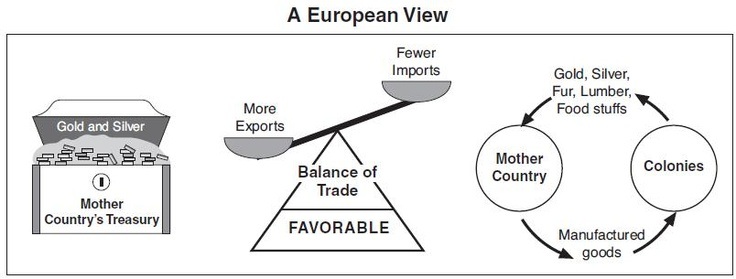
What is mercantilism?
A system where a mother countries gains money and power from natural resources that come from its colonies.
where colonies trade gold and silver with each other.
Wars that start over money.
Plantation colonies trading slaves for money.
“For quartering large bodies of armed troops among us:”
Quartering Act
Sugar Act
Intolerable Acts
Proclamation of 1763
"Sugar Act , Stamp Act 1765, Tea Act"
“For imposing Taxes on us without our Consent:”
“He has dissolved Representative Houses repeatedly, for opposing with manly firmness his invasions on the rights of the people.”
"He has made Judges dependent on his Will alone for the tenure of their offices, and the amount and payment of their salaries."
“For cutting off our trade with all parts of the world.”
closing the ports of Boston and New York
Tea Act
Navigation Acts
What is one of the grievances discussed in the Declaration of Independence?
depriving of trial by jury
decreasing taxes on colonists
favoring certain colonies over another colony
colonists suffering cruel and unusual punishment
When was the Declaration of Independence signed?
July 4 1776
July 17, 1776
July 4, 1774
August 2, 1776
Some of the ideas in the Declaration of Independence were based off of the teachings of which philosopher?
Baron de Montesquieu
Thomas Jefferson
John Locke
Benjamin Franklin

transferable
legislated
unalienable
inheirited

granted to citizens by their government
natural and possessed at birth
protected under religious doctrine
defined by the courts
Life, Liberty and the Pursuit of Happiness are considered -
transferable
legislated
unalienable
inherited
Life, Liberty and the Pursuit of Happiness were -
established by a series of Supreme Court decisions
defined by Thomas Jefferson in the Declaration of Independence
were established by the ratification of the US Constitution
defined by President George Washington in his farewell address
Whose job is it to protect your unalienable rights
Your Family
Your Friends
The Government
Yourself
Rights that cannot be taken from the people.
Unalienable Rights
Popular Sovereignty
Social Contract
Natural Rights

Which of these completes the graphic organizer?
Parliament repeals the Stamp and Sugar Acts
King George III allows colonists to petition tax relief
Parliament passes the Intolerable Acts
King George III appoints colonial representatives to Parliament
The colonists during the Boston Tea Party were disguised as __________.
American Indians
Bristish
French
None of the above
Who was involved in the Boston Tea Party?
Native Americans
King George III
British soldiers
Sons of Liberty
One effect of the Boston Tea Party was that the King closed Boston harbor.
Which British law was passed to punish the colonists for the Boston Tea Party?
Stamp Act
Tea Act
Coercive or Intolerable Acts
Townshend Acts

