
Font size
 Worksheets
SBC Math 7 First Quarter (Geometry & Operation of Rational num.
Total questions: 127
Worksheet time: 1hrs 24mins
What are the straight edges of a polygon called?
Diagonals
Vertices
Sides
Angles
The points where two sides of a polygon meet are called?
Sides
Diagonals
Vertices
Edges
Lines that connect non-adjacent vertices in a polygon are called?
Diagonals
Sides
Chords
Arcs
A polygon where all interior angles are less than 180° is called?
Concave polygon
Regular polygon
Convex polygon
Irregular polygon
A polygon with at least one interior angle greater than 180° is known as?
Convex polygon
Concave polygon
Irregular polygon
Regular polygon
A polygon where all sides and angles are equal is called?
Irregular polygon
Regular polygon
Concave polygon
Quadrilateral
A polygon with unequal sides and angles is called?
Regular polygon
Concave polygon
Convex polygon
Irregular polygon
What is the total length of all the sides of a polygon called?
Diagonal
Perimeter
Area
Sector
The space enclosed within the sides of a polygon is known as?
Diagonal
Area
Perimeter
Volume
What is an angle formed inside a polygon called?
Interior angle
Exterior angle
Right angle
Acute angle
What is an angle formed outside a polygon by extending one side called?
Interior angle
Exterior angle
Supplementary angle
Reflex angle
A four-sided polygon is known as a?
Pentagon
Quadrilateral
Hexagon
Heptagon
What do we call a five-sided polygon?
Pentagon
Octagon
Hexagon
Decagon
A polygon with six sides is called a?
Nonagon
Octagon
Hexagon
Heptagon
A polygon with seven sides is called a?
Nonagon
Octagon
Decagon
Heptagon
A polygon with eight sides is known as an?
Nonagon
Octagon
Hexagon
Pentagon
What do we call a polygon with nine sides?
Nonagon
Decagon
Heptagon
Octagon
A ten-sided polygon is called?
Octagon
Decagon
Pentagon
Heptagon
An angle less than 90° is called?
Obtuse angle
Acute angle
Right angle
Reflex angle
An angle equal to 90° is called?
Acute angle
Right angle
Obtuse angle
Reflex angle
An angle greater than 90° but less than 180° is called?
Acute angle
Obtuse angle
Right angle
Straight angle
What do we call an angle equal to 180°?
Reflex angle
Right angle
Straight angle
Acute angle
Two angles that add up to 90° are called?
Supplementary angles
Vertical angles
Complementary angles
Adjacent angles
Two angles that add up to 180° are called?
Complementary angles
Adjacent angles
Vertical angles
Supplementary angles
Angles that share a common side are called?
Complementary angles
Vertical angles
Adjacent angles
Alternate interior angles
Angles opposite each other when two lines intersect are called?
Adjacent angles
Corresponding angles
Vertical angles
Supplementary angles
A triangle where all sides and angles are equal is called?
Equilateral triangle
Isosceles triangle
Scalene triangle
Right triangle
A triangle where two sides and two angles are equal is called?
Equilateral triangle
Isosceles triangle
Scalene triangle
Right triangle
A triangle where no sides and no angles are equal is called?
Equilateral triangle
Isosceles triangle
Scalene triangle
Acute triangle
A triangle with one 90° angle is called a?
Right triangle
Obtuse triangle
Scalene triangle
Isosceles triangle
The longest side of a right triangle, opposite the right angle, is called?
Base
Hypotenuse
Leg
Height
The two shorter sides of a right triangle are called?
Legs
Hypotenuse
Base
Altitudes
The point where the medians of a triangle intersect is called the?
Orthocenter
Centroid
Circumcenter
Incenter
The point where the angle bisectors of a triangle intersect is called the?
Orthocenter
Centroid
Circumcenter
Incenter
The point where the perpendicular bisectors of the sides of a triangle intersect is called the?
Circumcenter
Centroid
Incenter
Orthocenter
The point where the altitudes of a triangle intersect is called the?
Circumcenter
Centroid
Incenter
Orthocenter
The distance from the center of a circle to any point on the circle is called?
Radius
Diameter
Circumference
Chord
Twice the radius of a circle is called the?
Radius
Circumference
Diameter
Chord
The perimeter or boundary of a circle is called?
Arc
Radius
Diameter
Circumference
The space enclosed within a circle is known as?
Radius
Area
Circumference
Diameter
A line segment that connects two points on a circle is called a?
Arc
Tangent
Chord
Sector
A line that touches a circle at exactly one point is called a?
Chord
Tangent
Secant
Arc
A line that intersects a circle at two points is called a?
Tangent
Chord
Secant
Diameter
An angle whose vertex is at the center of the circle is called a?
Central angle
Inscribed angle
Interior angle
Exterior angle
An angle whose vertex is on the circle is called a?
Central angle
Inscribed angle
Exterior angle
Interior angle
A region enclosed by two radii and the arc between them is called a?
Segment
Sector
Arc
Chord
A region enclosed by a chord and the corresponding arc is called a?
Sector
Arc
Segment
Tangent
A straight one-dimensional figure that extends infinitely in both directions is called a?
Line segment
Line
Ray
Chord
A part of a line with two distinct endpoints is called a?
Line
Line segment
Ray
Chord
A part of a line that starts at a point and extends infinitely in one direction is called a?
Line
Line segment
Ray
Chord
Points that lie on the same line are called?
Collinear points
Coplanar points
Intersecting points
Parallel points
Lines that are in the same plane and never intersect are called?
Perpendicular lines
Parallel lines
Intersecting lines
Secant lines
Lines that intersect at a 90° angle are called?
Parallel lines
Intersecting lines
Perpendicular lines
Tangent lines
Lines that cross or meet at a point are called?
Parallel lines
Perpendicular lines
Tangent lines
Intersecting lines
The point that divides a line segment into two equal parts is called the?
Midpoint
Centroid
Endpoint
Vertex
A flat two-dimensional surface that extends infinitely in all directions is called a?
Line
Ray
Plane
Segment
Points that lie on the same plane are called?
Collinear points
Parallel points
Coplanar points
Intersecting points
Planes that never intersect are called?
Intersecting planes
Perpendicular planes
Parallel planes
Tangent planes
Planes that cross each other along a line are called?
Parallel planes
Intersecting planes
Coplanar planes
Secant planes
If point T is the midpoint of line segment SR, and the length of line segment TR is 24 inches. Then what is the length of the line segment SR?
(a)
If two angles are adjacent and supplementary then what is their relationship?
(a)
What is a term use to describe the undefined geometric concept of a a location with no size?
(a)
In a triangle, if one angle measures 120°, what is the measure of the adjacent exterior angle?
50°
60°
70°
80°
Two adjacent angles are part of a parallelogram. If one angle measures 110°, what is the measure of the adjacent angle?
60°
70°
80°
90°
Two angles form a linear pair. If one angle measures 130°, what is the measure of the other angle?
40°
50°
60°
70°
Two angles are complementary. If one angle measures 35°, what is the measure of the other angle?
45°
55°
65°
75°
Two angles are supplementary. If one angle measures 85°, what is the measure of the other angle?
95°
105°
115°
125°
In a triangle, if one interior angle measures 70°, what is the measure of its adjacent exterior angle?
100°
110°
120°
130°
The interior angles of a triangle measure 50°, 60°, and 70°. What is the measure of the largest exterior angle?
100°
110°
120°
130°
If an exterior angle of a polygon measures 80°, what is the measure of its corresponding interior angle?
100°
120°
140°
160°
What is the measure of the exterior angle of a regular pentagon?
60°
72°
90°
108°
A trapezoid has the following interior angles: 80°, 90°, 80°. What is the measure of the fourth angle?
90°
100°
110°
120°
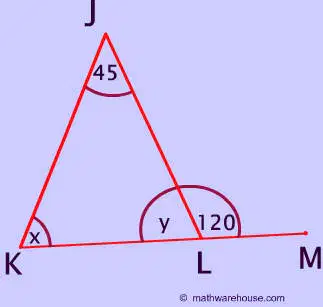
What is the measure of angle x?
45
60
65
75
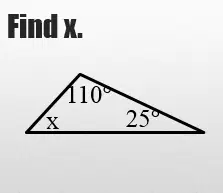
Find the measure of the indicated angle.
95
85
35
45
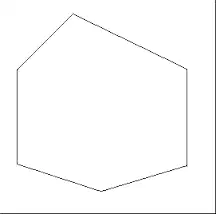
Find the angle sum of the interior angles of the polygon.
180°
540°
720°
1080°

Find the value of X.
90
98
100
118

Find the measure of the missing angle.
47
57
53
133
Which of the following best defines a parallelogram?
A quadrilateral with four right angles
A quadrilateral where opposite sides are parallel and equal in length
A quadrilateral with only one pair of parallel sides
A quadrilateral with all sides and angles equal
Which of the following best defines a square?
A quadrilateral with two pairs of parallel sides and unequal diagonals
A quadrilateral with one pair of parallel sides
A quadrilateral with four equal sides and four right angles
A quadrilateral with four equal sides but no right angles
Which of the following best defines a trapezoid?
A quadrilateral with four equal sides and four right angles
A quadrilateral with only one pair of parallel sides
A quadrilateral with opposite sides equal and parallel
A quadrilateral with no parallel sides
Which of the following best defines a rectangle?
A parallelogram with four right angles
A quadrilateral with four equal sides but no right angles
A quadrilateral with all sides and angles equal
A quadrilateral with only one pair of parallel sides
Which of the following best defines a rhombus?
A quadrilateral with four equal sides and four right angles
A quadrilateral with two pairs of parallel sides and unequal diagonals
A quadrilateral with only one pair of parallel sides
A quadrilateral with four equal sides
John had 5 apples. He bought 6 more but then gave away 8 and ate 9. How many apples does he have now?
-5
5
21
21
A group of students are working on a project to convert fractions to decimal numbers in a real-world context. They are using this knowledge to understand the distribution of resources in their community, ensuring fairness and equality. They come across the fraction 3/8. If they were to convert this fraction to a decimal number, what would it be? This question requires higher-order thinking skills as it involves application of mathematical knowledge in a real-world context.
0.375
0.38
0.8375
0.3875
-6 + 8 - 14 + 17
-5
5
-19
-21
52−27−8+23
-18
-2
14
52
(−2)3−9+12−81+2
-15
5
-11
7
10+(−5)2−42−(−8)
-23
59
27
11
−7.8÷−6
-1.3
1.3
1.8
-3.2
−98+(−92)
−96
−1 91
1 91
32
-10 + 8
-2
2
18
-18
convert 32 to decimal number...
0.6
0.66
0.70
6.6
Convert 45 to decimal number...
1.20
1.25
1.35
1.4
Convert −76 to decimal number...
-0.5871
convert to 54=...%
20%
70%
80%
(+)×(−) =?
POSITIVE
NEGATIVE
(−)×(+) =?
POSITIVE
NEGATIVE
So far do you understand majority of the questions in this slideshow?
YES
NO
KINDA

4.36+57.98=
(a)

5b =4
b = 9
b = 1
b = 20
b = 15
q = 9
q = 5
q = 14
q = 11
In a distance problem if both numbers are negative
add
subtract
positive
negative
take sign of number with greater absolute value
4 x 5 - 2 + 4
14
16
22
28
8 x 3 - 10 =
14
-54
20
12

62/3 - 5/8
20.04
36.2
12
18
3/4 / 1/2=
2.1
1.5
1.75
0.25
-7 x 6
(a)
0.5(0.5)
2.5
0.25
25
pineapples
−76(−98)
2116
−2116
748
−748
-12.5(-2.4)
26.8
-30
30
-26.8

−72(53)
−2110
2110
356
−356
-17.33(0.44)
7.6252
34.1340
-34.1340
-7.6252
-7 x 9 = ?
63
-56
-56
-63
−87×91 = ?
647
−727
727
−647
Is (-5) x (-9) negative or positive?
Negative
Positive
In multiplication both factors are positive
always positive
always negative

The answer to this expression is ... −72 + 4 21
POSITIVE
NEGATIVE
ZERO
All of the above.
Perform the indicated operation.
1/8 + 3/8
Simplify answer.
(a)
When multiplying fractions, a common denominator is required.
TRUE
FALSE
John is a fruit vendor. He has 2/3 of a bushel of apples and he wants to divide it equally among his 5/6 of a bushel of oranges. What will be the quotient of apples to oranges if he does so?
Reduce, or simplify the answer.
Consider the following options and choose the correct one:
12 / 15
5 / 9
4 / 5
-1 / 6
Perform the indicated operation.
(4/5) ÷ (5/6)
Write answer in lowest terms.
24 / 25
4 / 6
2 / 3
24 / 5
A group of friends decided to share a pizza. The pizza was cut into 6 equal slices. One friend ate 1/6 of the pizza and another friend ate 2/3 of the pizza. If the amount of pizza eaten by each friend is represented by a fraction, what is the product of the fractions representing the amount of pizza eaten by the two friends? Simplify your answer.
1 / 4
9
1 / 9
3 / 12

