
 Worksheets
IAM quiz test PGDM Batch 2023-25 T3
Total questions: 25
Worksheet time: 45mins
One approach for using multifactor models is to use factors that capture systematic risk. Which of the following is NOT a common factor used in this approach?
Consumer Confidence
unexpected changes in inflation
yield curve shifts
unexpected changes in real GDP
All of these are correct
Recently, you have received a tip that the stock of Buttercup Industries is going to rise from $76.00 to $85.00 per share over the next year. You know that the annual return on the S&P 500 has been 13% and the 90-day T-bill rate has been yielding 3% per year over the past 10 years. If beta for Buttercup is 1.0, will you purchase the stock?
Yes, because it is overvalued.
Yes, because it is undervalued.
No, because it is undervalued.
No, because it is overvalued.
Yes, because the expected return equals the estimated return.
The betas for the market portfolio and risk-free security are:
Market: 0 Risk-free: 1
Market: 1 Risk-free: 0
Market: −1 Risk-free: 1
Market: 1 Risk-free: −1
Market: 2 Risk-free: 1
Which of the following are you more you more likely to use in order to calculate the risk-free rate for use in equity valuation?
3-month T-bill rate
Yield on Long-term Corporate Bonds
Yield on a small-cap equity index
Return on the Nifty 50 Index
Which of the following is NOT true of the CAPM Model?
It assumes all investors are risk-averse and rational
It assumes all investors hold a market portfolio that is fully diversified
The CAPM assumes there is a non-linear retaionship between risk and return
The CAPM assumes markets are efficient.
One of the variables that has been known to have predictive power for stock returns beyond the CAPM market beta is:
Debt
Past stock returns
Standard deviation of stock returns
Firm Size
The empirical evidence on CAPM indicates that
Returns on high beta stocks are a little too high and returns on low beta stocks are a little too low
Other variables such as Size appear to have predictive power beyond CAPM
The Market Risk premium has been relatively stable across decades
High book to market firms outperform low book to market firms
The Market Model is often used
To estimate the market risk premium in CAPM
To estimate the Beta in CAPM
To estimate the firm-specific return in CAPM
To predict future stock returns

The expression for stock return variance in terms of the market model can be written in the following equation. If we assume that a stock's diversifiable risk has been diversified away , then the stock return variance is simply:
The variance of the market return
The variance of the idiosyncratic risk
The square of the product of Beta and the market return
The variance of beta
The standard error of the Beta estimate allows us:
To calculate the t-statistic of beta
To calculate the average beta of the portfolio
To assess the prescision of the beta
To calculate the t-statistic of beta and To assess the prescision of the beta
To calculate the average beta of the portfolio and To assess the prescision of the beta
Which of the following risk factors is NOT captured by Beta?
Risk emnating from fixed financing costs
Risk emnating from fixed operating costs
Risk emnating from cyclical revenues in seasonal industries
Risk emnating from the sensitivity of a company's business cycles to the general economy
A common issue in deciding the estimation period for computing beta involves:
Deciding deciding between daily and monthly returns
Deciding between using a stock-based index vs a more diversified index
Deciding between choosing more data or focus on the stability of the beta
Choosing a domestic market index vs a global index
As per data available from the Fama and French (1993) paper which we used in class, by how much did US small cap firms outperform the US large cap firms in the year 2004?
11.82%
5.06%
9.29%
1.19%
Using information from the slides to estimate size-adjusted expected returns, what would be the size-adjusted CAPM expected return for a stock with a beta of 1.2. Assume a risk--free rate of 4%, a market risk premium of 7% and a market cap of approx. $500 million for the firm.
12.4%
7.60%
16.07%
14.15%
All of the following are characteristics of a dealer market EXCEPT that:
it is a quote-driven market.
individual dealers buy and sell shares for themselves.
the NASDAQ market is a dealer market.
it has a centralized trading location.
All of these are characteristics of a dealer market.
Which of the following is NOT a characteristic of shelf registrations? Shelf registrations
Were introduced by Rule 415
allow large firms to register security issues and sell them piecemeal during the following six years.
provide flexibility and reduce registration fees and expenses.
are typically used for the sale of straight debentures rather than common stock or convertible issues.
All of the above are correct
Which of the following is an underwriting function?
Origination
Risk-bearing
Distribution
putting together an underwriting syndicate.
All of the above are correct
The U.S. secondary market with the largest number of issues traded is the
AMEX
NASDAQ
NYSE
TSX
LSE
Assume Jackie bought some shares of a $50 stock. She paid for it partly with her own cash and part by borrowing $100,000 - the maximum amount of money she could borrow given an initial margin requirement of 60 percent.
If the maintenance margin is 25%, to what price can the stock price fall before Jackie receives a margin call?
14.56
23.17
32.42
26.67
25.52
A pure auction market is one in which
dealers provide liquidity by buying and selling shares of stock for themselves.
dealers compete against each other to provide the highest bid and lowest asking prices.
buyers submit bid prices to sellers.
sellers submit ask prices to buyers.
buyers and sellers submit bid and ask prices to a central location to be matched.
In a call market, trading for individual stocks
occurs anytime the market is open.
takes place at specific times.
takes place at the open and close of the trading day.
is priced either by auction or by dealers.
None of these are correct.
Investors can leverage their stock transactions with the use of
Stop-loss orders
Limit Orders
Margin orders
Market Orders
Specialists
Which of the following is NOT a problem with using daily stock returns in estimating beta?
Autocorrelation of the error term
High frequency of data
Non-stationarity
Non-synchronous trading
Consider a two-factor APT model in which the first factor is changes in the 30-year T-bond rate, and the second factor is the percent growth in GNP. Based on historical estimates, you determine that the risk premium for the interest rate factor is 0.02, and the risk premium on the GNP factor is 0.03. For a particular asset, the response coefficient for the interest rate factor is −1.2, and the response coefficient for the GNP factor is 0.80. The rate of return on the zero-beta asset is 0.03. Calculate the expected return for the asset.
5%
2.4%
-3%
-2.4%
3%
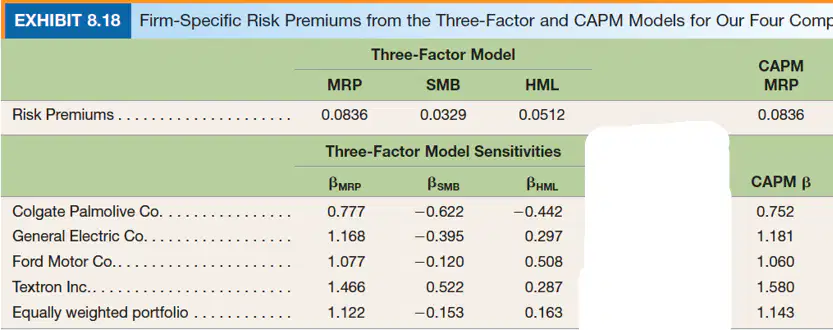
Assuming a risk-free rate of 3%, what is the cost of equity estimate for General Electric Co. using the 3-factor model ?
9.99%
12.99%
16.77%
12.87%

