
 Worksheets
Biogeochemical Cycles Test Makeup
Total questions: 20
Worksheet time: 10mins
Name
Class
Date
1.
Biogeochemical cycles are best described as the movement of _________ factors throughout an ecosystem.
a)
Abiotic
b)
Biotic
c)
Limiting
d)
Important
2.
In the water cycle, what happens when water vapor turns into tiny water droplets in the atmosphere?
a)
Evaporation
b)
Precipitation
c)
Condensation
d)
Sublimation
3.
What is the primary source of energy for driving biogeochemical cycles on Earth?
a)
Geothermal Heat
b)
The Sun
c)
Fossil Fuels
d)
Wind
4.
Which biogeochemical cycle involves the conversion of atmospheric nitrogen gas (N2) into a form that plants can use?
a)
Nitrogen Cycle
b)
Water Cycle
c)
Carbon Cycle
d)
Phosphorus Cycle
5.
How do human activities like deforestation and burning fossil fuels impact biogeochemical cycles?
a)
They have no significant impact on the cycles.
b)
They accelerate the cycles, leading to more efficient nutrient transfer.
c)
They disrupt the cycles, leading to imbalances and environmental issues.
d)
They only affect the water cycle.
6.
In the phosphorus cycle, what is the primary way phosphorus enters terrestrial ecosystems?
a)
Atmospheric deposition
b)
Weathering of rocks
c)
Volcanic activity
d)
Plant respiration
7.
What is the term for the process by which atmospheric nitrogen is converted into a form that can be used by plants?
a)
Nitrogen Fixation
b)
Deaerification
c)
Combustion
d)
Decomposition
8.
Which greenhouse gas associated with the carbon cycle contributes to global warming?
a)
Oxygen (O2)
b)
Carbon Dioxide (CO2)
c)
Nitrogen (N2)
d)
Water Vapor (H2O)
9.
How does nitrogen primarily return to the atmosphere in the nitrogen cycle?
a)
Through plant uptake
b)
Through photosynthesis
c)
Through denitrification
d)
Through ammonification
10.
Through which process does CO2 get absorbed into the Earth?
a)
Burning of fossil fuels
b)
Photosynthesis
c)
Respiration
d)
Car exhaust emissions
11.
Decomposers play an important role in the nitrogen cycle to help maintain the health of an ecosystem. Which would most likely occur if there was a decrease in the number of decomposers?
a)
Waste products would be converted to carbohydrates
b)
Energy needed for producers to make food would increase.
c)
Necessary nutrients would not be recycled in the environment.
d)
The amount of carbon dioxide in the atmosphere would decrease.
12.
The burning of fossil fuels has increased carbon emissions dramatically since the 1950s. If the amount of carbon dioxide in the atmosphere continues to rise, it appears to cause a warning trend and affect ecosystems throughout the world by:
a)
Increasing the amount of acid rain
b)
Increasing the amount of UV radiation
c)
Changing climates and melting polar ice caps
d)
Contaminating water sources with toxic chemicals
13.
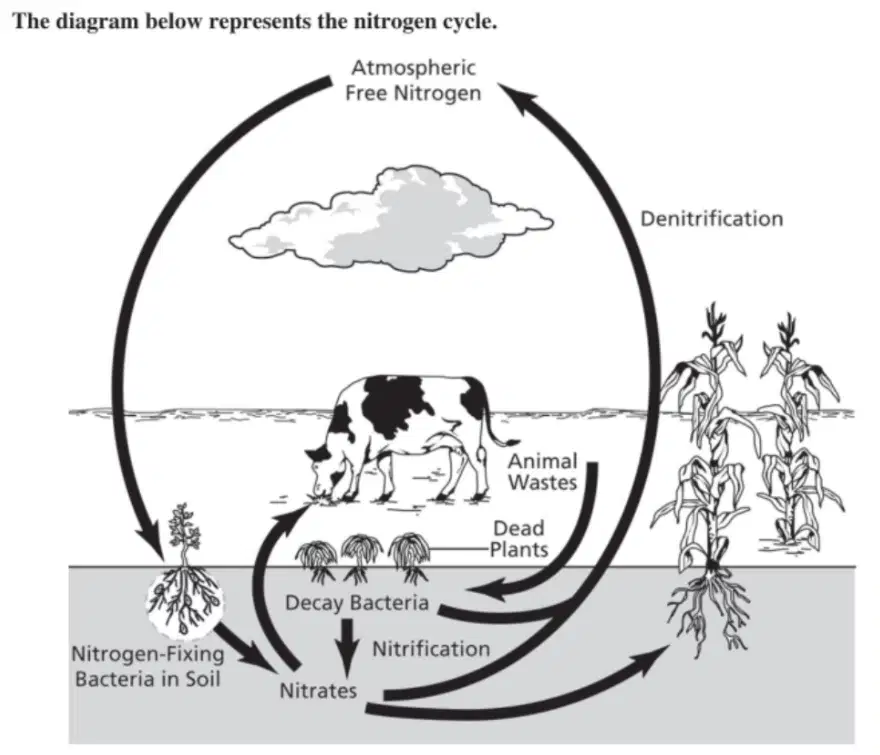
Which statement best explains what would most likely occur first if the amount of organic matter in the area suddenly decreased?
a)
The amount of decomposers would increase
b)
The amount of available nitrogen in the soil would decrease
c)
The number of nitrogen-fixing bacteria would increase
d)
The amount of atmospheric nitrogen would decrease
14.
An increase in the phosphorus content of soil affects an ecosystem’s total biomass (amount of life) by directly:
a)
Supplying shelter for decomposers
b)
Replacing the need for herbivores
c)
Increasing the carrying capacity for producers
d)
Reducing competition between top predators
15.
An increase in the amount of carbon dioxide in the atmosphere will most likely
a)
decrease precipitation.
b)
increase wind speeds.
c)
decrease temperatures.
d)
increase plant productivity.
16.
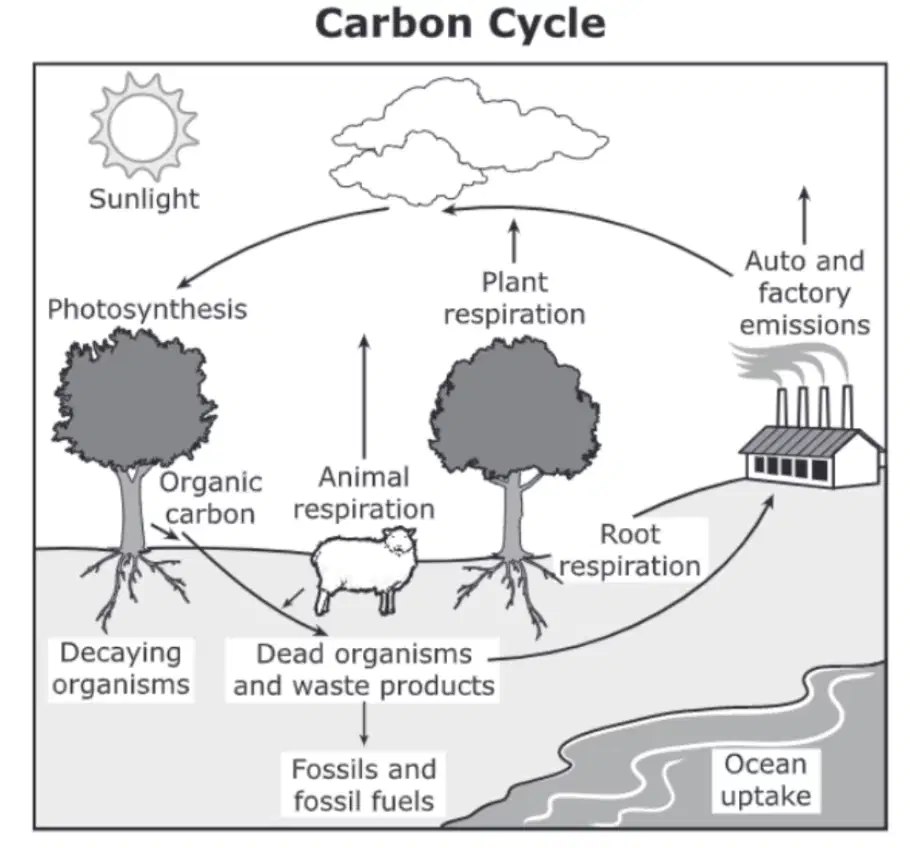
Which change would lead to higher carbon dioxide levels in the atmosphere?
a)
an increase in the burning of fossil fuels
b)
an increase in photosynthesis
c)
a decrease in animal respiration
d)
a decrease in the destruction of forests
17.
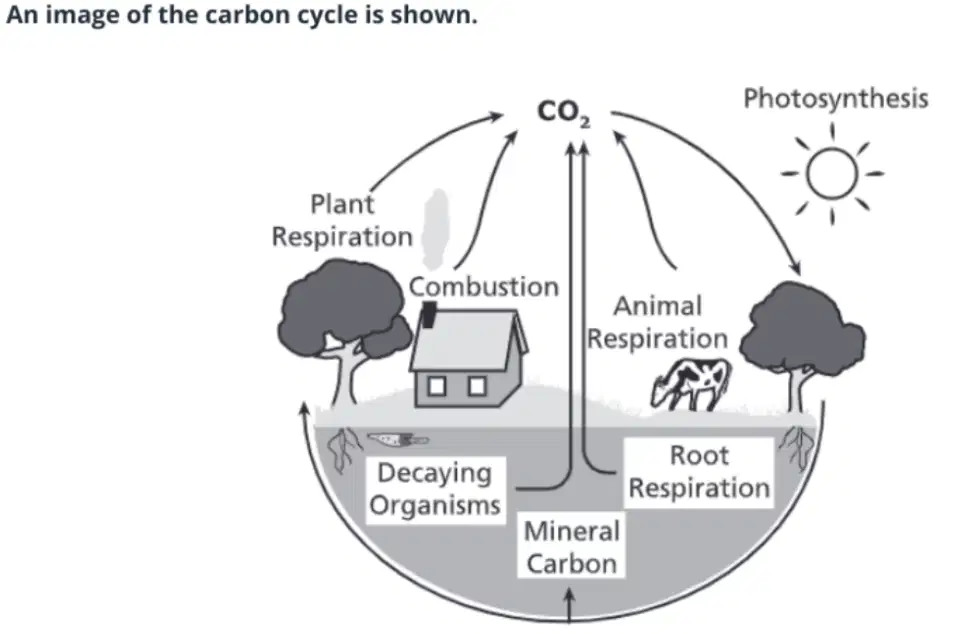
Which action could lead to a reduction in atmospheric carbon?
a)
using coal to power a factory
b)
burning logs in a fireplace
c)
animals eating mushrooms in a field
d)
humans planting trees in a forest
18.

If root nodules were prevented from forming, which of these would be the most likely impact on the local community?
a)
The plants would no longer be able to perform photosynthesis.
b)
The plants would increase water consumption to compensate for the loss of nitrogen.
c)
The soil would become depleted of usable nitrogen compounds.
d)
The concentration of atmospheric nitrogen gas would decrease.
19.
In an investigation into the role of plants in the cycling of matter, a researcher is designing an experiment in which plants will be grown under conditions that will limit the rate of photosynthesis. Which design would match the goal of the researcher?
a)
Grow the plants in a low oxygen environment and measure the rate of carbon dioxide production.
b)
Grow the plants in a low carbon dioxide environment and measure the rate of oxygen production.
c)
Grow the plants in soil containing excess water and measure the rate of transpiration.
d)
Grow the plants in soil containing excess nitrogen and measure the rate of plant growth.
20.
In surface waters, an excessive concentration of phosphorus is considered to be a pollutant. Phosphorus stimulates the growth of plankton and plants that eventually die and decompose. Bacteria consume the decomposing material, causing a decrease in the amount of dissolved oxygen. What will most likely occur in a lake ecosystem that has an overabundance of phosphorus?
a)
There will be an increase in other available nutrients
b)
The lake will begin to undergo eutrophication.
c)
There will be a decrease in food for other organisms.
d)
The water flow in the lake will increase.
100 %

