
Font size
 Worksheets
Properties of Matter Review 8.6 A,B,C,D,E
Total questions: 17
Worksheet time: 9mins

The drawing below shows the proper way to read a glass graduated cylinder. Why does the water not form a straight line across the surface?
Attraction between the water and the glass causes adhesion of the water.
Repulsion between the water and the glass causes adhesion of the water.
Cohesion among water molecules causes them to move higher on the glass.
Cohesion between the water and the glass causes some of the water molecules to rise.
Two solutions are mixed and react to produce AgCl. The chemical reaction is shown below by the balanced equation. AgNO₃ + LiCl → AgCl + LiNO₃ What happens to the total mass as the reaction takes place?
The mass increases
The mass decreases
The mass remains constant
The mass first increases and then decreases

A pool was tested using a pH strip as seen below. What is the current pH of the pool and what does this tell us?
The pH level of the pool is at a 3. This means that the pool is currently acidic and needs to be chemically balanced to neutral before it is safe to swim.
The pH level of the pool is at a 3. This means that the pool is currently basic and needs to be chemically balanced to neutral before it is safe to swim.
The pH level of the pool is at a 5. This means that the pool is currently neutral and is perfectly safe.
The pH level of the pool is at a 5. This means that the pool is currently acidic and needs to be chemically balanced to neutral before it is safe to swim.
What elements are involved in this chemical reaction? CaCO₃ → CaO + CO₂ There are more than one answer.
Cobalt
Calcium
Oxygen
Carbon
Chlorine
In the chemical reaction, HCl (acid) + NaOH (base) → H₂O + NaCl, what elements are involved and what is produced by the reaction?
Hydrogen, Chlorine, Sodium, Oxygen; Water and Sodium Chloride are produced.
Carbon, Oxygen, Hydrogen; Carbon Dioxide and Water are produced.
Nitrogen, Hydrogen, Oxygen; Ammonia and Water are produced.
Sulfur, Oxygen, Hydrogen; Sulfuric Acid and Water are produced.
As noted in the book, chlorine tablets are used in swimming pools to maintain the health of the water and the pH levels. The main reaction is: Cl₂ + H₂O → HOCl + HCl Which components are reacting as elements, compounds or mixtures? Click all that apply.
Cl₂ is an element
HCl is an element
H₂O, HOCl and HCl are compounds
HOCl and HCl combined are a mixture
HOCl is a mixture

Droplets of water remain on the lower side of this leaf, even though gravity pulls the water downward. What property of water keeps the drops of water from falling to the ground?
adhesion among water molecules in the droplet
cohesion between water molecules and molecules of the leaf
adhesion between water molecules and molecules of the leaf
surface tension of the water droplet
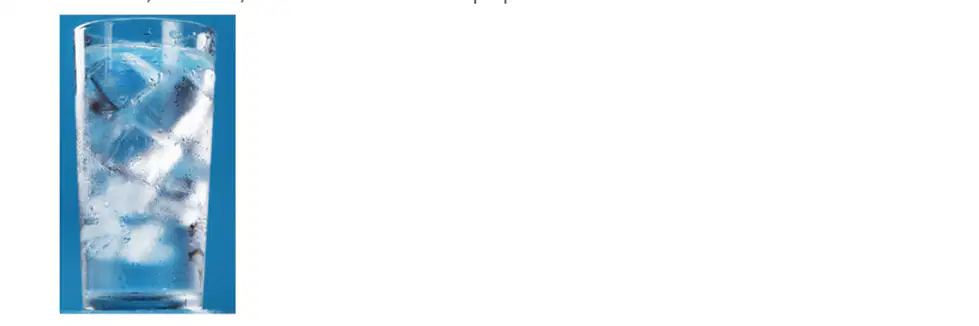
Adhesion, cohesion, and surface tension are properties that are observed in water. What unique property of water molecules makes adhesion, cohesion, and surface tension possible, AND why are adhesion, cohesion, and surface tension observed in liquid water but not in ice?
Hydrogen bonding; because in liquid water, molecules are closer and can form more hydrogen bonds.
Covalent bonding; because in liquid water, molecules are further apart and can form fewer covalent bonds.
Ionic bonding; because in liquid water, molecules are closer and can form more ionic bonds.
Metallic bonding; because in liquid water, molecules are further apart and can form fewer metallic bonds.

A student used pH test strips to determine the pH of some common household items. She recorded them in the table below. Which items in the table are classified as acids?
Egg Whites
Hand Soap
Coffee
Lemon Juice
Rain Water
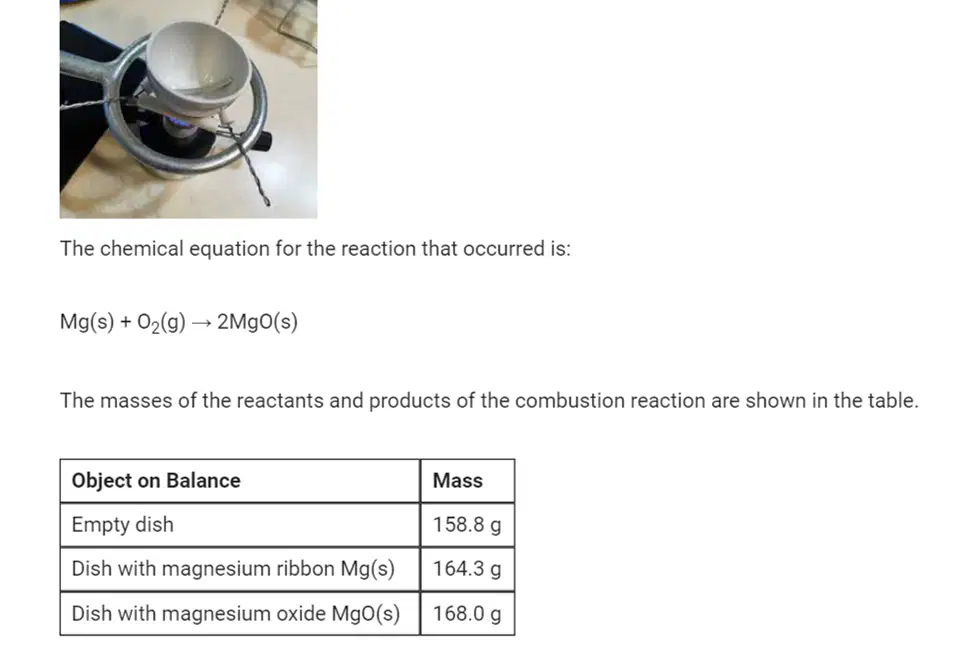
In a lab demonstration, a teacher burned a strip of magnesium ribbon in a crucible that was inside a fume hood. The chemical equation for the reaction that occurred is: Mg(s) + O₂(g) → 2MgO(s) The masses of the reactants and products of the combustion reaction are shown in the table. Assuming that the combustion reaction was complete, what mass of oxygen reacted with the magnesium ribbon?
Can not be determined
3.7 g
9.2 g
5.5 g
The chemical equation for photosynthesis shows that the products are sugar and oxygen gas. 6CO₂ + 6H₂O → C₆H₁₂O₆ + 6O₂ The sugar that is a product of this reaction has a total number of ______ Carbon, ______ Hydrogen, and ______ Oxygen atoms per each molecule. This is classified as a/an ______?
6 Carbon, 12 Hydrogen, 6 Oxygen, monosaccharide
5 Carbon, 10 Hydrogen, 5 Oxygen, disaccharide
7 Carbon, 14 Hydrogen, 7 Oxygen, polysaccharide
8 Carbon, 16 Hydrogen, 8 Oxygen, oligosaccharide
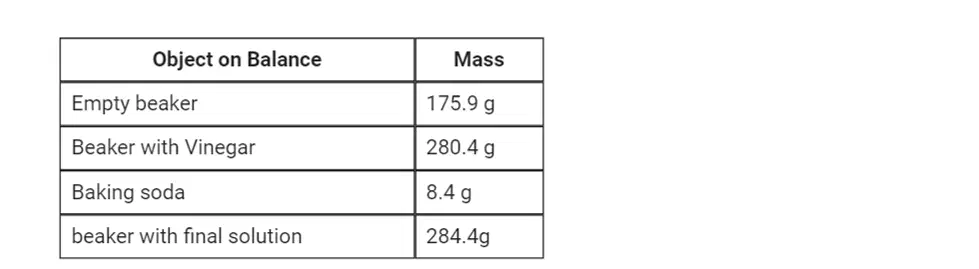
A student measured a vinegar solution into a beaker and then added 8.4 g of baking soda to the solution. The reaction between vinegar and baking soda formed water and sodium acetate, which remained in the solution. The reaction also formed carbon dioxide, which was released into the atmosphere as a gas. The measurements of the reactants and remaining products of the reaction are shown in the table. Assuming a complete reaction occurred, and based on these measurements above, what mass of carbon dioxide was released into the atmosphere?
can not be determined
4.0 g of CO₂
105.5 g of CO₂
4.4 g of CO₂
A student was given an unknown material and performed experiments to determine the nature of the material. The material was identified as being either an acid or base solution. The student recorded these observations about the solution. I. The solution conducts an electric current. II. When a drop of the solution is placed on a zinc strip, bubbles form. III. The solution is a clear, colorless liquid. Which observations provide evidence that could be used to determine whether the material is an acid or a base?
Observations I, II, III
Observations II and III only
Observation I only
Observation III only
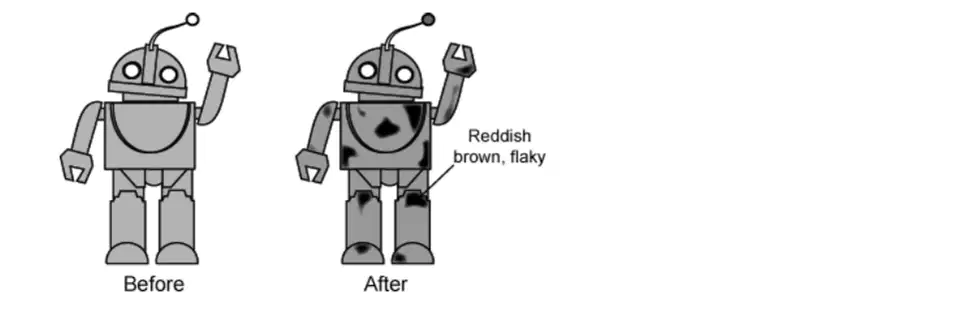
The pictures below were taken of Reginald the Robot before and after he got stuck outside in the rain. What has the rain most likely done to Reginald?
It caused a chemical reaction that combined the atoms in his metal body, causing it to melt.
It caused a chemical reaction that heated up the atoms in his metal body, causing it to burn.
It caused a chemical reaction that rearranged the atoms in his metal body, causing it to rust.
It caused a chemical reaction that broke apart the atoms in his metal body, causing it to decay.
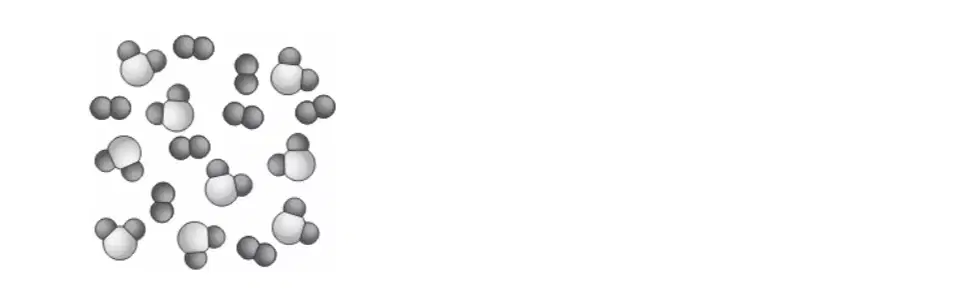
The model below shows the composition and arrangement of atoms in a beaker. What is the classification of the material in the image of the model above?
Element
Compound
Homogeneous mixture
Heterogeneous mixture
Which type of change must occur to form a compound?
Phase
Chemical
Physical
Nuclear
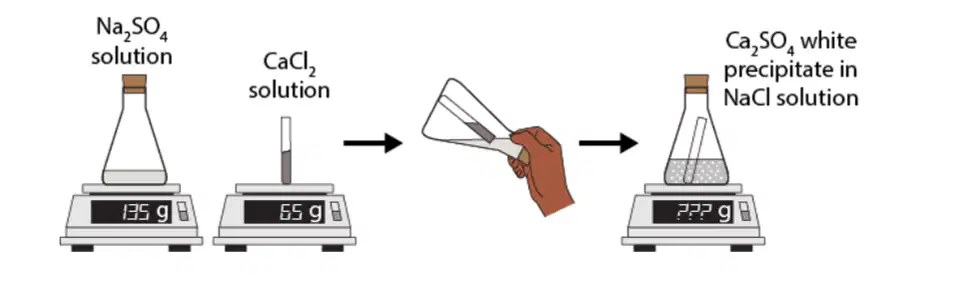
The mass of the new product is ______ grams.
100 grams
200 grams
300 grams
400 grams

