
NEW
Font size
 Worksheets
Cell Biology Quiz
Total questions: 26
Worksheet time: 13mins
Living things contain units of structure and function that arise from preexisting units. This statement best describes the
cell theory
lock-and-key model of enzyme activity
concept of natural selection
heterotroph hypothesis
Which factor contributed most to the development of the cell theory?
the discovery of many new species
the development of techniques to determine the chemical composition of substances
the increase in knowledge concerning factors influencing the rate of evolution
The improvement in microscopes and microscopic techniques
Which cell structure do nutrients pass through to enter a cell?
cell membrane
chloroplast
cytoplasm
nucleus
Which structure is found in a plant cell but not in an animal cell?
cell wall
cell membrane
cytoplasm
nucleus
Most of the hereditary information (DNA) that determines the traits of an organism is located in
only those cells of an individual produced by meiosis
the nucleus of cells
certain genes in the vacuoles of body cells
the numerous ribosomes in certain cells
Which organelles must be in a cell of a leaf for photosynthesis to occur?
cell wall
chloroplast
vacuole
ribosome
What is the site of protein synthesis in plant cells?
nuclei
chromosomes
vacuoles
ribosomes
Which organelle contributes the energy for muscles in an earthworm?
vacuoles
chloroplasts
mitochondria
ribosomes
Which organelle is usually found in both plant and animal cells?
cell walls
centrioles
ribosomes
chloroplasts
Which statement best describes the cell membrane of a cell?
It controls the movement of substances into and out of the cell.
It is composed of proteins only.
It allows all substances in and out of the cell.
It is only found in animal cells.
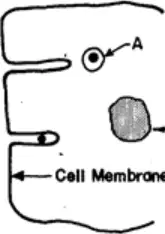
The diagram below illustrates how a protein molecule may enter the cell. Structure A is most likely a
ribosome
chloroplast
nucleus
vacuole
Most cellular respiration in plants takes place in organelles known as
chloroplasts
nuclei
ribosomes
mitochondria

The highest possible magnification that can be obtained when using this microscope is
40×
100×
400×
4,000×
Which part of a microscope should be used with the low-power objective, but not with the high-power objective?
coarse adjustment
fine adjustment
diaphragm
ocular
To locate a specimen on a prepared slide with a compound microscope, a student should begin with the low-power objective rather than the high-power objective because the
field of vision is smaller under low power than under high power
field of vision is larger under low power than under high power
specimen does not need to be stained for observation under low power but must be stained for observation under high power
amount of the specimen that can be observed under low power is less than the amount that can be observed under high power
The field of view becomes darker when a compound microscope is switched from low to high power. The field of view can then be made brighter by
decreasing the size of the diaphragm opening
increasing the size of the diaphragm opening
refocusing with the fine adjustment
refocusing with the coarse adjustment
A student views some cheek cells under low power. Before switching to high power, the student should
adjust the eyepiece
center the image being viewed
remove the slide from the stage
remove the coverslip
A slide of human blood cells was observed in focus under the low-power objective of a compound light microscope that had clean lenses. When the microscope was switched to high power, the image was dark and fuzzy. Which parts of the microscope should be used to correct this situation?
nosepiece and coarse adjustment
diaphragm and ocular
objective and fine adjustment
diaphragm and fine adjustment
The total magnification of an image formed by a compound light microscope is a result of multiplying the magnifications of the
eyepiece and diaphragm
objective and mirror
eyepiece and objective
low-power objective and high-power objective

Base your answer to the following question on the diagram below and on your knowledge of science. Identify two structures that identify this cell as a plant cell rather than an animal cell.
Cell wall and chloroplast
Nucleus and mitochondria
Ribosome and endoplasmic reticulum
Golgi apparatus and lysosome
Which cell organelle is composed of a series of channels throughout the cytoplasm that functions in the transport of molecules?
lysosome
chloroplast
cell wall
endoplasmic reticulum
A white blood cell ingests, then digests, a number of bacteria. Which cell organelles were directly responsible for the digestion of the bacteria?
centrioles
lysosomes
ribosomes
mitochondria
Which statement is true for all organisms?
They carry out photosynthesis.
They are multicellular.
They contain at least one cell.
They are consumers.

Which cell structure shown in the diagram contains genetic material?
Nucleus
Cell membrane
Cytoplasm
Mitochondria
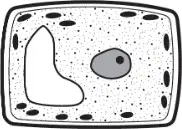
Which structure shown in the plant cell diagram is the site of photosynthesis?
Nucleus
Mitochondria
Chloroplast
Cell Wall
Which two structures are found in both plant and animal cells?
Cell membrane and nucleus
Chloroplast and cell wall
Vacuole and chloroplast
Cell wall and nucleus

