
 Worksheets
Unit 1 Practice Test
Total questions: 27
Worksheet time: 14mins
What is a force?
A type of energy
A push or pull on an object
The speed of an object
The mass of an object
What does Newton's third law state about two colliding objects?
Both objects stop moving
The lighter object moves faster
Speed is always conserved
For every action, there is an equal and opposite reaction.
In a collision, how does the force exerted by the first object on the second object compare to the force exerted by the second object on the first?
They do not affect each other
The forces are equal in magnitude, but opposite in direction
The forces point in the same direction
One is stronger than the other
Which of the following situations can NOT be explained using Newton's third law?
A soccer ball being kicked and moving
Two cars experiencing a head-on collision
A book on a table not falling due to gravity
The thrust of a rocket propelling it upwards
If two objects of different masses collide, which of the following is true?
The lighter object experiences a greater force
The force depends on the object's speed
The two objects experience the same force
The heavier object experiences a greater force
How does the mass of an object affect its motion?
Heavier objects need more force to change motion
Heavier objects move faster
Mass has no effect on motion
Lighter objects need more force to change motion
What factors determine the change in an object's motion?
Its mass and speed
Sum of forces on it and its mass
Its size and mass
Its color and shape
What is the result of unbalanced forces acting on an object?
The object's motion changes
The object's color changes
The object becomes imbalanced
The object's mass increases
If more force is applied to a stationary object, what is likely to happen?
The object would shrink
The object would get heavier
The object would move faster
The object would change shape
What is the relationship between the net force on an object and its motion?
All forces stop an object's motion
The object moves in the opposite direction of the force
The object's motion does not depend on the force
The object’s change in motion depends on the net force
If two forces of the same magnitude act upon an object in the same direction, what will be the resultant force?
The same as one force
Half of one force
Twice the magnitude of one force
No resultant force
What component needs to be considered to plan an investigation on an object's motion?
Only the object's volume
Only the object's size
Only the object's shape
The sum of forces and the object's mass
How does the mass of an object affect the change in its motion?
mass has no effect
bigger mass means smaller change for the same force
lighter objects cannot move fast
heavier objects always move slower
What force is responsible for gravitational interactions?
Friction
Inertia
Magnetism
Gravity
What does the strength of gravitational interactions depend on?
Masses of objects and their distance
Size of objects
Temperature of objects
Color of objects
What determines the strength of gravitational interactions between two objects?
Masses of objects and distance between them
Masses of objects and temperature
Size and weight of the objects
Size of objects and distance between them
What happens to the gravitational force if the distance between two objects increases?
It increases
It becomes zero
It remains the same
It decreases
Speed is the measure of how quickly an object moves, while velocity includes direction, so two objects can have the same speed but different velocities.
True
False
Acceleration is the rate of change in velocity over a given period of time.
True
False
If an object is moving in a straight line at a constant speed, it does not have acceleration.
True
False
Velocity of an object can change without its speed changing.
True
False
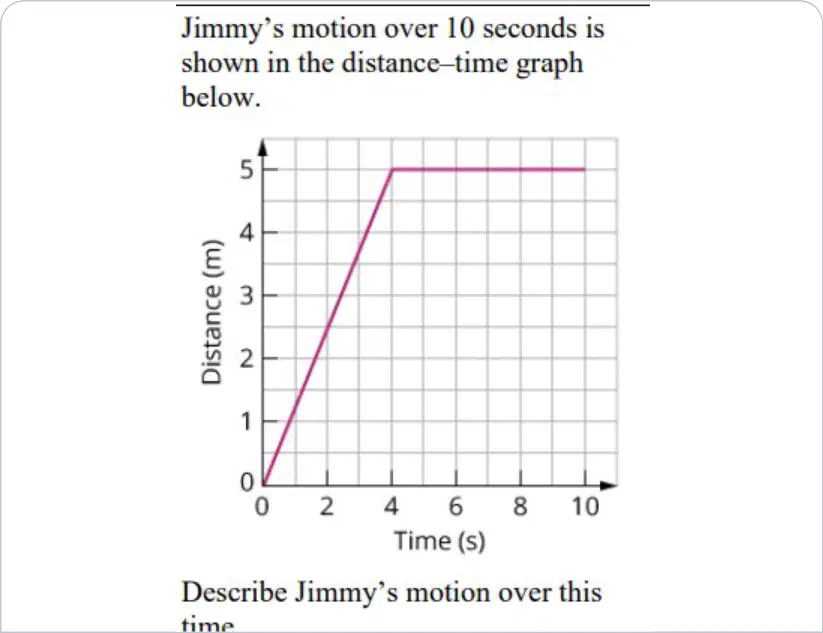
Jimmy’s motion over 10 seconds is shown in the distance–time graph below. What best describes Jimmy’s motion over this time?
Jimmy is stationary.
Jimmy is moving at a constant speed.
Jimmy is accelerating.
Jimmy is decelerating.
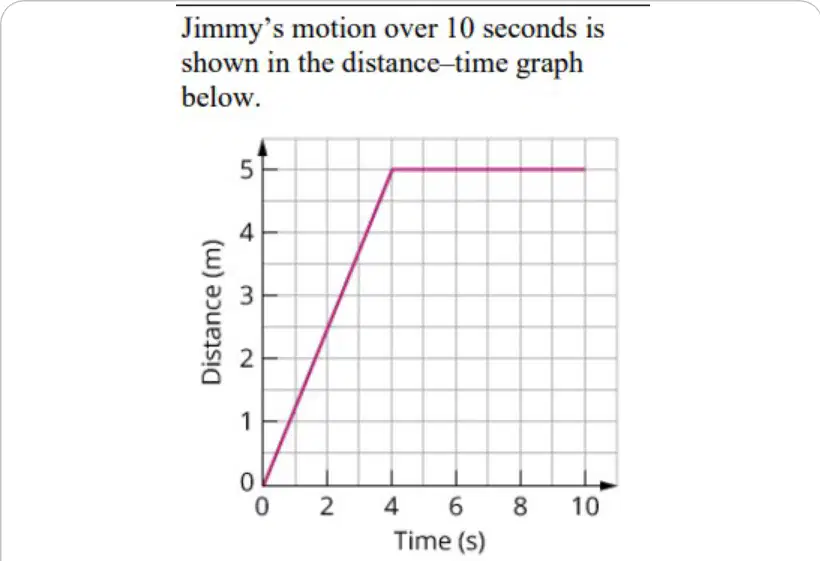
Which statement best describes Jimmy's motion over this time.
Jimmy walks at a constant speed for the first 4 seconds of his motion and ends up 5 m from his starting point. For the next 6 seconds he stands still.
Jimmy walks at a slow speed for the first 10 seconds of his motion and ends up 9 cm from his starting point. For the next 8 seconds he stands still.
Jimmy walks at a constant force for the first 2 seconds of his motion and ends up 6 mm from his starting point. For the next 5 seconds he stands still.
Jimmy runs at a constant gravitational force for the first 14 seconds of his motion and ends up 5 m from his starting point. For the next 6 seconds he stands still.
A car travels 60 km in 2 hours. What is its speed?
120 km/h
60 km/h
30 km/h
2 km/h
A cyclist accelerates from 0 to 20 m/s in 10 seconds. What is the acceleration?
10 m/s²
2 m/s²
0.5 m/s²
200 m/s²
A train travels 300km north, then 300km east. What is its resultant velocity if the total time is 10 hours?
300 km/h
30 km/h
60 km/h
600 km/h
A skateboarder slows from 10 m/s to stop in 5 seconds. What's the acceleration?
-1 m/s²
-2 m/s²
-5 m/s²
-10 m/s²

