Wayground logo

Free Printable Worksheets

Font size

S
M
L
XL
Worksheets

Review for Test#2Q1 CH2425

Total questions: 42

Worksheet time: 41mins

Name
Class
Date
1.

The temperature at which a substance changes from a liquid to a gas.

a)

density

b)

odor

c)

boiling point

d)

buoyancy

2.

The ability of a substance to conduct heat, sound, or electricity.

a)

malleability

b)

magnetism

c)

color

d)

conductivity

3.

The ability of a substance to be pressed or pounded into a thin sheet.

a)

magnetism

b)

conductivity

c)

ductility

d)

malleability

4.

Vaporization is the process when a ________________________.

a)

liquid turns into a gas

b)

gas turns into a solid

c)

gas turns into a liquid

d)

solid turns into a liquid

5.
Which of these is an example of sublimation?
a)
water turning to ice
b)
ice cream dripping
c)
a puddle drying up
d)
dry ice being used to make fog
6.

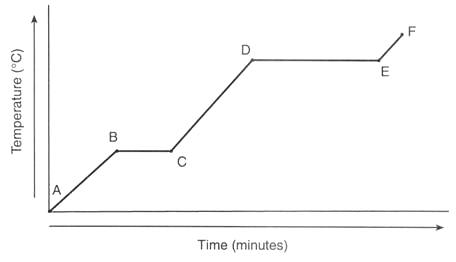
Between which two points is the liquid warming?

a)

A <----> B

b)

B <----> C

c)

C <----> D

d)

D <----> E

e)

E <----> F

7.

Between which points is the temperature of the substance remaining constant?

a)

A-B only.

b)

A-B, C-D, E-F

c)

B-C only.

d)

B-C, D-E

8.
The graph shows a cooling curve for an unknown substance.  What is happening during segment DE?
a)
boiling
b)
condensation
c)
freezing
d)
melting
9.

From point A to point E, the sample is going through an

a)

exothermic process by releasing heat to the surroundings

b)

exothermic process by absorbing heat from the surroundings

c)

endothermic process by releasing heat to the surroundings

d)

endothermic process by absorbing heat from the surroundings

10.

The kinetic energy of the particles are increasing between which points?

a)

A-B only.

b)

A-B, C-D, E-F

c)

B-C only.

d)

B-C, D-E

e)

B-C, C-D

11.

Which position represents a substance in a gas state?

a)

1

b)

3

c)

5

d)

2

12.
True or false: melting and freezing occur at the same temperature!
a)
True
b)
False
c)
I don't know
13.

A substance's heating curve is shown in the graph. What is its boiling point? (Diagram B)

a)

100 C

b)

60 C

c)

80 C

d)

20 C

14.
Blue Color: Chemical or Physical Property
a)
Chemical Property
b)
Physical Property
15.
Density: Chemical or Physical Property
a)
Chemical Property
b)
Physical Property
16.
Flammability (burns): Chemical or Physical Property
a)
Chemical Property
b)
Physical Property
17.
Reacts with Acid: Chemical or Physical Property
a)
Chemical Property
b)
Physical Property
18.
Melting Point: Chemical or Physical Property
a)
Chemical Property
b)
Physical Property
19.
Melting Point: Chemical or Physical Property
a)
Chemical Property
b)
Physical Property
20.
Ability to rust is this type of property:
a)
Physical property
b)
Chemical property
21.

A substance that has indefinite shape and indefinite volume

a)

solid

b)

liquid

c)

gas

d)

solid and liquid

22.

A substance that has particles that are fluid, has an indefinite shape, but a definite volume

a)

Solid

b)

Liquid

c)

Gas

d)

Liquid and gas

23.

Rusting metal is an example of a ____ change.

a)

chemical

b)

phase

c)

state

d)

physical

24.

Use the basic properties of solids, liquids, and gases to identify the correct state of matter in the image.

a)

(A) gas, (B) liquid, (C) solid

b)

(A) solid, (B) liquid, (C) gas

c)

(A) liquid, (B) solid, (C) gas

d)

(A) solid, (B) gas, (C) liquid

25.

What type of substance has low compressibility and high density?

a)

solid

b)

liquid

c)

gas

d)

gas and liquid

26.

Which of the following is NOT a physical change?

a)

Crushing a can

b)

boiling water

c)

shredding paper

d)

burning paper

27.
Rotting bananas?
a)
Physical Change
b)
Chemical Change
28.
Melting a chocolate bar?
a)
Physical Change
b)
Chemical Change 
29.
Cutting your hair?
a)
Physical Change
b)
Chemical Change
30.
Mixtures can be _____________ into the substances that make them up. 
a)
separated
b)
placed
c)
melted
d)
blended
31.
What is the definition of chemical changes?
a)
changes that lead to the formation of new substances with different chemical properties
b)
characteristics that describe how a substance interacts with other substances
c)
changes that describe how a substance behaves under different conditions
d)
changes that alter the form or appearance of a substance, but not its chemical composition
32.

Which of the following is an example of a physical change?

a)
rusting iron
b)
burning wood
c)
melting ice
d)
cooking an egg
33.
Which of the following is an example of a physical change?
a)
Burning wood
b)
Cooking an egg
c)
Melting ice
d)
Rusting iron
34.
_____________ reaction releases heat causing surrounding to get hot.
a)
Exothermic
b)
Endothermic
c)
Physical
d)
None of the above
35.
________________ is an example of a chemical change.
a)
Melting ice
b)
Rotting apple
c)
Folding clothes
d)
Bending metal
36.
_______________ is an example of a physical change.
a)
Burning wood
b)
Rotting apple
c)
Cutting paper
d)
Instant ice packs
37.
A ___________ change alters the size, shape, or composition of a substance.
a)
Physical
b)
Chemical
c)
Endothermic
d)
Exothermic
38.
How do you separate iron filings from sand?
a)
You can use a filter.
b)

You can use a sifter.

c)
You can use a magnet.
d)
You can use all of the methods!
39.
What is the process of separating at which the components move at different rates?
a)
centrifugation
b)
chromatography
c)
heating
d)
decantation
40.
Separating mixtures based on boiling points.
a)
Desalination
b)
Distillation
c)
Decantation
d)
Condensation
41.

The method of separating a solid from a liquid by turning the liquid into a gas.

a)

Evaporation

b)

Filtration

c)

Centrifugation

d)

Chromatography

42.

The method uses to separate a solid from a liquid or a gas by passing them through a device that is too small to let the solid particles through.

a)

Evaporation

b)

Distillation

c)

Filtration

d)

Centrifugation