
NEW
Font size
 Worksheets
African Study Guide # 2
Total questions: 41
Worksheet time: 36mins
The former laws in South Africa that separated people according to race, giving political and economic power to white
Apartheid
Distribution
Multiracial
Segregation
Who was arrested and went to jail for leading protest against apartheid law?
F.W. deKlerk
Gandhi
Martin Luther King
Nelson Mandela

Which color is Southern Africa?
Orange
Which color is Eastern Africa?
Orange
Which color is Northern Africa?
Green
Orange
Which color is Western Africa?
Green
Red
Orange
Which color is Central Africa?
Green
Red
Orange

Which river is located in the area circled?
Tigris River
Euphrates River
Indus River
Nile River


Which physical feature is indicated by the red star?
Sahel
savanna
tropical rainforest
Kalahari Desert

What is E?
Congo River
Niger River
Nile River
Congo Basin
What is H?
Great Rift Valley
Ethiopian Highlands
Atlas Mountains
Sahel
What is P?
Ethiopian Highlands
Kalahari Desert
Great Rift Valley
Sahel


Feature #7
Cape of Good Hope
Horn of Africa
Mt. Kilimanjaro
Madagascar


Which region is partly shaded in green on the map?
Sahel
Sahara
Tropical Rainforest
Savanna

Which African region is shaded on the map?
Savanna
Tropical Rainforest
Sahel
Desert

Which African region is shaded on the map?
Tropical Rainforest
Kalahari Desert
Savanna
Sahel

Mt. Kilimanjaro is the tallest mountain in Africa, is located in what country?
Tanzania
Kenya
Ethiopia
Rwanda
Land or a climate that has little or no rain; too dry or barren to support vegetation, desert
Grassland
Semi-Arid
Arid
Rainforest
Land or a climate that has some rain, but not much; dry but can plant some crops
Grassland
Semi-Arid
Arid
Rainforest

Northern Africa is home to the world's largest desert, which is
After the Berlin Conference, Great Britain colonized more of the African population than any other European country. What was the percentage?
15%
30%
9%
2%
True or False: Ethiopia was the only African country to remain independent after the Berlin Conference.
False
True
The colonization of African countries by the Europeans caused the process of assimilation. The native people of Africa were required or encouraged to change their religion, culture,
Age
Race
Eye Color
Language

Islam is the dominant religion in which African region?
Northern
Southern
Central
Eastern

What is the population (in millions) of males in Egypt between the ages of 60 to 64?
What is the population (in millions) of females in Egypt between the ages of 100 or over?
0
1.2 million
5 million
0.8 million
What did the Berlin Conference of 1884 do?
It divided up the lands of Africa among the European powers, yet no African leaders were invited to take part in this.
It ended slavery in Europe and the Americas.
They came to the conclusion that Europeans would remove all colonies from Africa.
It made slavery illegal in all parts of Africa.
Trans-Atlantic Slave Trade
When did the Trans-Atlantic slave trade occur?
Late 1400s to mid-1800s
1800s to 1900s
A group of people who share a language, culture, similar backgrounds are called a
Christianity, Islam, and Buddhism are groups of people that believe in the same god or deity. These are examples of
Religious Groups
Sports teams
Schools
Old People

What river is shown on the map?
Zambezi River

What is the name of the area circle in red on the map?
Suez Canal
Sahara Desert
Atlas Mountains
None of these
Africa lack of water is effecting the people that lives inland because they are not able to do?
Go Outside
Grow Crops/Farm
Fish
None of These above
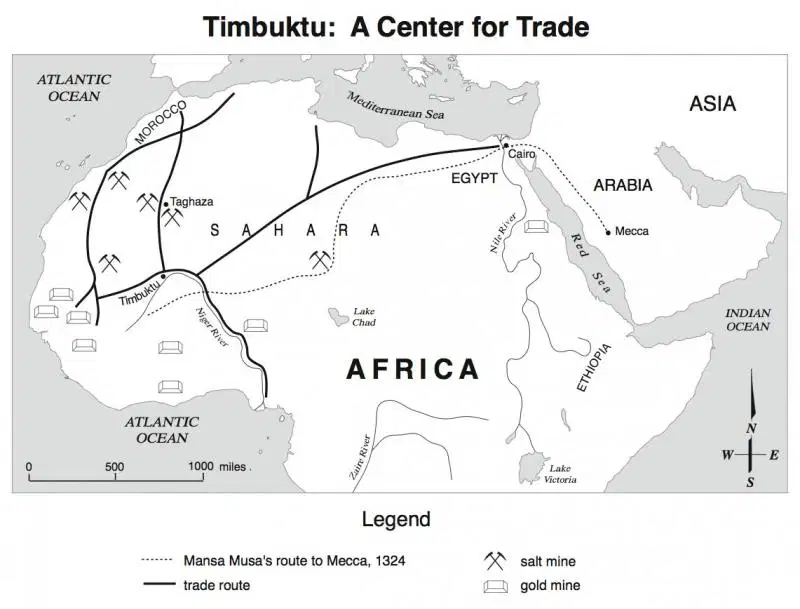
What minerals were mined Near Timbuktu and Taghaza?
Gold and Silver
Silver and Salt
Gold and Salt
None of these
What mineral was mined along Mansa Musa's route to Mecca?
Silver
Salt
Gold
None of these

