
 Worksheets
Unit 2, Chapter 3 Bayou Bridges
Total questions: 50
Worksheet time: 37mins
What was the purpose of Jefferson's Embargo Act of 1807?
To increase trade with Britain and France
To avoid war by halting trade with Britain and France
To strengthen the U.S. military
To support British naval blockades

What marked a critical confrontation between American forces and Tecumseh's confederation in 1811?
The Battle of New Orleans
The Battle of Tippecanoe
The Battle of Yorktown
The Battle of Saratoga
Why did the British aim to capture New Orleans?
Due to its economic importance and strategic location
To gain control of the Mississippi River
To establish a new British colony
To negotiate peace with the U.S.

What is Dolley Madison noted for during the British invasion of Washington, D.C.?
Her role in the American Revolution
Her bravery and saving important documents
Her opposition to the War of 1812
Her efforts in the abolitionist movement
What marked the beginning of the Era of Good Feelings?
The end of the Civil War
America's success in the War of 1812
The signing of the Treaty of Paris
The Louisiana Purchase
What was the impact of the Adams-Onís Treaty negotiated by John Quincy Adams in 1819?
It resolved conflicts over Florida and established boundaries between U.S. and Spanish territories.
It led to the Louisiana Purchase.
It marked the beginning of the U.S. Civil War.
It established the U.S. as a world superpower.
What was the main purpose of the Monroe Doctrine issued in 1823?
To promote trade with Europe.
To assert U.S. opposition to colonialism in the Western Hemisphere.
To establish a new form of government.
To create a military alliance with Latin America.
What did the Necessary and Proper Clause allow Congress to do?
Limit the powers of the President.
Exercise powers not explicitly listed in the Constitution.
Declare war on foreign nations.
Establish a national religion.
What was the significance of the Monroe Doctrine in U.S. foreign policy?
It marked a turning point, asserting the nation’s role as a dominant power in the Western Hemisphere.
It led to the U.S. joining the League of Nations.
It resulted in the U.S. adopting a policy of isolationism.
It caused the U.S. to lose influence in Latin America.
What was a significant feature of the Election of 1824?
It was a peaceful election with no opposition.
It marked a split in the Democratic-Republican Party.
It was the first election with a female candidate.
It was decided by a popular vote.
What is a blockade?
A type of public transportation
A military strategy aimed at preventing people and goods from entering or leaving an area
A journey with a clear purpose
A translation of languages
What does infrastructure include?
Political parties
Roads, bridges, irrigation, public transportation
Expeditions
Language translation
What is partisanship?
The act of taking over territory
The state of choosing one political party, cause, or person over others due to personal affiliation
A type of water body
A military strategy
What does it mean to intervene?
To take action to change the course of an event
To build infrastructure
To lead an expedition
To translate languages
a military strategy aimed at preventing people and goods from entering or leaving an area
Which of these were part of Henry Clay's American System? Select 3 Correct Answers.
establishing a national bank
lowering tariffs to allow southern planters more purchasing power
establishing a protective tariff to make imports more expensive
establishing state banks to give western farmers access to currency
investing in internal transportation to improve travel, trade, and communication
Use the excerpt to answer the following question.
O! say can you see, by the dawn’s early light,
What so proudly we hail’d at the twilight’s last gleaming,
Whose broad stripes and bright stars through the perilous fight,
O’er the ramparts we watch’d, were so gallantly streaming?
And the rockets’ red glare, the bombs bursting in air,
Gave proof through the night that our flag was still there—
O! say, does that star-spangled banner yet wave
O’er the land of the free, and the home of the brave?
Which battle is commemorated in this poem?
Battle of Fort McHenry/Baltimore
What was the purpose of the Monroe Doctrine?
To prevent further European colonization of East Asia
To prevent trade with all European countries
To prevent further European colonization of North and South America
To prevent European countries from contacting the United States
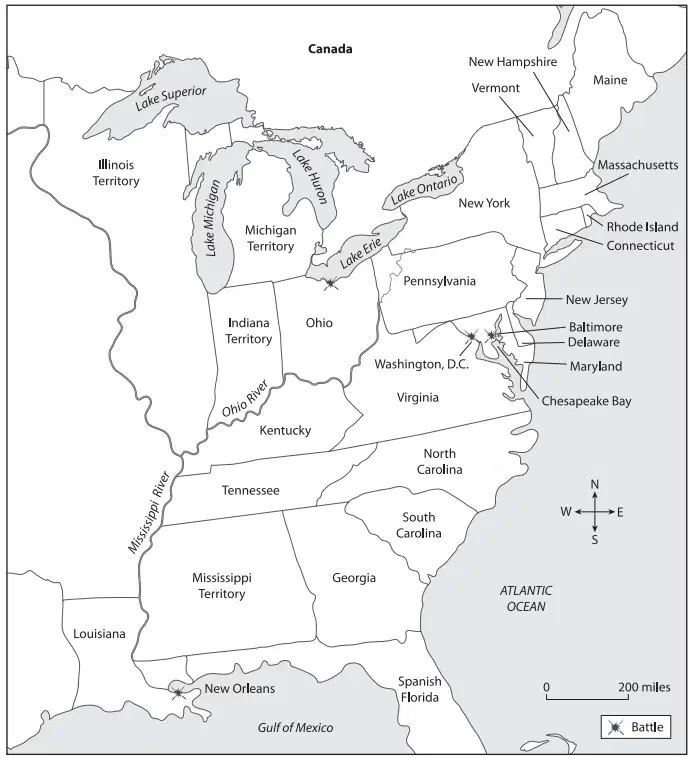
How did the British get to Washington, D.C.?
up the Ohio River
through Lake Erie
up the Mississippi River
through the Chesapeake Bay
impose your will on another country
impose an official ban on (trade or a country or commodity)
To send something to another place
To move something
To take a hike
In response to Latin American countries declaring independence from Spain, the United States issued:
the Neutrality Proclamation
the Tariff of Abominations
the Monroe Doctrine
a declaration of war
Seizing people against their will and forcing them to serve in the military
Impressment
Manufacturing
Embargo
Nullify
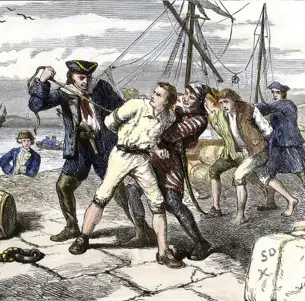
Which of the following is a cause of the War of 1812?
French naval attacks on U.S. harbors
British invasions of countries allied with the United States
French embargoes on trade with the United States
British impressment of U.S. sailors
Which Supreme Court case affirmed the supremacy of federal law over state law in 1819?
Marbury v. Madison
Brown v. Board of Education
McCulloch v. Maryland
Roe v. Wade

Which of the following best completes the diagram above?
Boston Tea Party
War of 1812
American Revolution
Civil War
How did the War of 1812 most affect the U.S. economy?
Disruption in trade contributed to domestic industrial growth
Small farmers benefited from higher export prices for grain crops
The sale of treasury bonds to international companies was prohibited
New trade alliances resulted in increased foreign investment
Which act did Congress write hoping to force the British and French to lose money?
Espionage Act
Embargo Act
Sedition Act
Trade Agreement Act
What treaty was signed by Great Britain and the United States to officially end the War of 1812?
Treaty of Appomattox
Treaty of Versailles
Treaty of Tippecanoe
Treaty of Ghent

What city was almost completely destroyed by fire by our enemy in the War of 1812?
Washington
Boston
Washington DC
Philadelphia
A strong belief that your own country and common culture are the most important.
Impressment
Embargo
Nationalism
Monroe Doctrine
What stated that the US wouldn't interfere with any existing European colonies in the Americas and America are not to be considered as subjects for future colonization by any European powers?
American System
Missouri Compromise
Monroe Doctrine
Which battle was fought after the signing of the Treaty of Ghent?
Battle of Champlain
Battle of Lake Erie
relating to or originating within a country; nationally
precedent
diverse
domestically
debt
Protective ___________ were a major part of Clay's economic plan to encourage the growth of American manufacturing.
agriculture
shipping
tariffs
wars
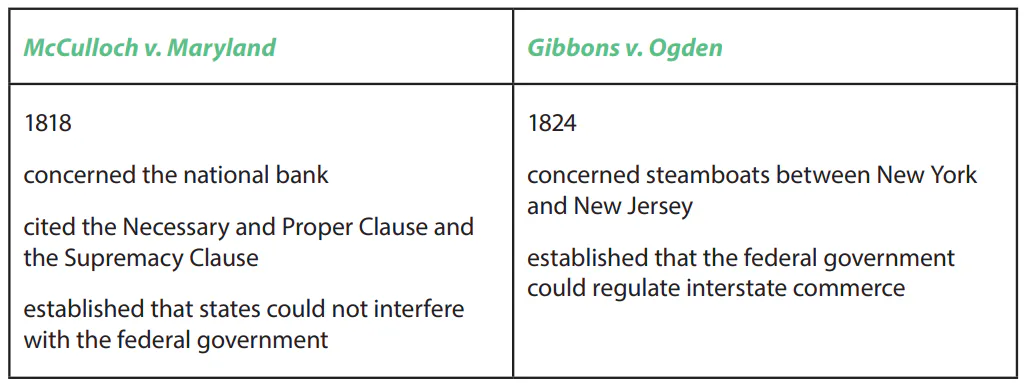
Which part of McCulloch v. Maryland was applicable to Gibbons v. Ogden?
banking on a national scale
the Necessary and Proper Clause
the Supremacy Clause
one party being an individual
Members of congress who wanted war with England
Whigs
Federalists
War Hawks
Democratic-Republicans

What city did Fort McHenry protect during the war. The place where the National Anthem was written.
Baltimore
New York City
Orlando
Washington DC
After the War of 1812 there was a feeling of
secession
compromises
nationalism
anger

War Hawks wanted to go to war with _______________________ .
Spain
France
Great Britain
Italy
Use the excerpt to answer the following question.
With the existing colonies or dependencies of any European power we have not interfered and shall not interfere. But with the Governments who have declared their independence and maintain it, and whose independence we have, on great consideration and on just principles, acknowledged, we could not view any interposition for the purpose of oppressing them, or controlling in any other manner their destiny, by any European power in any other light than as the manifestation of an unfriendly disposition toward the United States.
What United States position does this excerpt explain?
What were the three main parts of Henry Clay’s American System?
1. A strong banking system
2. A protective tariff
3. A network of roads and canals
1. A strong banking system
2. A protective tariff
3. A system of public schools
1. A free trade agreement
2. A protective tariff
3. A system of public schools
1. A national currency
2. A protective tariff
3. A network of roads and canals
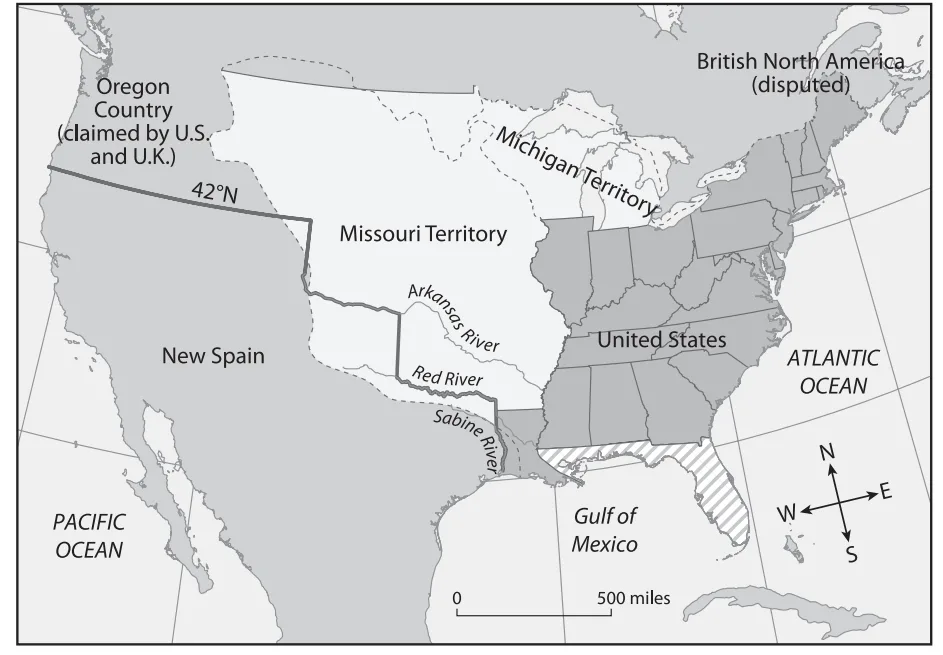
Based on this map, where did the United States give up land to New Spain?
north of 32° N
west of the Sabine River
west of 100° W
north of 42° N
Why did the Embargo Act of 1807 make Jefferson extremely unpopular?
It hurt merchants financially.
Which of the following phrases describe the “war hawks” associated with the War of 1812?
Select the two correct answers
Native Americans who fought during the War of 1812.
young men who had not taken part in the American Revolution
congressional politicians who wanted to enter the War of 1812
pirates who took part in the War of 1812 by bypassing blockades
British troops who burned American cities and destroyed American artifacts
What event boosted American manufacturing?
Invention of the railroad
The War of 1812
The Mexican-American War
Finding gold in California
Who enlisted the help of servants and enslaved workers to save many government records from the White House before the British burned it?
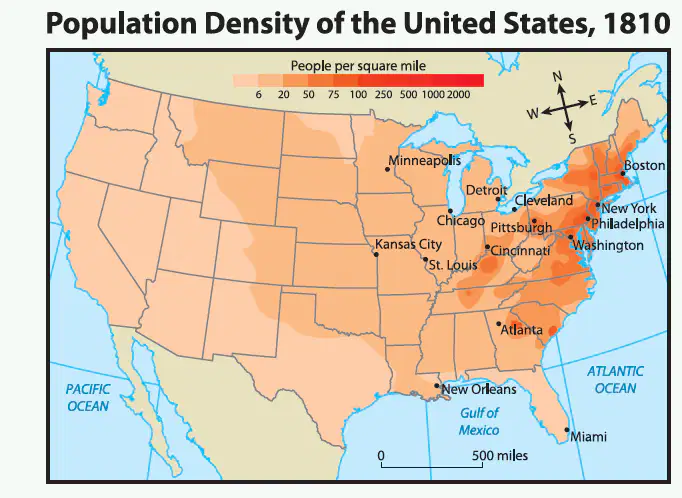
Use the map to answer the following question.
Based on this map, which of the following cities had the lowest population density?
Which political parties emerged in the 1820s? Select the two correct answers.
Democratic Party

