
NEW
Font size
 Worksheets
Lesson 7 - The War for Independence
Total questions: 20
Worksheet time: 10mins
Which of these was a weakness of the Continental army at the start of the war?
supply shortages
weak commander
unfamiliar territory
long travel distances
At the start of the war, what was a weakness of the British troops?
poor leadership
understaffed army
insufficient supplies
poorly trained soldiers
Why did many of the British people not support the war?
The king was unpopular.
They planned to move to America.
The cost to taxpayers was too high.
They wanted the Americans to have their independence.
What was the result of the American victories at Trenton and Princeton?
The Hessians joined the American side.
It showed that the Americans could defeat the British.
It proved that General Washington was wrong about his soldiers.
The British were forced to abandon New York and New Jersey.
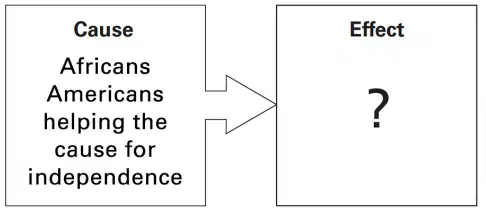
Which of these belongs in place of the question mark in the diagram below?
Slavery was abolished throughout the colonies.
Several colonies began to take steps to end slavery.
African Americans who fought were given their freedom.
African Americans were respected and their brave acts rewarded.
Why did African Americans join the Continental army?
They had excellent military skills.
They were generously paid to join the army.
They blamed Great Britain for their enslavement.
They hoped independence would lead to an end of slavery.
What caused the American defeat in Brooklyn, New York, in August 1776?
weak leadership
unmotivated troops
undisciplined enemy
inexperienced soldiers
Which word describes the “summer soldier and sunshine patriot”?
traitors
fighters
quitters
optimists
Which statement describes Washington’s military strategy after 1776?
to avoid battles with the British
to defeat the British in one large battle
to fight a defensive war and tire the British out
to prevent food and supplies from reaching the British
Which of these was an effect of the American victory at Saratoga?
British troops gained confidence.
General Burgoyne resigned his post.
Great Britain withdrew from Canada.
European countries came to the aid of America.
Which of these nations became an American ally after the victory at Saratoga?
France
Canada
Mexico
Germany
Which of these was a clear disadvantage for General Burgoyne in Albany, New York?
unfamiliar territory
not enough soldiers
insufficient supplies
poor communication
Which group prevented a British victory in the South?
Loyalists
mercenaries
French soldiers
guerrilla troops
Which of these describes the progress of the war?
The British won every battle until the final one.
All are correct
At the beginning, the Americans were outmatched, but their skills and tactics improved.
The Americans outnumbered the British, finally defeating them at the Battle of Yorktown.
How did the American Revolution impact other parts of the world?
It led to Great Britain giving up its other colonies.
It made other nations fearful of American strength.
It encouraged other nations to fight for their independence.
It made citizens of other nations fearful of a fight for independence.
In addition to independence, what did the Treaty of Paris give to the Americans?
British land in Canada
the right to punish the Loyalists
land east of the Mississippi River
the return of taxes paid to Great Britain

In which colonial region did the Battle of Yorktown take place?
New England
Southern
Middle
Western
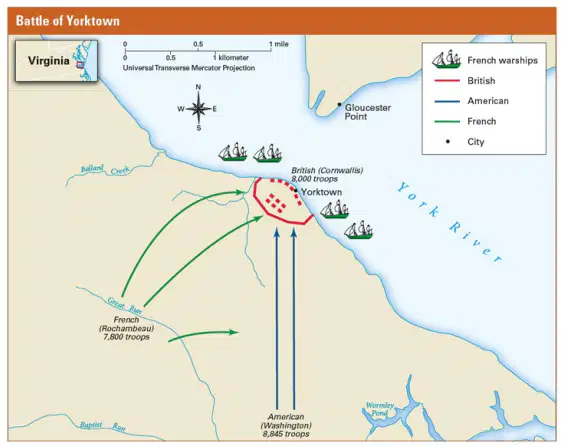
What prevented the British from being rescued by the British navy?
All are correct
French warships
Lack of supplies
American blockades
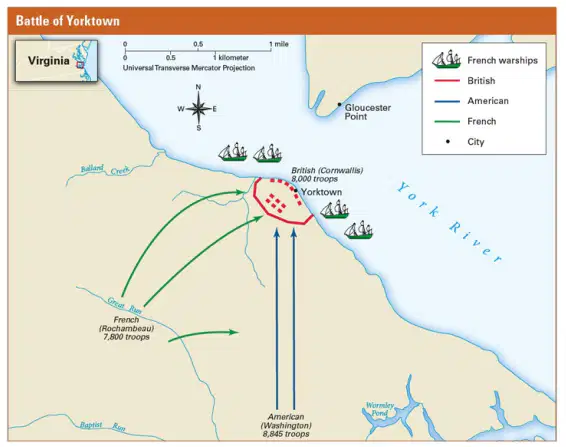
How were the British defeated at the Battle of Yorktown?
They ran out of ammunition
They were outnumbered by American troops
They were surrounded by American and French forces
They surrendered due to disease
What happened during the winter at Valley Forge?
soldiers were starving
soldiers were shirtless and barefoot
soldiers were trained by Friedrich von Steuben and Marquis de Lafayette
All are correct

