
 Worksheets
Texas History DCA #1 Review
Total questions: 75
Worksheet time: 2hrs 44mins
How did families influence the colonization of East Texas settlements?
Families settled permanently and helped to grow settlements into towns.
Families played a role in teaching native peoples at the settlements.
Families played a role in teaching native peoples at the settlements.
The presence of families lessened the tensions between friars and soldiers.
The Spanish Colonial era is defined by the building of which of the following
missions
railroads
presidios
towns
Why was the LaSalle expedition important to the Spanish?
Spain saw the French as a threat to Spain's claim on Texas.
The French set up successful settlements in Spanish Texas
Spain reacted by starting the process of colonizing Texas.
The first reaction was to hunt down LaSalle's people.
The missions often failed because
the soldiers refused to protect the missions.
wild animal attacks were common.
the priests and friars were not willing to work with the Native Americans.
the Native Americans were not interested in mission life.
Father Fransisco Hidalgo wrote to the governor of French Louisiana because
he was tired of the Spanish government refusing to rebuild the missions in East Texas.
he wanted permission to trade with the French in Louisiana.
he wanted a Popeye's franchise in Nacodoches.
he wanted the French to build a mission for the Tejas.
The settlement at San Antonio was built in 1718 because
it had good roads.
it was half-way between the Rio Grande and East Texas.
people liked the River Walk.
no one was living there.
Crop failures and disease killed many Native Americans at missions. This resulted in which of the following.
Missions grew because the Native Americans had faith in the missionaries.
Missions grew because so many settlers moved into the nearby towns.
Missions did not grow due to the setbacks.
Mission did not grow because Spain did not care about the success of the missions.
The European explorer who led an expedition in search of the “glittering cities” was —
Alonso Álvarez de Pineda
Francisco Vásquez de Coronado
René-Robert Cavalier, Sieur de LaSalle
Alvar Núñez Cabeza de Vaca

The Spanish colonists listed above primarily came to Texas in order to –
Oversee Spanish Presidios
Discover lost cities of gold
Establish Catholic missions
Learn native languages from Texas Indians
The founder of the first Spanish mission in East Texas was –
Damian Massanet
José de Escandón
Antonio Margil de Jesús
Francisco Hidalgo
Alonso Álvarez de Pineda –
Rene-Robert Cavelier, Sieur de LaSalle:

Which of the following best completes the timeline?
France claims Spanish missions, presidios, and pueblos
LaSalle's Fort St. Louis fails in East Texas; Spain renews its interest in Texas
American Indians are eager to occupy missions in East Texas
France increases effort to control northern and eastern Texas regions
Which is NOT a way the Spanish missions impacted the settlement of Texas?
Language
Food
Names of Places
Hairstyles

What was built to protect the Spanish priests and Native Americans?
Presidios
Missions
Churches
Barracks
What did the Spanish call the land we now call Mexico?
New Spain
New Madrid
The New World
Hispañola

Identify the Texas Region that is in blue.
Mountains and Basins
Great Plains
North Central Plains
Coastal Plains

Identify the Texas Region that is in red.
Mountains and Basins
Great Plains
North Central Plains
Coastal Plains

Identify the Texas Region in green.
Mountains and Basins
Great Plains
North Central Plains
Coastal Plains

Identify the Texas Region that is in yellow.
Mountains and Basins
Great Plains
North Central Plains
Coastal Plains

Which Texas Region has the most rivers?
Mountains and Basins
Great Plains
North Central Plains
Coastal Plains

Which Spanish Explorer was a medicine man, that was captured by the Karankawas, and documented his experiences in his journal about the land of Texas and its people?
Christopher Columbus
Alonzo Pineda
Cabeza De Vaca
LaSalle

Which Spanish Explorer mapped the Texas Gulf Coast in 1519?
Christopher Columbus
Alonso Pineda
Cabeza De Vaca
LaSalle

Which Texas region has the most precipitation?
Mountins and Basins
North Central Plains
Great Plains
Coastal Plains

Which Texas region has the least precipitation?
Mountains and Basins
Great Plains
Central Plains
Coastal Plains

When traveling EAST to WEST TEXAS, the elevation...
Increases
Decreases
How did the "First People of Texas adopt to their environment?
Tigua and Jumano made their houses from adobe.
Comanche and Apache roamed the Great Plains region due to the harsh climate during the winter.
The Caddo used the crop rotation system for their farming.
The Karankawa and Coaheletican fished for their food.
All of the Above

Which mission was founded in 1682, and was the first mission built in Texas near present day El Paso?
San Antonio de Valero
San Antonio de La Bahia
Yselta De Sur Pueblo
The Alamo
What are the 3 G's?
Goats, Grapes, and Grass
Gems, Gold, and Glory
God, Gold, and Glory
Guts, Ghosts, and Grit


Which region would i find the Palo Duro Canyon?
Coastal Plains
Mountains and Basins
Great Plains
Central Plains

Big Bend National Park is located in which region?
Great Plains
Coastal Plains
Mountains and Basins
Coastal Plains

The Caddo Indians called their tribes "Tejas". In English this means what?
Those who are friends
Live for each other
family
Eastern Texas

How did nomadic American Indian tribes meet their basic needs for food and shelter?
Shopping Online
Farming and ranching
Hunting and gathering
Earning wages through work

Which type of shelter did nomadic American Indian tribes often use?
Beehives
Pueblos
Huts
Teepees

What indian tribe was best known for hunting on horseback?
Comanche
Caddo
Karankawa
Apache

Coronado and other Spanish explorers were motivated to lead expeditions to North America because of the stories they heard about —
seven cities of gold
a giant sea monster
horses that could fly
an immortal native tribe
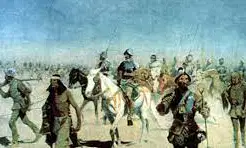
Which of these eras of Texas History was happening from 1500-1600?
Age of Contact
Mexican National Era
Texas Revolution
Republic of Texas

Which culture group lived in teepees, hunted the buffalo, and included the tribes of Apaches, Comanches, and Tonkawas?
Gulf
Pueblo
Plains
Southeastern

What religion was taught to Native Americans living in missions during the Spanish Colonial Era?
Islam
Catholicism
Methodist
Buddhism

These objects shown were very important to the lives of Native Texans. What impact did the have On Native ability to settle in one location?
The objects allowed them to dig and plant seeds more efficiently.
The objects allowed them to keep captured fish alive longer.
The objects allowed them to store and protect surplus crops.
The objects allowed them to cook maize or native corn.
The following items were found at an archaeological dig: dugout canoes, arrow heads, and can traps. Which Native Texan tribe lived at this settlement?
The Tonkawa
The Karankawa
The Caddo
The Coushatta
Which statement best describes Texans during the Natural Texas and Its People era?
The inhabitants had migrated to Texas from South America.
The inhabitants were Native Americans and Mexicans.
The inhabitants survived by hunting and gathering food.
The inhabitants named the region Tejas after the oldest tribe.

According to the map, where would the Jumano a Puebloan tribe live?
II
III
iV
I

According to the map, where would the Comanche a Plains tribe live?
II
III
IV
I

According to the map, where would the Coahuiltecan a Gulf tribe live?
II
III
IV
I

According to the map, where would the Caddo a Southeastern tribe live?
II
III
IV
!
The Tigua and the Jumanos were different than other native inhabitants of Texas because---
their houses were made from adobe.
their communities were led by woman.
they rode horses while hunting buffalo.
they grew amaranth instead of maize.
The Apache and the Comanche were different than other native inhabitants of Texas because---
their houses were made from adobe.
their communities were led by woman.
they rode horses while hunting buffalo.
they grew amaranth instead of maize.
What is the most arid region of Texas, it has cool nights and hot days?
North Texas
West Texas
Central Texas
Coastal Texas
How did Europeans increase their knowledge of Texas in 1519?
Alonso Alvarez de Pineda of Spain was the first European to see Texas.
Alonso Alvarez de Pineda of Spain mapped the Texas coastline.
Juan Ponce De Leon and Diego Velasquez were the first Europeans to see Texas.
Juan Ponce De Leon and Diego Velasquez were the first Europeans to explore Texas.
The ability of the Caddo to grow a surplus of crops allowed them to---
follow buffalo herds for a longer period of time.
establish more permanent settlements, like villages.
eat only agricultural crops
sell their crops of maize to other tribes for money

Analyzing the map above, which physical geographic feature influenced where the missions
and presidios were built in Texas?
mountains
cities
rivers
heavy rainfalls
Which major Texas city was founded by Spanish colonists in 1718?
San Antonio
El Paso
Laredo
Corpus Christi
Which generalization about the establishment of towns is best supported by evidence on the map?
Towns were mainly located along the Rio Grande River.
Towns were well established before the building of the missions.
Towns developed in the mountainous regions of Texas.
Towns tended to grow near the location of missions and presidios
Missions were used to claim land
True
False

What is an example of Texans adapting to their environment in the dry and hot regions of Texas?
People cut down trees in the rainforest to build homes
People built adobe houses because there were few or no trees.
Families built log cabins using the many trees found on the plains.
Anglo families hired Native Americans to build brick homes.


How did the Native Americans adapt to their environment?
By relying on the natural resources and materials around them
By copying European practices
The Natives did not rely on natural resources
By praying to their gods for food and water

Most major cities in Texas are near...
Waterways for transportation
Animals for food
Cotton farms
Which of these explorers landed at Matagorda Bay while searching for the mouth of the Mississippi River? (HINT: He's French)
Rene-Robert Cavelier Sieur de La Salle
Álvar Núñez Cabeza de Vaca
Francisco Vásquez de Coronado
Which economic activity of missions thrived in the physical geography and environment of central Texas?
Ranching
Trading
Fishing
What physical feature is common in both the Great Plains and the Coastal Plains regions of Texas?
Flat land suitable for farming or ranching
Both are near water
Both have high elevations
Which motivation led early European explorers to investigate the Americas?
Desire to find gold
Spread democracy
To have fun
Which sequence of events is in correct chronological order? (first to last)
Pineda maps Texas
Cabeza de Vaca reports on Texas
La Salle establishes Fort St. Louis
La Salle establishes Fort St. Louis
Cabeza de Vaca reports on Texas
Pineda maps Texas
Cabeza de Vaca reports on Texas
La Salle establishes Fort St. Louis
Pineda maps Texas

Which number on the map is the Red River?
1
2
3

Letter B on the map is which city?
Dallas
Houston
Richardson

The letter C (the star) is which city
El Paso
Austin
Richardson
Letter E on the map is which city?
Dallas
Houston
Richardson
El Paso
What mission is also known as the Alamo?
Nuestra Senora de la Limpia Concepcion del Socorro
San Franciso de los Tejas
San Antonio de Valero
Nuestra Senora del Refugio
Which of the following was NOT one of the main activities that people engaged in at the missions?
education
oil production
religious activities
work
What region is the coldest region in Texas?
Central Plains
Coastal Plains
Great Plains
Mountains and Basins
Which is the correct sequence of eras?
Natural Texas and It's People, Age of Contact, Spanish Colonial
Natural Texas and It's People, Mexican/American War, Spanish Colonial
Texas Revolution, Age of Contact, French Colonial
Age of ContactNatural Texas and It's People, Spanish Colonial

