
NEW
Font size
S
M
L
XL
 Worksheets
Test 1 part B
Total questions: 28
Worksheet time: 14mins
Name
Class
Date
1.
This symbol X:
a)
raises a pitch by one half step.
b)
raises a pitch by one whole step.
c)
lowers a pitch by one half step.
d)
lowers a pitch by one whole step.
2.
F to F# is a(n):
a)
whole step.
b)
diatonic half step.
c)
chromatic half step.
d)
enharmonic.
3.
A to Bb is a(n)
a)
whole step.
b)
diatonic half step.
c)
chromatic half step.
d)
enharmonic.
4.

Which pattern of whole steps (W) and half steps (H) matches the musical example? (The Xs represent intervals other than half and whole steps.)
a)
X H H W X X W H W W H
b)
X H H H X X H H W W H
c)
X H H W X X W W H H W
5.
How many half steps are between A and C?
a)
2
b)
3
c)
4
d)
5
6.
How many whole steps are between A2 and B2?
a)
0
b)
1
c)
2
d)
4
7.

How many whole steps are between the keys marked with an X?
a)
3
b)
4
c)
8
d)
10
8.
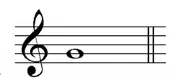
Which is a half step below the given note?
a)
F
b)
F#
c)
Ab
d)
A
9.

Which is a whole step below the given note?
a)
Eb
b)
E
c)
F#
d)
G
10.
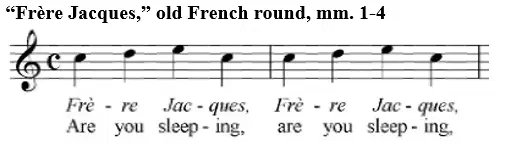
Count the number of intervals that are one half step or one whole step in the excerpt. (Do not count the interval from E to C in your final answer.)
a)
0 half steps, 4 whole steps
b)
4 half steps, 4 whole steps
c)
6 half steps, 2 whole steps
d)
8 half steps, 0 whole steps
11.
The interval from F# to G# is a:
a)
half step.
b)
whole step.
c)
neither.
12.
Which of the following represents sounding pitches from highest to lowest?
a)
Cx-C#-C-Cb-Cbb
b)
Cbb-Cb-C-C#-Cx
c)
Cb-C-C#-Cx-Cbb
d)
Cx-C-C#-Cb-Cbb
13.
A musical work's primary pulse is called the:
a)
tempo
b)
meter
c)
beat
d)
rest
14.
Simple meter means:
a)
the beats group into twos.
b)
the beats group into threes.
c)
the beats divide into twos.
d)
the beats divide into threes.
15.
A musical work's secondary pulse is called the:
a)
beat.
b)
beat division.
c)
simple meter.
d)
tempo.
16.
A work's meter indicates:
a)
how beats are grouped.
b)
how beats are divided.
c)
how beats are divided and grouped.
d)
whether there are beats.
17.
Duple meter means:
a)
the beats groups into twos.
b)
the beats group into threes.
c)
the beats divide into twos.
d)
the beats divide into fours.
18.
Quadruple meter means:
a)
the beats group into twos.
b)
the beats group into threes.
c)
the beats group into fours.
d)
the beats group into fives.
19.
Triple meter means:
a)
the beats group into twos.
b)
the beats groups into threes.
c)
the beats divide into twos.
d)
the beats divide into threes.
20.
Tempo is:
a)
often notated in Italian.
b)
the speed of beats in music.
c)
conveyed by the conductor.
d)
all of the above.
21.
Which indicates a slow tempo?
a)
presto
b)
allegro
c)
adagio
d)
vivace
22.
The downbeat always occurs on beat:
a)
1
b)
2
c)
3
d)
4
23.
Which of the following marks indicates the loudest dynamic level?
a)
piano
b)
mezzo piano
c)
mezzo forte
d)
forte
24.

Identify the type of note.
a)
half note
b)
quarter note
c)
eighth note
d)
sixteenth note
25.

Identify the type of note.
a)
half note
b)
quarter note
c)
eighth note
d)
sixteenth note
26.

Identify the type of note.
a)
whole note
b)
half note
c)
quarter note
d)
eighth note
27.

Which part of the note is circled?
a)
beam
b)
flag
c)
dot
d)
notehead
28.

Identify the type of note:
a)
half note
b)
quarter note
c)
eighth note
d)
sixteenth note
Reset

