
 Worksheets
Light
Total questions: 60
Worksheet time: 1hrs 3mins
Bouncing of a light ray when it strikes a reflecting surface is called.........
Refraction
Dispersion
Reflection
Diffraction
Caleb is sitting near the window on a sunny day. When he closes the curtain, the room becomes darker. What property of the curtain allows it to make the room darker?
The curtain absorbs light.
The curtain is brightly colored.
The curtain folds easily.
The curtain is rectangular shape.
Light travels in straight lines until reflected by another object. Which illustration best shows the light being reflected?


The angle of incidence is _________ the angle of reflection


In the diagram, which letter represents the angle of incidence?
A
B
C
D
The path of light is always straight and never curved.
True
False
May be true or false
None of these
Due to the reflection of light, the impression of an object formed in a mirror is called the ___ of the object
Image
shadow
Light
Does light need a medium to travel?
|Yes
No


Frosted glass is made of glass with an etched surface. How would you describe the glass as light travels through it?
Translucent
Transparent
Opaque
Diffraction
Light waves cannot travel completely through the following?
Air
rock
water
vacuum
A ray of light falling on a mirror is called _______________.
reflected ray
normal ray
emergent ray
incident ray
The angle between the incident ray of light and the ray reflected from a plane mirror is 70°. The angle of incidence will be:
70°
30°
35°
90°
The angle of incidence of light on a plane mirror is 30°.The angle of reflection will be:
30°
60°
15°
0°
The angle of incidence on a plane mirror is 30°. The angle between the incident ray and the reflected ray is
30°
15°
60°
90°
The property due to which a light ray striking a surface is returned back into the same medium is called
refraction
reflex action
reflection
regression
A ray of light falling on a mirror, leaves the surface of the mirror and is then called ________.
reflected ray
normal
incident ray
refracted ray
The primary colours are
Red, Blue and Yellow
Magenta, Yellow and Cyan
Red, Blue and Cyan
Blue, Green and Red
A perpendicular drawn on the point of incidence of light on the surface of a mirror is called ________.
incident ray
reflected ray
normal
none of these
When a ray of light strikes a plane mirror along the normal, the angle of incidence is __________.
90°
zero degree
45°
none of these
A celestial body of ice, dust, and rock with an elongated and elliptical orbit.
Asteroid
comet
moon
planet
Between which 2 planets do we find the asteroid belt?
Mercury and Jupiter
Earth and Mars
Mars and Jupiter
Jupiter and Saturn
The biggest asteroid is ______
Proxima Centauri
Ceres
Earth
None
Asteroids are like
Stars
Planets
Asteroids are lumps of ____
Rock
Ice
Gas clouds
None
For planets, diameter is mentioned which tells us about the size of planet. Why the diameter is not mentioned for asteroid?
Because asteroid is not a square
Because asteroid is not a sphere
Because asteroid is not a triangle
If you wanted to find an asteroid with a telescope,
where would be the best place to look?
Between Earth and Venus
Between Jupiter and Saturn
Between Mars and Jupiter
Between Saturn and Uranus
A large object orbiting a star
Sun
Astroids
Planet
Meteorite
Force pulling objects toward one another
Galaxy
Gravity
Gas
Dust
Large mass of stars
Universe
Solar System
Galaxy
Planet
The bending of light at the interface of two different mediums is
Reflection
Magnification
Refraction
Polarization
A ray of light travelling from glass slab to Air, then the refracted ray bends
Towards normal
At normal
Away from the normal
Reflect back to the same medium
A ray of light passes from a medium X to another medium Y. No refraction of light occurs if the ray of light hits the boundary of medium Y at an angle of:
120 degree
90 degree
45 degree
Zero degree

What is the angle of reflection (θr) in the image?
56o
90o
124o
34o
Which of the following factors contributes to the bending of light?
Change of speed of light
Change of density of light
Change of colour of light
Change of energy of light
When the light passes out of the glass, back into the air
It bends away from the normal
It does not bend
It bends towards the normal
It continues to be the normal
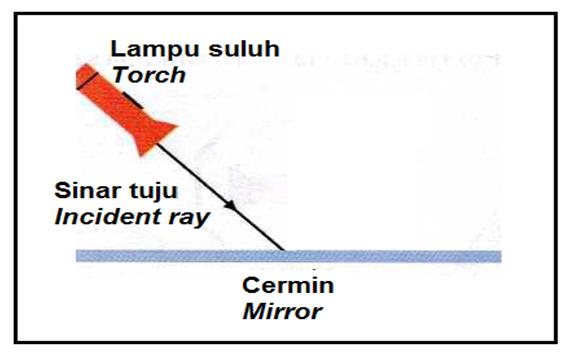
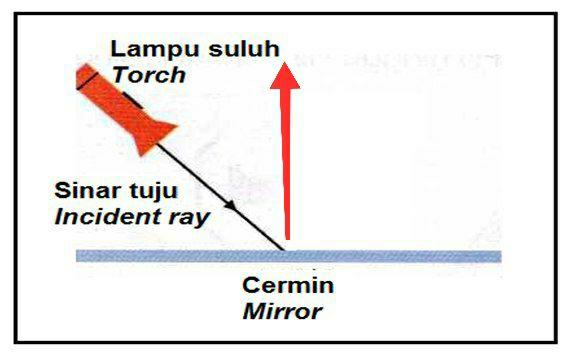
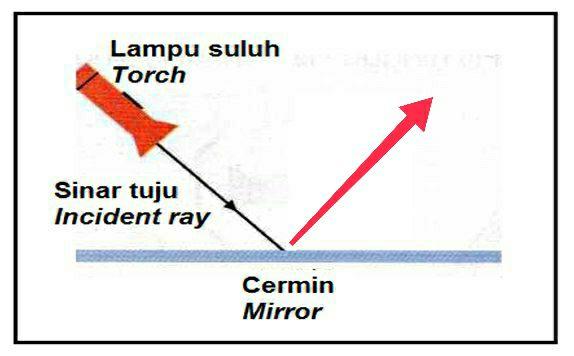
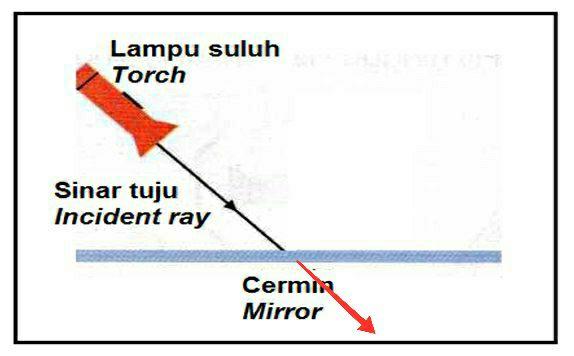
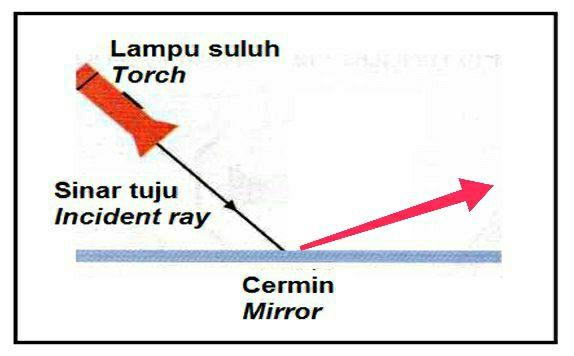
The following diagram shows the ray diagram when a torch light is torched towards a mirror. Which of the following is the correct reflected ray?
What is the angle of reflection (θr) in the image?
56o
90o
124o
34o

Why doesn’t the surface of a wooden boat reflect light as the surface of water does?
Because the boat's surface is rough and absorbs more light.
Because the surface of the boat is red, not blue.
Because the boat is not a natural object like the water is.
Because the boat is on top of the water's surface.

If the angle of incidence in the diagram is 50 degrees, which statement is true?
The angle of reflection is 40 degrees because is is measured from the normal line, which is 90 degrees
The angle of reflection is 50 degrees because it is equal to the angle of incidence.
The angle of reflection is 60 degrees, because it is greater than the angle of incidence.
The angle of refraction is 50 degrees, because it is equal to the angle of incidence.
Explain how a prism works based on refraction.
A prism works based on refraction by reflecting light instead of bending it.
A prism works based on refraction by bending light as it enters and exits the prism due to the change in speed caused by entering a denser medium.
A prism works based on refraction by speeding up light as it enters and exits the prism.
A prism works based on refraction by absorbing light and emitting it at a different angle.
Describe the phenomenon of dispersion of light.
Dispersion of light is the phenomenon where light is separated into its constituent colors due to the different wavelengths of each color.
Dispersion of light is the bending of light due to a change in medium.
Dispersion of light is the reflection of light off a surface.
Dispersion of light is the absorption of all colors by a medium.
What is reflection of light?
Reflection of light is the process where light bounces off a surface, changing direction but not its wavelength.
Reflection of light is the emission of light from a source.
Reflection of light is the bending of light waves around an object.
Reflection of light is the absorption of light by a surface.
Define angle of incidence and angle of reflection.
Angle of incidence is the angle between the incident ray and the reflected ray.
Angle of reflection is the angle between the incident ray and the normal to the surface.
Angle of incidence is the angle between the reflected ray and the normal to the surface.
Angle of incidence is the angle between the incident ray and the normal to the surface at the point of incidence. Angle of reflection is the angle between the reflected ray and the normal to the surface at the point of reflection.
Explain the difference between regular and diffuse reflection.
Regular reflection occurs only in vacuum, while diffuse reflection occurs in any medium.
Regular reflection involves the bending of light rays, while diffuse reflection involves the absorption of light rays.
Regular reflection involves smooth surfaces reflecting light rays at the same angle, while diffuse reflection involves rough surfaces reflecting light rays in various directions.
Regular reflection is a form of refraction, while diffuse reflection is a form of diffraction.

