
 Worksheets
Unit 1: Prehistory and Early Humans Exam
Total questions: 20
Worksheet time: 10mins
Name
Class
Date
1.
Almost all humans in the Paleolithic Age ____________.
a)
a. were hunters and gatheres
b)
b. were nomadic
c)
c. used simple stone tools
d)
d. all of the above
2.
What type of lifestyle did people in the Paleolithic period lead?
a)
a. Settled in villages
b)
b. Nomadic and constantly moving
c)
c. Hunting in one place
d)
d. Trading goods in cities
3.
Which material was most important for making tools in the Paleolithic period?
a)
a. Bronze
b)
b. Iron
c)
c. Stone
d)
d. Copper
4.
What was the greatest benefit when people began farming?
a)
a. They had more time to relax
b)
b. They had better-tasting food
c)
c. They had a larger and more stable supply of food
d)
d. They had enough water for crops
5.
Which is true about the Neolithic Era? Select two correct answers.
a)
a. metal tools had to be invented before agriculture was possible
b)
b. agriculture created food surpluses that allowed large groups to live in one place
c)
c. the invention of agriculture ended the Stone Age
d)
d. agriculture allowed people to live in permenent settlements
e)
e. agriculture caused populations of humans to decrease
6.
What was one of the major technological advancements during the Paleolithic period?
a)
fire
b)
pottery
c)
agriculture
d)
domestication
7.
What marked the beginning of the Neolithic period?
a)
a. The invention of writing
b)
b. The discovery of fire
c)
c. The development of agriculture and domestication
d)
d. The creation of cave art
8.
Why did people live in larger communities in the Neolithic era than in earlier times?
a)
a. They needed more people for hunting and gathering
b)
b. They could grow more food to feed more people
c)
c. They created better ways of getting along with other people
d)
d. They could trade their crops with other communities
9.
How did having a surplus of food help early communities?
a)
a. It allowed some people to stop farming and specialize in other work
b)
b. It made people leave their villages
c)
c. It forced everyone to farm more
d)
d. It made trading unnecessary
10.
Which situation below is an example of domestication?
a)
a. a person exchanges a basket of wheat for a basket of apples
b)
b, a person creates fire by striking two rocks together
c)
c. a person spins the wool sheared off a sheep
d)
d. a person creates a stone tool
11.
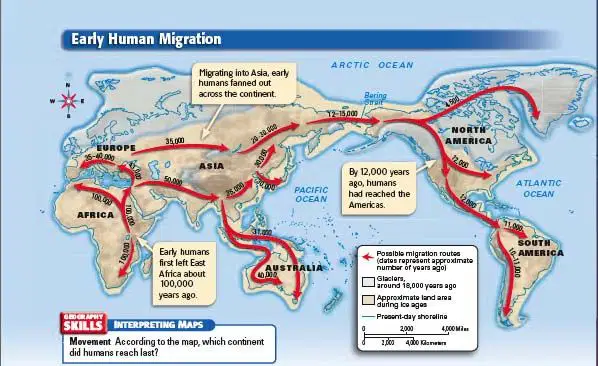
Study the map below. From what continent did early humans migrate?
a)
a. Asia
b)
b. Europe
c)
c. Australia
d)
d. Africa
12.
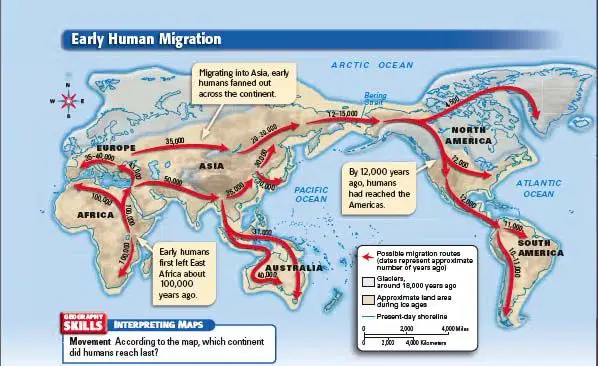
Study the map below. According to the map, what part of the world did humans reach last?
a)
a. Asia
b)
b. Europe
c)
c. Australia
d)
d. South America
13.
How did the environment influence the tools that nomadic people used?
a)
A. They used modern machines to hunt animals.
b)
B. They made tools from natural materials like stone, bone, and wood.
c)
C. They built factories to create metal tools.
d)
D. They used only tools made by other groups.
14.
How did the environment affect where nomadic people chose to live?
a)
A. They only lived in cities.
b)
B. They followed animals and plants based on the seasons.
c)
C. They stayed in one place and built large homes.
d)
D. They always lived by the ocean.
15.
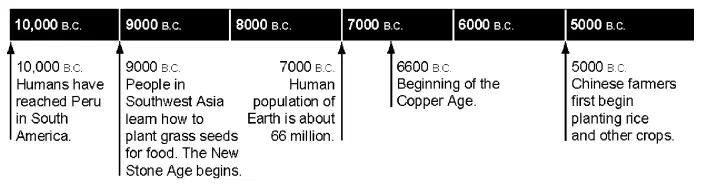
When did humans reach South America's Peru?
a)
a. 10,000 B.C.
b)
b. 5,000 B.C.
c)
c. 8,000 B.C.
d)
d. 6,000 B.C.
16.
How were the people able to cross the Bering Strait?
a)
a. They walked on the frozen water.
b)
b. They walked on dry land that had been covered up by the Bering Strait before the Ice Age.
c)
c. They sailed in a boat.
d)
d. They walked on the ice.
17.
The land bridge connected what 2 continents?
a)
a. North and South America
b)
b. Asia and Africa
c)
c. Hawaii and Alaska
d)
d. North America and Asia
18.
Why is it believed the Native Americans walked over the land bridge into North America?
a)
a. They wanted to move.
b)
b. They were following their food.
c)
c. They were looking for other people.
d)
d. They were lost.
19.
According to this passage, nomads are people who:
a)
a. Developed writing
b)
b. Communicated with sign language
c)
c. Traveled from place to place
d)
d. Were farmers
20.
The hunter-gatherer way of life made it impossible for people to live:
a)
a. In groups
b)
b. In cold climates
c)
c. Without a spoken language
d)
d. In permanent homes
100 %

