
 Worksheets
Rocks Test
Total questions: 23
Worksheet time: 12mins
The process in which layers of sedimentary rock are formed is called _____________________.
Composition
Deposition
Stratification
Erosion
A rock whose mineral grains are NOT formed in bands is called______________________.
Foliated
Non-Foliated
Erosion
Deposition
Grains of sand are washed into rivers and oceans through the process of______________________.
Erosion
Deposition
Rock Cycle
Stratification
The minerals found in a rock determine its ______________________.
Stratification
Rock Cycle
Composition
Deposition
Rocks change their composition during the ______________________.
Stratification
Rock Cycle
Erosion
Composition
The process in which sediment is dropped and comes to rest is called:
Deposition
Stratification
Cementation
Foliation
Which of the following is a coarse-grained igneous rock?
Shale
Granite
Gneiss
Marble
Partially decomposed plant material forms:
Chemical Sedimentary Rock
Fossiliferous Limestone
Clastic Sedimentary Rock
Coal
When shale is exposed to slight heat and pressure, what foliated metamorphic rock does it become?
Schist
Gneiss
Phyllite
Slate
Please read the following passage and use it to answer the next 3 multiple choice questions. Passage 1 - The texture and composition of a rock can provide good clues about how and where the rock formed. Scientists use both texture and composition to understand the origin and history of rocks. For example, marble is a rock that is made when limestone is metamorphosed. Only limestone contains the mineral—calcite—that can change into marble. Therefore,wherever scientists find marble, they know the sediment that created the original limestone was deposited in a warm ocean or lake environment. 1. In the passage, what does the word "origin" mean?
Size or Appearance
Age
Location or Surroundings
Source or Formation
Passage 1 - Question 2 - Based on the passage, what can the reader conclude?
Marble is a Sedimentary Rock.
Limestone is created by sediments deposited in warm ocean or lake environments.
Marble is a rock that is made when sandstone has undergone metamorphism.
In identifying a rock, the texture of a rock is more important than the composition of the rock.
Passage 1 - Question 3 - What is the main idea of the passage?
Scientists believe Marble is the most important type of rock to study.
Scientists study the composition and texture of a rock to determine how the rock formed and what happened after it formed.
Some sediments are deposited in warm oceans or lakes.
When limestone undergoes metamorphism, it becomes Marble.
Passage 2 - Fulgurites are a rare type of natural glass found in areas that have quartz-rich sediments, such as beaches and deserts. A tubular fulgurite forms when a lightning bolt strikes material such as sand and melts the quartz into a liquid. The liquid quartz cools and solidifies quickly, and a thin, glassy tube is left behind. Fulgurites usually have a rough outer surface and a smooth inner surface. Underground, a fulgurite may be shaped like the roots of a tree. The fulgurite branches out with many arms that trace the zigzag path of the lightning bolt. Some fulgurites are as short as your little finger, but others stretch 20 meters into the ground. Question 1: In the passage, what does the word "tubular" mean?
Flat and Sharp
Round and Long
Funnel Shaped
Pyramid Shaped
Passage 2 - Question 2 - From the information in the passage, what can the reader conclude?
Fulgurites are formed above ground.
Sand contains a large amount of quartz.
Fulgurites are most often very small.
Fulgurites are easy to find in sandy places.
Passage 2 - Question 3 - Which of the following statements best describes a fulgurite?
Fulgurites are frozen lightning bolts.
Fulgurites are root-like rocks.
Fulgurites are glassy tubes found in deserts.
Fulgurites are natural glass tubes formed by lightning bolts.
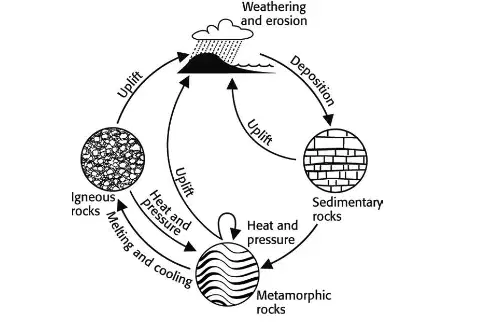
Please use the following diagram to answer the next 3 questions. Question 1 - According to the rock cycle diagram, which of the following statements is true?
Only sedimentary rocks get weathered and eroded.
Sedimentary rocks are made from metamorphic, igneous, and sedimentary rock fragments and minerals.
Heat and Pressure create igneous rocks.
Metamorphic rocks are created by melting and cooling.
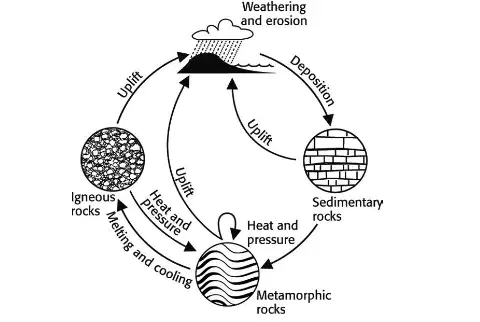
Question 2 - A rock exists at the surface of the earth. What would be the next step in the rock cycle?
Cooling
Weathering
Melting
Metamorphism
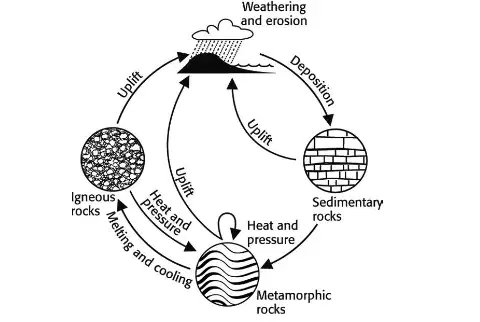
Question 3 - Which of the following processes brings rocks to the earth's surface where they can be eroded?
Burial
Deposition
Uplift
Weathering
What type of rock is formed when magma cools and solidifies?
Sedimentary
Metamorphic
Igneous
Fossiliferous
Which process involves the breaking down of rocks into smaller pieces?
Erosion
Weathering
Deposition
Cementation
What type of rock is formed from the cooling and solidification of lava on the Earth's surface?
Sedimentary
Metamorphic
Extrusive Igneous
Intrusive Igneous
What is the term for the process by which sediment is transported by wind, water, or ice?
Erosion
Deposition
Transportation
Stratification
Which type of rock is formed from the accumulation and compaction of sediment?
Igneous
Metamorphic
Sedimentary
Fossiliferous

