
 Worksheets
Algebra 2 9 Week TEST
Total questions: 67
Worksheet time: 3hrs 20mins


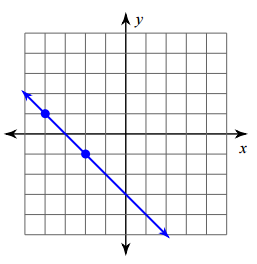
(6,7) and (4,2)
(2, 4) and (6, 12)
(10, 1) and (5, 2)


What is the slope-intercept form of the equation of a line?
y=yx+b
y=mx+b
x=yx+b
x=xy+b
What does the b mean in y=mx+b?
Slope
Nothing
x-intercept
y-intercept
(6,7) and (4,2)

What is the slope represented in the table?
slope: 21
slope: 2
slope: −21
slope: −2

What is the Slope represented in this table?
slope: −41
slope: −4
slope: 41
slope: 4
What is the slope of the line with the equation
y = −23x + 4
−23
23
4
−4
What is the y-intercept of the line with the equation
y = −2x + 4
−2
2
4
−4
what is the slope of the following 12x - 6y = 30
2
-2
12
-12

3x-6y=12
-3y + 5x = 12
what is the slope of y = 4 - 6x
4
6
-6
-4
which of the following is the best first step to solve for y = mx +b? equation is -2x - 4y = -12
add 4y to both sides
subtract 2x from both sides
add 2x to both sides
divide by -4
Identify which equations show direct variation and which do not.
y=2x
y=31x
y=3x−4
y=−6x
y=x
y=x2
y=4−x
y=7
Match each direct variation equation to the constant of variation, k.
y=−2x
-2
y=3x
3
y=41x
41
y=−5x
-5
y=2x
2

Does the given graph show a direct variation?
Yes
No
Do x and y show direct variation?
y = 2x + 3
Yes
No

Is this the graph of a direct variation?
Yes
No
Which is an example of direct variation?
xy = 10
y = x2
y = 5x
y2 = x
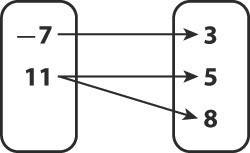
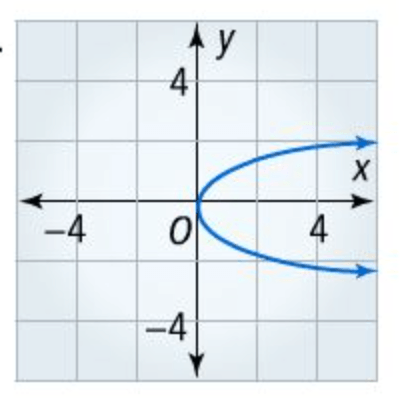


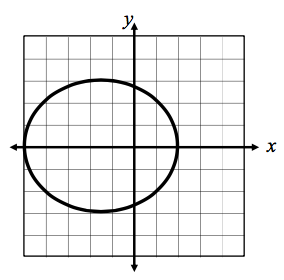
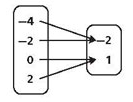
R: {-2, -2, 1, 1}
Function
R: {-2, 1}
Function
R: {-2, -2, 1, 1}
Not a Function
R: {-2, 1}
Not a Function
R: {0, 1, 2, -4}
R:{1, -3, -4}
R:{1, -3, -4}
What is the slope of the line, in the standard (x,y) coordinate plane, that is parallel to x + 5y = 9 ?
-5
-1/5
1/5
9/5
9
Which equations have a rate of change (slope) greater than 1?
y=2x+1
y=5x−2
y=21x+4
y=23x−7
x + 5y = -25
5x - 3y = -9
-3y + 5x = 12

4x - 8y = 72


Slope-Intercept Form?
(y = mx +b)

Slope-Intercept Form?
(y = mx +b)

Slope-Intercept Form?
(y = mx +b)

Convert the equation of the line
y + 5 = -3(x - 6)
into slope intercept form.
y = -3x - 23
y = -3x - 13
y = -3x - 11
y = -3x + 13
Write the following equation in slope intercept form:
y + 9 = 3(x - 1)
y = 3x + 12
y = 3x - 12
y = 3x - 6
y = 3x + 6
Convert the equation to slope-intercept form: y - 5 = 3 ( x + 2 )
y = 3x + 8
y = 3x + 11
y = 3x + 1
y = 3x - 8
Write the equation of a line with slope m = 3 that goes through the point (1,-5)
in point - slope form
y−5=3(x+1)
y+5=3(x−1)
y−3=−5(x+1)
y−1=3(x+5)
(-2, -1); m= -3

