
 Worksheets
7th Grade School-wide Assessment Q1#2
Total questions: 20
Worksheet time: 10mins
The balanced chemical equation below shows the decomposition of water into hydrogen and oxygen gas. 2H2O(l) → O2(g) + 2H2(g) How many atoms are in the reactants?
2
4
6
8
The balanced chemical equation below shows the decomposition of water into hydrogen and oxygen gas. 2H2O(l) → O2(g) + 2H2(g) How many atoms are in the products?
2
4
6
8
Ms. Trischitta measured the mass of a closed and sealed beaker containing several ice cubes. The mass was 100g. An hour later the ice cubes had melted, and Ms. Trischitta measured the mass of the beaker again. What was the mass of the beaker?
25g
50g
75g
100g

In the chemical reaction shown, all the HCl and Zn will react to form H2 and ZnCl2. Which of the following describes the results of this reaction?
The zinc chloride will have less mass than zinc.
The mass of the products will equal the mass of the reactants.
The mass of the hydrogen atoms will decrease in the products.
The mass of the hydrogen atoms will increase in the reactants.
Consider the reaction of sodium and water below and select all the correct statements about it. 2Na(s) + 2H2O(l) → 2NaOH(aq) + H2(g)2Na(s) + 2H2O(l) → 2NaOH(aq) + H2(g)
There are more sodium atoms in the reactants than in the products.
There are more hydrogen atoms in the reactants than in the products.
There are as many atoms in the reactants as there are in the products.
Mass is conserved throughout the reaction.
There is more hydrogen gas in the products than in the reactants.
The order of elements in the periodic table is based on
the number of protons in the nucleus.
the electric charge of the nucleus.
the number of neutrons in the nucleus.
atomic mass
As you move from left to right across the periodic table, elements
become less metallic.
have a lower atomic weight.
have a lower atomic number.
become more metallic.
Most elements are
metals.
metalloids.
nonmetals.
Semiconductors.

A mixture of two gases is in a rigid container at 25°C. The particle diagram shows a mixture of neon gas and argon gas. The temperature was decreased below the boiling point of each gas. Which diagram shows what would happen to the gas mixture?
A
B
C
D
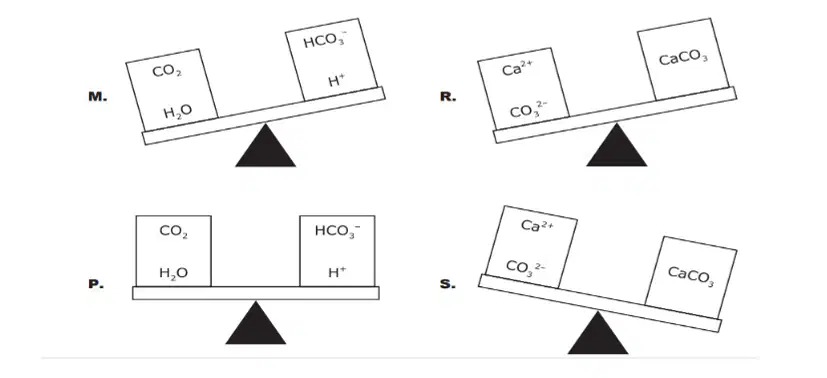
Which diagram correctly represents the mass of one of the chemical reactions?
M
P
R
S
A student was reading about the gases in air. Ozone helps protect Earth from harmful ultraviolet rays that come from the sun. Certain types of pollution created by humans have caused a hole in the ozone layer. This hole is over the South Pole and could become larger if this type of pollution increases. Which question should the student ask to determine if ozone is an elemental molecule? (7.PS1.2)
What is the color of the molecule?
What is the shape of the molecule?
What elements are present in the molecule?
How many atoms are present in the molecule?

A student has been learning about atoms. He wrote a small paragraph describing one. The student describes particles on the edge of the atom. Which statement supports the student’s claim that the particles on the edge of the atom do not move away from the center? (7.PS1.1)
The particles are connected to the center by an object similar to a rope.
The particles are attracted to the center because they have a charge opposite to the center’s charge.
The particles are held in place because atoms are a solid structure.
The particles are pushed toward the center by the nuclear charges of other atoms.
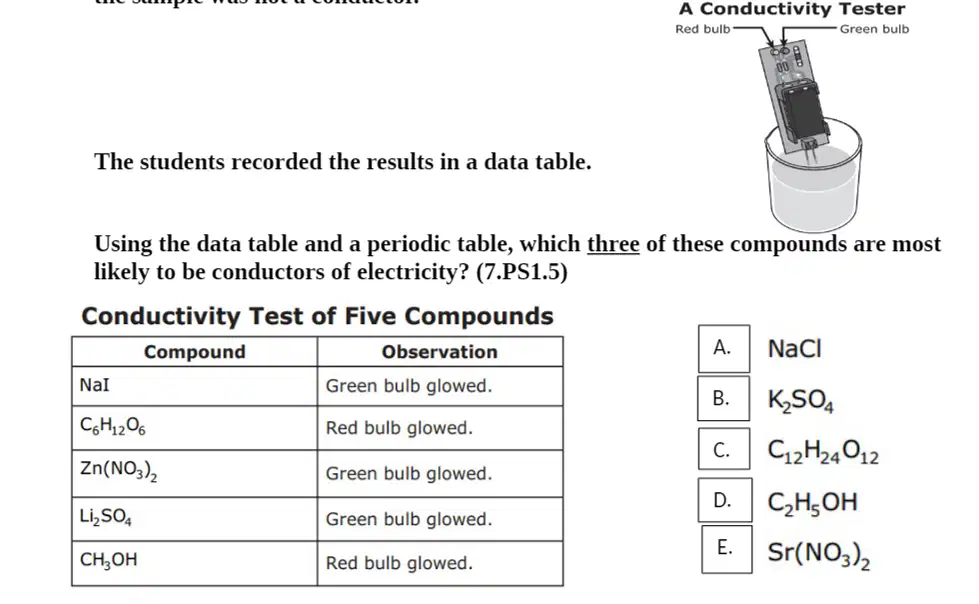
Using the data table and a periodic table, which three of these compounds are most likely to be conductors of electricity? (7.PS1.5)
NaCl
K2SO4
C12H24O12
C6H12O6
Sr(NO3)2
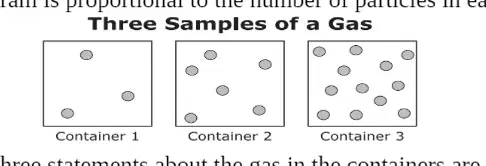
Which three statements about the gas in the containers are true? (7.PS1.6)
The gas particles in Container 1 will be the easiest to compress.
The gas particles in Container 3 will be the hardest to compress.
The gas particles in Container 2 will move faster than the gas particles in Container 1.
The gas particles in Container 3 will move slower than the gas particles in Container 1.
If the temperature is decreased in each container, the pressure will decrease in each container.
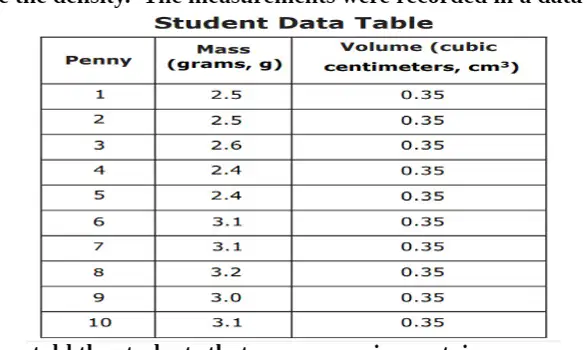
Students were looking at coins during lunch. One of them noticed that older pennies looked and felt different from new pennies. The students decided to investigate whether all pennies are made of the same materials. The students measured the mass and the volume of 10 pennies and then divided the mass by the volume to determine the density. The measurements were recorded in a data table. The teacher told the students that newer pennies contain copper and zinc. Copper has a density of 8.96 g/cm³. Zinc has a density of 7.1 g/cm³. Which statement is best supported by the data and information from the teacher?
All pennies are pure copper.
All pennies have the same amount of copper since their volume is the same.
Pennies 1 through 5 are mostly copper because the mass of copper is less than the mass of zinc.
Pennies 6 through 10 are mostly copper because their density is closer to copper’s density.
Which of the following can indicate that a chemical change has occurred?
burning
color change
light is emitted
a change in smell or taste
temperature change
Which increase in temperature would require the most thermal energy? Assume all the H₂O (water, ice or water vapor) samples are the same size and that temperature changes occur at standard pressure.
heating water from 10 to 12 °C
heating ice from -1 to 1 °C
heating steam from 105 to 107 °C
heating ice from -20 to -18 °C
Lily is doing a science experiment with a substance in a sealed jar. At first, the substance’s molecules are moving around each other. What will happen to Lily’s substance if she transfers energy into the substance and causes a phase change? After the phase change, the substance’s molecules will move . . .
faster, and the substance will be a liquid.
faster, and the substance will be a gas.
slower, and the substance will be a solid
slower, and the substance will be a liquid.
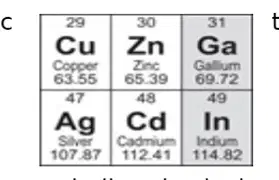
Here is a portion of the periodic table. Which two elements are most likely to have similar physical properties?
Copper and Zinc.
Copper and Silver
Cadmium and Indium
Gallium and Cadmium
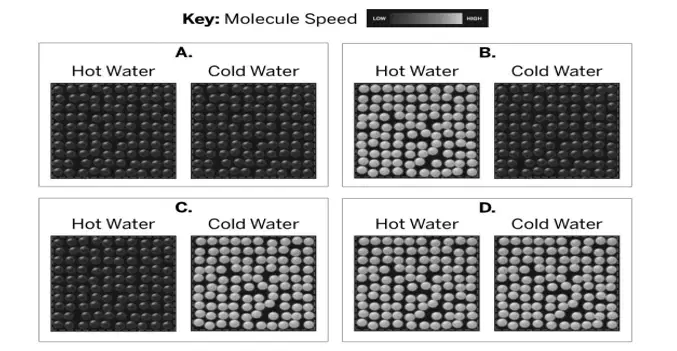
It can be difficult to show what particles are actually doing because we can’t see them. One way to model particles is shown. Study the diagram and choose the correct statement. Which image correctly represents the hot and cold-water particles?
A
B
C
D

