
NEW
Font size
 Worksheets
Matter Review Honors
Total questions: 47
Worksheet time: 24mins
Matter that has a definite volume and a definite shape is a .
solid
liquid
gas
plasma
The amount of energy needed to change a material from a liquid to a gas is the heat of
evaporation
fusion
vaporization
condensation
The maximum amount of a solute that can be dissolved in a given amount of solvent is its
dilution
solubility
concentration
density
When two or more substances are physically combined, the result is a(n)
chemical change
element
compound
mixture
The air that you breathe is an example of a(n) solution
solid
liquid
gaseous
plasma
As a sample of matter is heated, its particles
are unaffected
move more quickly
move more slowly
stop moving
The most common state of matter in the universe is
solid
liquid
gas
plasma
The color of ink is a
physical change
physical property
chemical change
chemical property
Three examples of physical changes are
sawing wood, crushing a can, and burning a marshmallow
burning of gasoline, rotting an egg, and exploding fireworks
freezing of water, evaporation of gasoline, and rusting of a nail
boiling of water, blowing up a balloon, and melting a candle
In a solution, the substance that is being dissolved is the
solute
solvent
liquid
gas
Which of the following is not a physical property?
Color
Odor
State
Reactivity with oxygen
Matter in which the particles are free to move in all directions until they have spread evenly throughout their container is a
solid
liquid
gas
plasma
is another name for a homogeneous mixture
Liquid
Substance
Suspension
Solution
Which of the following will speed up the dissolving of a solid in water
Cool the solution
Grind up the solvent
Freeze the solute
Stir the solution
The amount of energy needed to change a material from the solid state to the liquid state is the heat of
condensation
vaporization
fusion
evaporation
Increasing the surface area of a solid
increases the speed of dissolving
causes the solid to ionize
has no effect on the speed of dissolving
slows the speed of dissolving
In which phase of matter are the molecules of the substance farthest apart from each other?
solid
liquid
gas
crystal
A solution that contains all of the solute it can normally hold at a given temperature is
saturated
unsaturated
supersaturated
diluted
A flask containing molecules of gas A and a separate flask containing molecules of gas B are both at the same temperature. Gases A and B must have equal
volumes
masses
pressure
average kinetic energies
Hydrogen, gold, and iron are all examples of
homogeneous mixtures
heterogeneous mixtures
elements
compounds
A type of matter formed by chemically joining two or more elements is known as a
compound
solution
colloid
suspension
Which shows the Tyndall effect
colloids
solutions
elementscompounds
compounds
Which term best describes when particles escape from the surface of a liquid and become gaseous?
sublimation
evaporation
vaporization
deposition
Water’s makes it an excellent solvent for salts like sodium chloride, as well as other substances required to carry out metabolic processes.
pH
specific heat
polarity
density
A solution that contains more of the solute than it can normally hold at a given temperature is
saturated
unsaturated
supersaturated
mega-saturated
Which of the following liquids would be the most viscous
syrup
water
lemonade
soda
The Law of Conservation of Mass states
Mass never stays constant
Mass is always added during a chemical change
Mass is always lost during a chemical change
Mass is not lost or created during a chemical change
What type of mixture is saltwater?
homogeneous
heterogeneous
What type of mixture is salad dressing?
homogeneous
heterogeneous
What type of mixture is Peanut butter?
homogeneous
heterogeneous
What type of mixture is Trail mix?
homogeneous
heterogeneous
What type of mixture is Lemonade?
homogeneous
heterogeneous
Fragrance of a flower is a
physical change (PC)
chemical property (CP)
chemical change (CC)
physical property (PP)
Burning popcorn and making water is a
chemical change (CC)
physical change (PC)
chemical property (CP)
physical property (PP)
Flammability of a substance is a
physical property (PP)
chemical property (CP)
physical change (PC)
chemical change (CC)
Inflating a tire is a
physical property (PP)
chemical property (CP)
physical change (PC)
chemical change (CC)
Boiling water is a
physical property (PP)
chemical property (CP)
physical change (PC)
chemical change (CC)
Density of an object is a
physical property (PP)
chemical property (CP)
physical change (PC)
chemical change (CC)
Sharpening a pencil is a
physical property (PP)
chemical property (CP)
physical change (PC)
chemical change (CC)
Rusting of a fishing pole is a
physical property (PP)
chemical property (CP)
physical change (PC)
chemical change (CC)

Label #1 from the picture
solid
liquid
gas
boiling point
Label #2 from the picture
solid
liquid
gas
melting point
Label #3 from the picture
solid
liquid
gas
melting point
Label #4 from the picture
solid
liquid
gas
boiling point
Label #5 from the picture
solid
liquid
gas
boiling point
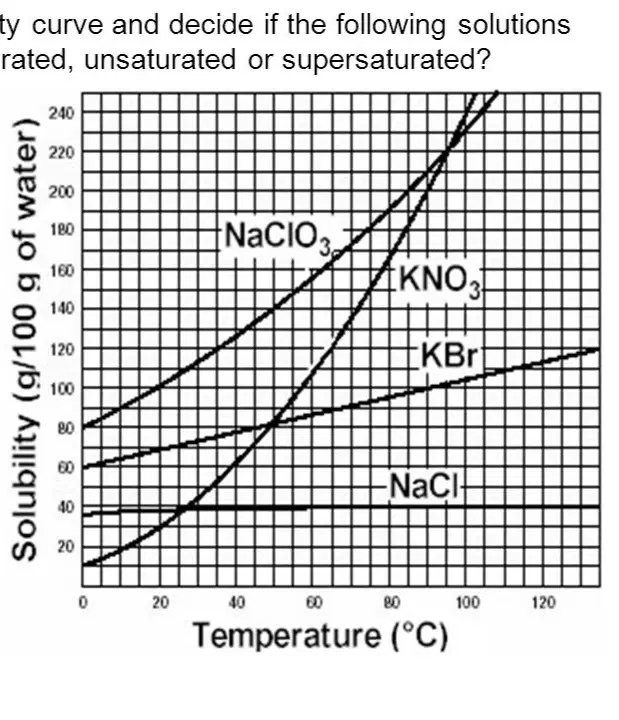
In terms of saturation, how would you classify a KBr solution with a concentration of 90 g in 100 g of water at 10°C?
saturated
supersaturated
unsaturated
In terms of saturation, how would you classify a KNO3 solution of 30 g in 100 g of water at 40°C?
saturated
supersaturated
unsaturated

