
 Worksheets
Science Olympiad Qualifying Test
Total questions: 53
Worksheet time: 37mins
A scientist is studying the growth of a plant species in different soil types. She observes that the plants grow taller in soil type A compared to soil type B. What could be a reasonable hypothesis for this observation?
Soil type A has more nutrients than soil type B.
Soil type B has more sunlight than soil type A.
Soil type A has less water than soil type B.
Soil type B has more nutrients than soil type A.
A student is conducting an experiment to determine the effect of temperature on the solubility of sugar in water. Which of the following is the best plan for the experiment?
Measure the amount of sugar that dissolves in water at different temperatures and record the results.
Dissolve sugar in water and measure the temperature of the solution.
Heat the sugar and water mixture and observe the color change.
Measure the amount of sugar before and after dissolving in water at room temperature.
A group of students is designing a model to demonstrate the water cycle. Which of the following components should they include to accurately represent evaporation?
A container of water with a heat source underneath.
A fan blowing over a container of water.
A container of water with ice cubes floating in it.
A sealed container with water and a thermometer.
Consider the following chemical equation: 2H2+O2→2H2O . What does this equation tell us about the conservation of mass?
The mass of the reactants is greater than the mass of the products.
The mass of the reactants is equal to the mass of the products.
The mass of the products is greater than the mass of the reactants.
The mass of the reactants is less than the mass of the products.
A student is asked to explain why the moon appears to change shape over the course of a month. Which of the following explanations uses evidence and reasoning?
The moon changes shape because it is moving closer and farther from the Earth.
The moon appears to change shape due to the Earth's shadow falling on it.
The moon's phases are caused by its orbit around the Earth, changing the portion of the moon that is illuminated by the sun.
The moon changes shape because it rotates on its axis.
A student is tasked with designing an experiment to test the effect of light intensity on plant growth. Which of the following is a critical step in the planning process?
Choose a single type of plant to use in the experiment.
Use different types of soil for each plant.
Water the plants with different amounts of water.
Measure the height of the plants once at the end of the experiment.
A teacher asks students to predict what will happen if a balloon filled with air is placed in a freezer. Which prediction demonstrates strategic thinking?
The balloon will pop because the air inside will expand.
The balloon will shrink because the air molecules will move closer together.
The balloon will stay the same size because the air is trapped inside.
The balloon will change color due to the cold temperature.
A student is analyzing data from an experiment on the boiling points of different liquids. Which of the following conclusions is based on evidence and reasoning?
All liquids boil at the same temperature.
The boiling point of a liquid depends on its molecular structure.
The boiling point of a liquid is always higher than its freezing point.
The boiling point of a liquid is the same as its melting point.
A student is asked to create a model of the solar system. Which of the following considerations is most important for accurately representing the relative sizes of the planets?
The distance between the planets.
The color of each planet.
The diameter of each planet.
The number of moons each planet has.
A student is investigating the relationship between the angle of sunlight and the temperature of a surface. Which of the following hypotheses is most reasonable based on scientific principles?
The temperature of a surface decreases as the angle of sunlight increases.
The temperature of a surface increases as the angle of sunlight decreases.
The temperature of a surface increases as the angle of sunlight increases.
The temperature of a surface is not affected by the angle of sunlight.

Which statement is an inference about this picture?
The van is tan.
The van drove into a KFC building.
The driver was hungry.
Red and white are part of the KFC building.
The Science Teacher sets up an experiment to see how the mass of a ball affects the distance it rolls off a ramp. Identify the independent variable.
distance traveled by the ball
height of the ramp
mass of the ball
weight of the ball
The Science Teacher sets up an experiment to see how the mass of a ball affects the distance it rolls off a ramp. Identify the dependent variable.
height of the ramp
distance traveled by the ball
mass of the ball
weight of the ball
If you increase the amount of spinach you eat, then you will increase the iron in your blood because spinach is high in iron.
What's the dependent variable?
the amount of iron in your blood
the amount of spinach you eat
what time of day you eat the spinach
your gender
If I ride my bike to school instead of walking, then I will get to school faster because I can bike faster than I can run. What is the dependent variable?
Where you go to school
How fast you get to school
Riding a bike or walking
Your age

There are three young girls with party hats on

It is a hot summer day

Based on this data table, which is the dependent variable in Amelia's experiment?
the number of bean plants in each group
the amount of water given daily to each plant
the height of each bean plant
the amount of fertilizer given to each group of bean plants
An experiment is performed on plants to see how different liquids affect plant growth. Each plant in the experiment is given a different liquid; water, apple juice, or milk. Each plant has the same amount of soil, sunlight, and listens to the same music. In this investigation, what are the controlled variables? Select all that apply
type of plant
amount of soil
plant growth
type of liquid
type of soil
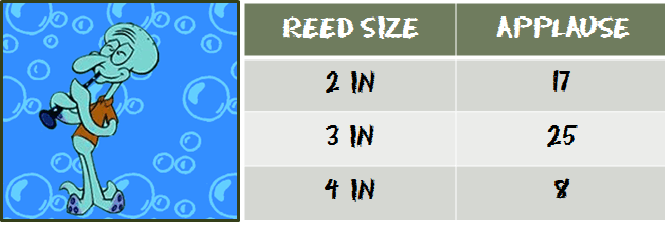
Squidward found new reeds to tryout for his clarinet. He used an APPLAUSOMETER to measure applause after playing Under the Sea with each reed. The results were put in the table. What would be controlled variables for this experiment? Select all that apply
The song played
The reed used
The applause after each song
The clarinet used
The audience
In a formal hypothesis, what variable comes after the word IF
independent variable
dependent variable
controlled variable
In a formal hypothesis, what variable comes after the word THEN?
independent variable
dependent variable
controlled variable

Choose the best hypothesis for "What effect does studying have on your test grade?"
IF I study more often, THEN my test grades will be better because I will have learned the material for class.
IF I have a good test grade, THEN I will study because I can learn.
Good grades are from studying.
IF I want a good grade on a test, THEN I have to study more often

Choose the BEST hypothesis for "How will exercising affect your health?"
IF you have better health, THEN you will exercise because it strengthens your heart.
IF you exercise, THEN you will have better health because it is good for your heart
Exercising means you're healthy.
IF you want to be healthy, THEN you need to exercise.

A scientist hypothesizes the the temperature at which an alligator's egg is incubated will determine whether the alligator will be male or female. The independent variable is
the male alligators
the gender of the alligator
the temperature
the incubator

A scientist hypothesizes the the temperature at which an alligator's egg is incubated will determine whether the alligator will be male or female. The dependent variable is
the temperature
the size of the baby alligators
the incubator
the gender of the baby alligators
What is the logical order of the relationship between atoms, molecules, cells and so on?
molecules, atoms, cells, tissues, organs, systems
atoms, cells, molecules, systems, organs
atoms, molecules, cells, tissues, organs, systems
cells, tissues, atoms, molecules, organs, sytstems
What gas exchange is carried out by humans?
carbon dioxide in - carbon dioxide out
oxygen in - carbon dioxide out
carbon dioxide in - oxygen out
oxygen in - oxygen out
Complete digestion allows your body to absorb...
food
nutrients
oxygen
carbon dioxide
What system is responsible for the defense against harmful antigens to the body?
digestive
animal
immune
respiratory
SELECT ALL THAT APPLY:
Trees may be used for...
habitats
medicine
chemicals
building materials
Select all that apply: Which of the following may lead to aquatic environmental issues?
water pollution
thermal pollution
overfishing
air pollution
Which of the following may NOT prevent sources of pollution?
recycling
using alternative energy
increasing water consumption
removal of pollutants
What direction do lines of longitude appear on a map?
there are only lines of latitude
diagonal
left and right
up and down
This type of rock is formed from melted rock deep inside the Earth.
igneous
sedimentary
metamorphic
granite
Animals with backbones are called ____________.
neucleus
vertebrates
chloroplasts
invertebrates
The process of moving sediment by wind, water, or ice.
erosion
jetty
plate
weathering
Where would you most likely find a delta?
on a mountaintop
in a deep valley
near the mouth of a river
at the base of a volcano
The four inner planets are...
Rocky and small
Small and made of ice
Very large and made of ice
Very large and made of gases
Which of these might you find in a plant cell but not an animal cell?
cell membrane
vacuole
nucleus
cell wall
What type of organism adds the most nutrients to the soil as it feeds?
producers
consumers
decomposers
both producers and consumers
SELECT ALL THAT APPLY:
What describes what soil is made of?
dead plants
broken rocks
minerals
dead animals
A substance that is made of only one type of atom is called...
solution
element
property
compound
Why do scientists use the scientific method?
To make sure they get credit for their discoveries.
To make sure their results are valid and can be performed by other scientists.
So that other scientist don't get mad at them
They don't know how do experiments

(Click the image to make it larger)
The picture provided shows an ocean bay food chain. Sea otters move into the ocean bay. They eat all of the sea urchins. This change will cause the...
kelp to have less food
crabs to have more food
sea ducks to have less food
arctic foxes to have more food
A _______ is a substance with a pH greater than 7.
neutralizer
buffer
acid
base
Which of the following is NOT a benefit of forests to the environment?
prevention of leaching
increased evaporation
reduction of erosion
serves as wind breaks

(Click the image to make it larger)
What ocean would you be in if you were at 30 degrees south and 150 degrees west?
The Atlantic Ocean
The Arctic Ocean
The Pacific Ocean
The Indian Ocean
A guess about the probable outcome of an experiment is called...
hypothesis
control
variable
constant
Astronauts are much lighter when they walk on the moon than when they walk on Earth. This is because of...
the depth of the moon's craters
the light coming from the sun
the strength of the moon's gravity
the solar winds

