
 Worksheets
electricity review
Total questions: 33
Worksheet time: 21mins
The electric force between two objects is related to which pair of characteristics?
the charge on each object and the area of contact between the two objects
the charge on each object and the distance between them
the charge on each object and the mas of each object
the mass of each object and the distance between them

Both are positively charged and repelling.
Both are negatively charged
The top object is positively charged and the lower object negative
The top object is negatively charged and the lower object positive

What can you tell about the charges on these objects?
Object's charges are opposite and repel
They are opposite and increasing
Objects charges are opposite and attract
They are the same and repel
Which are true of electricity?
A form of energy
An imaginary force
Results from electron flow
Transfer of matter through conductors
What is current electricity
the build up of a charge on an object
Energy involving a moving electric charge
The level of power at a given moment
Electrons flowing out of a motor
What is static electricity?
Synonymous with magnetism
When two conductors touch
production of noisy electricity
an accumulated charge on an object
Electricity can only exert a force with contact?
True: otherwise how would the electrons flow?
False: it's a field force, like gravity
What does the electrical force between two objects depend on?
How much charge the objects have
The mass of the objects
How far apart they ore
The constant of gravity

What type of charging is happening here? Hint: They are not touching
induction
conduction
friction
magnetification

What type of charging is happening here? Hint: They ARE touching.
induction
conduction
friction
magnetification
You see a lightning rod on a farmhouse roof. What else must be present for it to work?
that the rod be a good conductor
connection to a ground rod
that the rod be massive
static electricity
What is one use of static electricity?
To demonstrate how brave Franklin was
To power cars
To make inkjet printing work
To supply residential electricity
What will happen proportionally to the electrical force between two objects if the charge on one object is doubled?
0x (they cancel each other)
2x doubled
1/4 x
4x
What kind of electricity powers our homes and businesses?
static electricity
current AC electricity
neutral electricity
proton electricity
For electricity to flow to any device, there has to be a complete (a) .
What is a material through which electricity passes easily - such as copper?
electron
insulator
proton
conductor
What is a material through which electrical current does NOT flow well or at all?
electron
insulator
proton
conductor
What is Ohm's Law formula?
In the water analogy, volts are like _____________
The resistance of the pipes
The current or amount of water
The height of the water
The temperature of the water
Electricity from batteries is
direct current or DC
indirect current or IC
alternating current or AC
meta current or mc
Our electrical system for buildings has what type of current?
direct current or DC
indirect current or IC
alternating current or AC
meta current or MC

The big cylinders on the power line poles decrease the voltage before wires branch off to homes. They are called ________
induction
transformers
moderators
capacitors

Other types of these devices INCREASE the voltage or force of the electricity so that it can travel further. They are step-up ______________.
generators
magnets
transformers
moderators
What is the unit of measure for resistance?
Watts
Ohms
Volts
Current
Is electricity the flow of protons?
True
False
What is the equation for Ohm's Law?
IV=R
V=CR
V=IR
V=I/R
What is the total resistance in a series circuit if R1 = 200 Ω and R2 = 150 Ω
50 Ω
350 Ω
85 Ω
100 Ω

What does this symbol represent?
Battery
Wire
Resistor
Cell
Resting electrons are a form of (a) electricity.
What is the total resistance in a parallel circuit if R1 = 100 Ω and R2 = 100 Ω?
200 Ω
50 Ω
0 Ω
10000 Ω
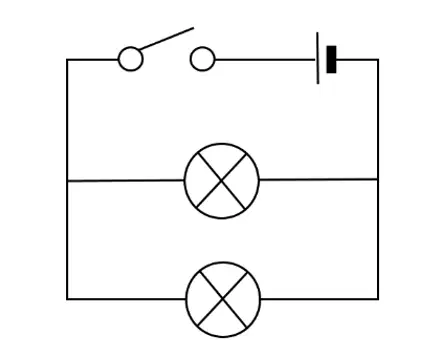
What type of circuit is this?
Parallel
Combination
Series
Perpendicular
Where are protons located in an atom?
Electron cloud
Proton cloud
Inside the nucleus
Outside the nucleus
How many electrons to conductors have?
6
5 or more
4
3 or less

