
 Worksheets
213 PPT6 SI Units Quiz
Total questions: 59
Worksheet time: 31mins
drag and drop the measurements to their correct place
Scientific Unit of measurement for temperature
Kelvin(k)
Time
Seconds (s)
Mass
Kilogram(Kg)
Length
Metres(M)
Electric current
Ampere(A)
Which symbol represents the SI unit for mass?
M
s
Kg
A
What is the base quantity for the unit 'Second'?
Length
Mass
Time
Electric current
What is the symbol for the SI unit of thermodynamic temperature?
K
M
A
s
What is the SI unit for velocity?
m/s
m/s²
N
Pa
Which of the following is the SI unit for acceleration?
l/s
m/s²
N
Pa
What is the SI unit for flow rate?
m/s
m/s²
l/s or l/m
Pa
Which unit is used to measure force in the SI system?
m/s
m/s²
N
Pa
What is the SI unit for pressure?
m/s
m/s²
N
Pa
What is the rate at which an object changes its position, taking into account speed and direction?
Acceleration
Velocity
Force
Flow rate
What is the rate at which an object increases its velocity?
Flow rate
Force
Acceleration
Velocity
What is the gravitational pull value used for acceleration due to gravity?
9.81 m/s
9.81 m/s²
9.81 KN/m²
9.81 m/s³
What does flow rate measure?
The speed of an object
The amount of fluid that flows through a pipe at a given time
The force applied to an object
The change in velocity of an object
What is an influence on an object that may cause it to move?
Velocity
Acceleration
Force
Flow rate
If a cistern base measured 0.8m by 1.0m, what would the area be?
0.8m²
1.0m²
0.9m²
1.2m²
What would be the volume of a cistern which measured 1m long, 0.8m wide, and 0.75m in height?
0.6m³
0.8m³
0.75m³
1.0m³
What is the definition of pressure in terms of force and area?
Pressure is the area per force.
Pressure is the force per area.
Pressure is the volume per area.
Pressure is the mass per volume.
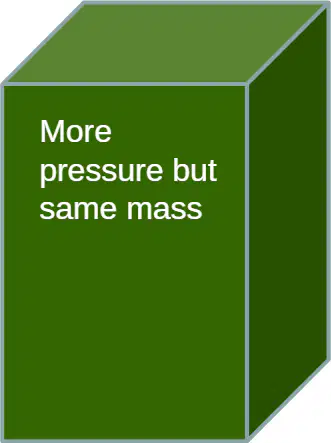
Which object exerts more pressure on the floor if both have the same mass?
The taller object
The shorter object
Both exert the same pressure
Neither exerts pressure
What is the unit of pressure in the International System of Units (SI)?
Newton
Pascal
Joule
Watt
How is pressure calculated?
Force multiplied by area
Force divided by area
Area divided by force
Area multiplied by force

What happens to pressure when a force is applied over a large area?
Pressure increases
Pressure decreases
Pressure remains the same
Pressure becomes zero
In which direction does the pressure exerted by a solid object act?
Downward only
Upward only
Outward only
Inward only
How does the pressure exerted by a liquid differ from that of a solid?
It acts only upward
It acts downward and outward
It acts only inward
It acts only sideways
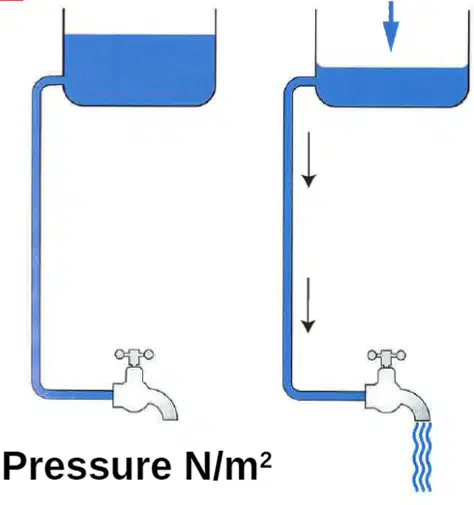
What is the formula to calculate the Intensity of Pressure (IoP) in N/m²?
Head height x 9.81 (gravity)
Head height + 9.81 (gravity)
Head height / 9.81 (gravity)
Head height - 9.81 (gravity)
What is the Intensity of Pressure (IoP) if the head height is 6 meters?
58.86 N/m²
60.00 N/m²
50.00 N/m²
70.00 N/m²
If the Intensity of Pressure (IoP) is 78.48 N/m², what is the head height?
8 meters
10 meters
6 meters
12 meters
What is the most common measurement for pressure used in the plumbing industry?
Pascal
Bar
Metres head
Psi
Which of the following is a standard measure for pressure?
Bar
Metres head
Pascal
Psi
What does the phrase "the greater the head, the greater the pressure" imply?
Pressure decreases with head
Pressure is unrelated to head
Pressure increases with head
Pressure remains constant with head
What is the equivalent in Bar for 100 Kilopascals (kPa)?
0.1
0.5
1.0
2.0
How many Meters head is equivalent to 200 Kilopascals (kPa)?
10
15
20
25
What is the Pounds per square inch (PSI) for 50 Kilopascals (kPa)?
7.25
14.5
21.75
29.0
If the pressure is 2.5 Bar, what is the equivalent Kilopascals (kPa)?
100
150
200
250
What is the atmospheric pressure at sea level?
101.3 kPa
100.0 kPa
99.9 kPa
102.5 kPa
How does atmospheric pressure change with altitude?
Increases above sea level, decreases below sea level
Decreases above sea level, increases below sea level
Remains constant at all altitudes
Increases at all altitudes
What causes siphonic action in many WCs?
Gravity
Atmospheric pressure
Water temperature
Pipe diameter
What causes siphonic action to occur?
Gravity
Atmospheric pressure
Temperature difference
Magnetic fields
Why does the lower beaker have greater pressure?
It is higher
It is larger
It is lower
It is sealed
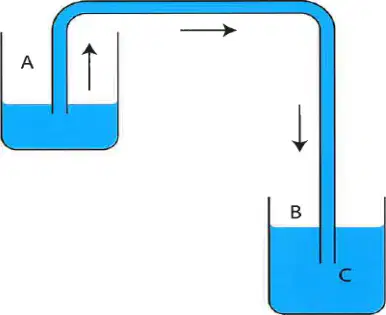
What happens when suction is applied at point C?
Water flows from beaker B to beaker A
Water flows from beaker A to beaker B
Water remains stationary
Water evaporates
What is the atmospheric pressure given in the document?
101.3 kN/m²
100.0 kN/m²
102.5 kN/m²
99.8 kN/m²
What is the pressure at point A according to the document?
Above atmospheric pressure
Below atmospheric pressure
Equal to atmospheric pressure
Zero pressure
How much pressure is added by the water in the leg of the tube per 1m head?
14.7 kN/m²
10.0 kN/m²
12.5 kN/m²
15.0 kN/m²
What is the total pressure pushing down at point A?
116 kN/m²
110 kN/m²
120 kN/m²
105 kN/m²
What is the definition of force as described in the learning material?
An influence on an object that may cause it to move.
A measure of the amount of matter in an object.
The energy stored in an object due to its position.
The resistance of an object to a change in its state of motion.
What happens when the tap is open according to the diagram?
The water remains at rest.
The force of gravity pushes the water down the pipe and out of the tap.
The water evaporates.
The water changes color.
What is the mass of 1 litre of water?
1 kg
2 kg
0.5 kg
10 kg
If a cistern holds 40 litres of water, what is the force of water leaving the tap?
392 N
196 N
981 N
40 N
What is the acceleration due to gravity used in the calculation of force in this context?
9.81 m/s²
10 m/s²
8.9 m/s²
9.5 m/s²
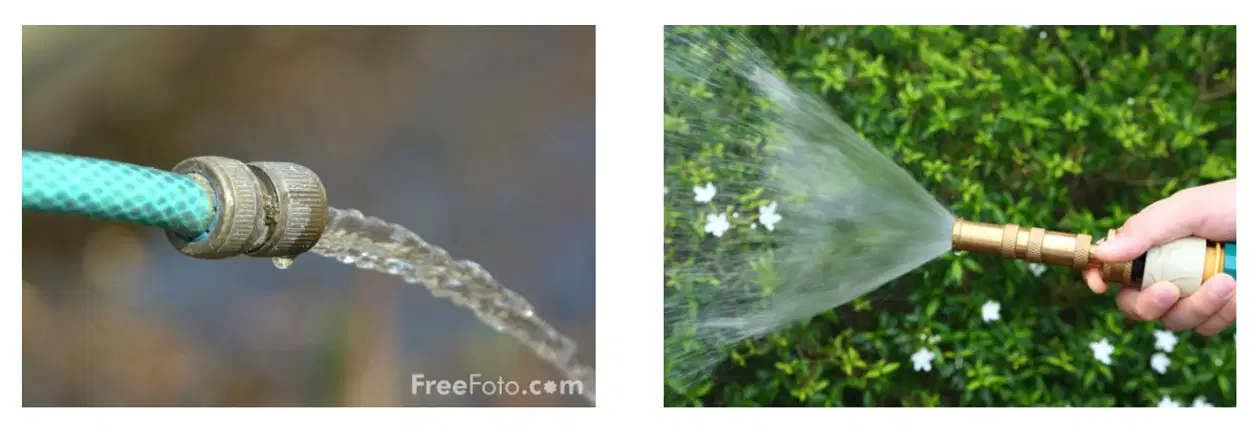
What happens to the speed of water when the pipe diameter is reduced?
The speed decreases.
The speed remains the same.
The speed increases.
The speed fluctuates.
When the pipe diameter is reduced, what happens to the pressure and flow rate?
Both pressure and flow rate increase.
Both pressure and flow rate decrease.
Pressure increases, flow rate decreases.
Pressure decreases, flow rate increases.
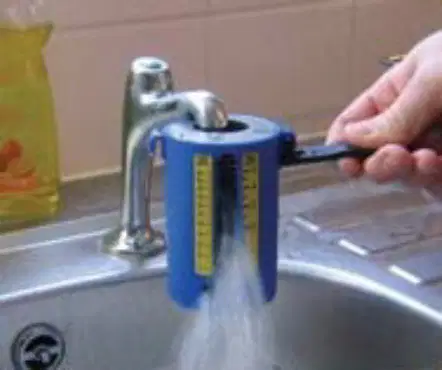
What is the definition of flow rate in plumbing?
The speed at which water heats up in a system.
The amount of fluid that flows through a pipe or from an outlet over a given time.
The pressure exerted by water in a closed system.
The temperature change of water in a pipe.
Which of the following factors does NOT affect flow rate?
Changes in direction
Pipe size
Color of the pipe
Pressure
What are the units used to express flow rate in plumbing?
Litres per minute (l/min) or litres per second (l/s)
Gallons per hour (gph) or gallons per minute (gpm)
Cubic meters per hour (m³/h) or cubic meters per second (m³/s)
Pounds per minute (lb/min) or pounds per second (lb/s)
At what temperature does a litre of water weigh 1 kg?
0°C
4°C
10°C
20°C
What is the equivalent length of pipe for one elbow in terms of resistance to water flow?
0.26m
0.37m
0.50m
0.75m
How many elbows are equivalent to 3.7m of pipe?
5 elbows
10 elbows
15 elbows
20 elbows
What is the effect of pipe size on water flow?
Smaller pipes allow more water to flow
Larger pipes allow more water to flow
Pipe size has no effect on water flow
Smaller pipes reduce friction
What happens to the flow rate as pipe length increases?
Flow rate increases
Flow rate decreases
Flow rate remains constant
Flow rate doubles
Which material is described as having smooth resistance?
Galvanised LCS
Polybutylene
Copper
PVC

