
NEW
Font size
 Worksheets
Animal/plant functions and structures
Total questions: 18
Worksheet time: 9mins
Marvin predicts that if marigold flowers are planted around a group of tomato plants, then fewer insects will eat the tomatoes. Which of the following observations would best support Marvin's prediction?
A count of 20 insects before marigolds are planted and 20 insects after marigolds are planted.
A count of 20 insects before marigolds are planted and 12 insects after marigolds are planted.
A count of 10 tomato plants before marigolds are planted and 5 tomato plants after marigolds are planted.
A count of 10 tomato plants before marigolds are planted and 15 tomato plants after marigolds are planted.
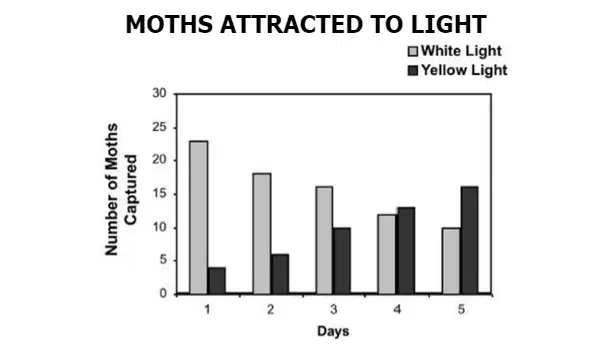
Which of the following conclusions is valid based on the graph?
Captured moths prefer yellow light.
Only white moths are attracted to white light.
The number of moths captured per day using white light decreased each day.
The number of moths captured per day using yellow light decreased after day 5.
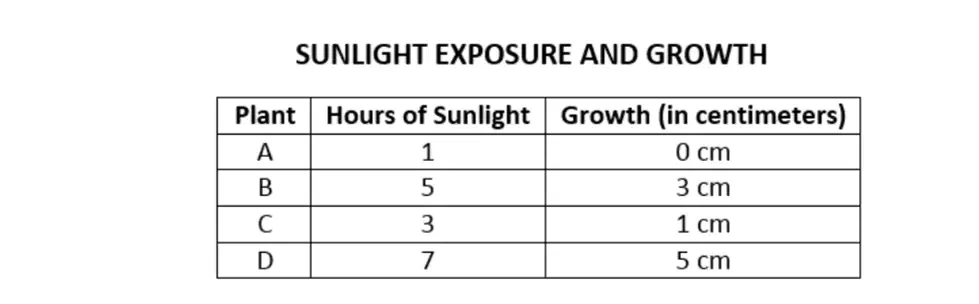
Students are investigating the effect of the number of hours per day of sunlight on plant growth. What conclusion can be made about this investigation?
Plants do not need sunlight to grow.
Plants grow more with fewer hours of sunlight.
Plants receiving more hours of sunlight grow more.
Plants receiving over seven hours of sunlight will not grow.
Arctic foxes grow new fur with different seasons. They grow brown fur in the summer and white fur in the winter. These changes are examples of which survival characteristic?
adaptation
hibernation
metamorphosis
migration
Beetles in a certain population can either be green-colored or brown-colored. A change in the environment has caused the green-colored beetles to become more visible and heavily preyed upon by other animals. What will most likely happen to this beetle population?
The number of brown-colored beetles will increase.
The green-colored beetles will reproduce at a faster rate.
The green-colored beetles will change their color to brown.
The population of green-colored and brown-colored beetles will become extinct.
The life cycle of a mosquito is based on temperature and daylight. With increased global temperatures, one species of mosquito is beginning to reproduce earlier in the year for a longer period of time. Which phrase below best describes this change in the life cycle of the mosquito?
a species losing habitat
a species overpopulating
a species adapting to changes in an environment
a species gaining a competitive advantage over predators
Many plants that are found in a tropical rainforest have very large leaves. How would large leaves be most helpful for rainforest plants?
by attracting insects for pollination
by hiding the stems from predators
by collecting sunlight for making food
by shading the stems and roots from heat
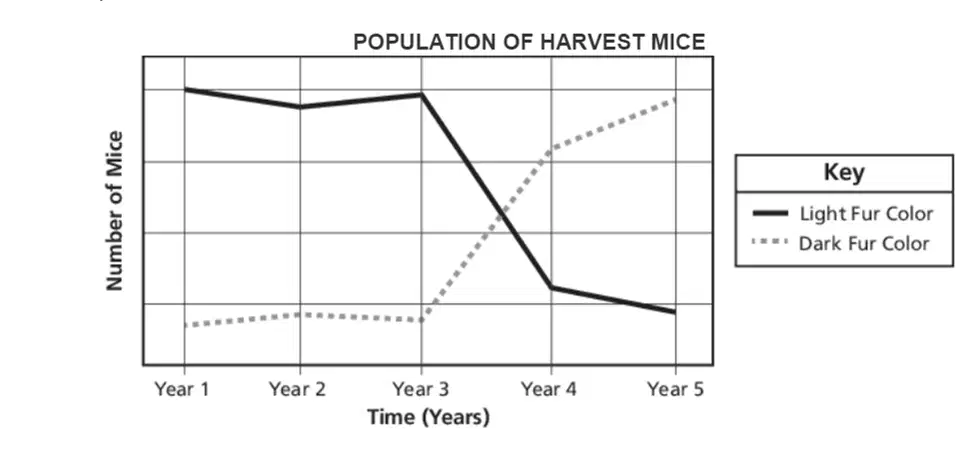
Scientists studied a population of harvest mice living in a small area. Some mice have dark-colored fur and some mice have light-colored fur. The graph below shows how the number of mice with each type of fur color changed over five years. Which of the following would best explain the data in the graph?
An environmental change killed most of the plants that the mice eat.
An environmental change allowed an invasive species to be introduced.
An environmental change reduced the amount of water available to the mice.
An environmental change caused one fur color to be more visible to predators than the other.
The apple snail is an unusual organism because it has both gills and a lung. How might a combined respiratory system like this give apple snails an advantage over other snails without this characteristic?
The apple snail could move more rapidly.
The apple snail could lay eggs with thicker shells.
The apple snail could be more immune to disease.
The apple snail could expand its range to find food.
Manatees are mammals that live in warm, shallow waters. They can easily become sick and die when temperatures drop. Which behavior is most important to the survival of a manatee in changing water temperatures?
Breathing at a slower rate
Swimming to deeper waters
Feeding more to increase body fat
Migrating to natural springs of warm water
Why do some desert plants have thick, waxy leaves?
To attract pollinators
To store water
To increase photosynthesis
To deter herbivores
What is the primary reason some animals hibernate during winter?
To escape predators
To conserve energy
To find new habitats
To reproduce
How does the coloration of a chameleon help it survive in its environment?
By attracting mates
By regulating body temperature
By camouflaging with surroundings
By signaling danger to predators

What does 'pupa' refer to?
Egg laying process
Adult insect
Wormlike stage of insect development
Inactive stage of development intermediate between larva and adult
How do cacti adapt to their arid environment?
By growing tall to reach sunlight
By developing deep roots to access water
By producing colorful flowers to attract pollinators
By shedding leaves to reduce water loss
What is the main purpose of a bear's thick fur during winter?
To attract mates
To camouflage in the snow
To provide warmth
To store food
Why do some birds migrate long distances?
To find new nesting sites
To escape predators
To access food resources
To avoid competition

