
NEW
Font size
 Worksheets
Genetics Quiz Review
Total questions: 16
Worksheet time: 10mins
In humans, where does DNA replication take place?
ribosomes
nucleus
mitochondria
cytoplasm
RNA from a bear is compared to RNA from a sunflower. Both will contain the ________________.
sugar ribose and the base uracil.
sugar deoxyribose and the base thymine.
sugar ribose and the base adenine.
sugar deoxyribose and the base cytosine.
During DNA replication, a ______________ nitrogen base is complementary to a Adenine.
Guanine
Uracil
Thymine
Cytosine
Put the following steps of protein synthesis in order: 1. Transfer RNA picks up individual amino acids and carries them to the ribosome. 2. An mRNA copy leaves the nucleus and goes to the ribosome. 3. A protein is made. 4. A single strand of DNA is copied to make mRNA.
1, 2, 3, 4
4, 2, 1, 3
3, 4, 2, 1
4, 3, 2, 1
Sections of DNA that serve as the blueprints/instructions for making proteins are called ____.
ribose sugar
genes
triphosphates
nucleotides
Nucleotides are the monomers for nucleic acids. They consist of a phosphate, a 5-carbon sugar and base. A nucleotide for DNA differs from a nucleotide for RNA because DNA has
Deoxyribose sugar and Thymine
Deoxyribose sugar and Uracil
Ribose sugar and Uracil
Deoxyribose sugar and Adenine
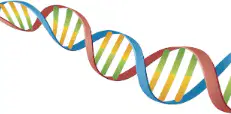
DNA's shape is a double helix, with nucleotides forming the "twisted ladder" structure. Which components of the nucleotide form the specific parts of the ladder structure?
Handrails are carbohydrates and lipids, base pairs form the steps of the ladder.
Handrails are phosphate and sugar, base pairs form steps of the ladder.
Handrails are the base pairs, phosphate and sugar form the steps of the ladder.
Handrails and steps are all made of thymine and uracil only
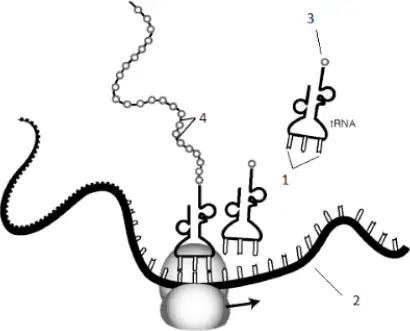
Label some of the parts in the process of protein synthesis.
1 represents anticodon; 2 represents mRNA
1 represents transcription; 2 represents mitosis
1 represents mRNA; 2 represents anticodon
1 represents mitosis; 2 represents replication
Transcription aims to make an RNA copy of a gene's DNA sequence. How would the following strand of DNA be transcribed?
TAC-TAG-AGC-ATT
AUG-TAG-CGA-TTC
AUG-ATC-TCG-TAA
AUG-AUC-UCG-UAA
TAA-AUG-CGC-TAA
Which of the following is a characteristic of RNA but not DNA?
Contains the base thymine.
Double-stranded structure.
Contains the sugar ribose.
Stable under alkaline conditions.
During translation, which molecule is responsible for bringing the correct amino acid to the ribosome?
mRNA
tRNA
rRNA
DNA

The reverse codon found on the tRNA.
Codon
Anticodon
Mitosis
Meiosis

Three nucleotide bases that code for the end
of a strand of protein.
Anticodon
Start Codon
Stop Codon
tRNA

A nucleotide base that takes the place of Thymine in RNA.
Uracil
Thymine
Adenine
uRNA

Assembling proteins via instructions from DNA.
Replication
Mutations
Protein synthesis
Homeostasis

Use the codon chart to translate the following mRNA:
AUG | GGC | CCU
Methionine | Glycine | Proline
Tyrosine | Proline | Glycine
Methionine | Lysine | Stop
TAC | CCG | GGA

