wayground logo

Free Printable Worksheets

NEW

Font size

S
M
L
XL
Worksheets

Unit 2.1.4 Action Potential Part 2 Review Quiz

Total questions: 25

Worksheet time: 25mins
Name
Class
Date
1.
When a neuron is resting, the inside of the axon has a ____________ charge.
a)
positive
b)
negative
2.
When a neuron is not engaged in an impulse.
a)
Resting potential
b)
Action potential
c)
Neural potential
d)
Synaptic potential
3.
Neurotransmitters are released from the
a)
Dendrites
b)
Post-synaptic neuron
c)
Presynaptic neuron
d)
Axon
4.
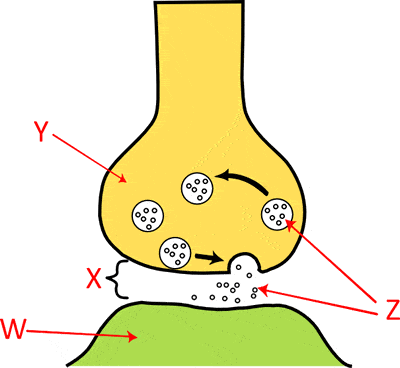
W
a)

Axon Terminal

b)
Neurotransmitters
c)
Dendrite
d)
Synapse
5.
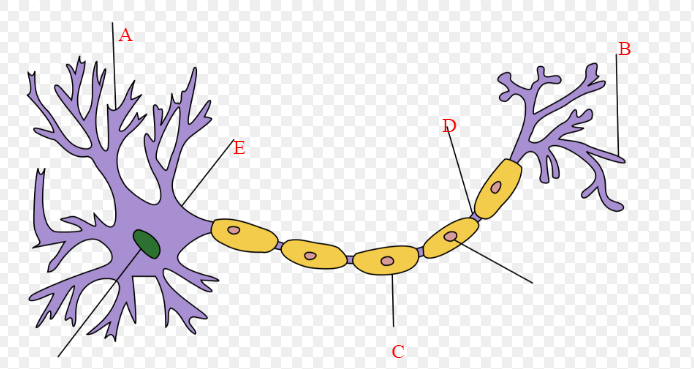
A
a)
Dendrite
b)
Axon
c)
Axon Terminal
d)
Cell Body
6.

B

a)

Dendrite

b)

Axon

c)

Axon Terminal

d)

Cell Body

7.
What is the chemical used by a neuron to transmit an impulse across a synapse to another nerve cell?
a)
Neurotransmitters
b)
Synapse
c)
Threshold
d)
Impulse
8.
-70 mV is the measure of a
a)
Threshold Potential
b)
Action Potential
c)
Resting Potential
d)
End Point Potential
9.
When a membrane potential reaches +30mV, ________ channels open, ________ occurs, and ________ channels close.
a)
Sodium, depolarization, potassium
b)
Potassium, depoloarization, sodium
c)
sodium, repolarization, potassium
d)
postassium, repolarization, sodium
10.
The area between the pre-synaptic cell and the post-synaptic cell is termed the synaptic cleft.
a)
True
b)
False
11.
The sodium-potassium pump is involved in establishing the resting membrane potential. 
a)
True
b)
False
12.
Nerve impulses within the neuron are sent in _____ form
a)
Electrical
b)
Chemical
c)
Electro-chemical
d)
Petrochemical
13.
The correct direction of the neural impulse within one neuron.
a)
Axon Terminal to Dendrite
b)
Dendrite to Axon Terminal
c)
Cell Body to Axon
d)
Axon Terminal to Cell Body
14.
This is the electrical charge that travels down an axon when a neuron is firing
a)
Resting Potential
b)

Action Potential/Electrical Impulse

c)
Threshold
d)
Refractory Period
15.
What is a neurotransmitter?
a)
fatty covering of the axon
b)
nerve cell
c)
chemical messenger
d)
gap between neurons
16.
What generates a nerve impulse on the post-synaptic membrane? 
a)
Calcium binding with a receptor site
b)
Potassium leaking into the post-synaptic membrane 
c)
Neurotransmitter binding with receptor sites
d)
Neurotransmitter being removed from the synapse
17.

The action potential arrives at the ____ and depolarizes the ____ membrane.

a)

Axon terminal, pre-synaptic

b)

Axon terminal, post synaptic

c)

pre-synaptic, axon terminal

d)

post synaptic, axon terminal

18.

What happens in an axon terminal when an action potential arrives at the presynaptic membrane?

a)

sodium ions diffuse in

b)

sodium ions diffuse out

c)

calcium ions diffuse in

d)

calcium ions diffuse out

19.

What is Y?

a)

Axon terminal

b)

Neurotransmitters

c)

Dendrite

d)

Synapse

20.

What is the role of the Na+-K+ pump?

a)

To actively transport Na+ and K+ against their electrochemical gradients

b)

To allow Na+ and K+ to move down their electrochemical gradients

c)

To maintain the membrane's impermeability to ions

d)

To depolarize the neuron

21.

What happens when the membrane potential becomes more positive than the resting potential?

a)

The membrane becomes impermeable

b)

The membrane potential remains unchanged

c)

The membrane is depolarized

d)

The membrane is hyperpolarized

22.

What is the primary ion responsible for depolarization in neurons?

a)

Ca2+

b)

Cl-

c)

K+

d)

Na+

23.

What happens when K+ channels open in a neuron?

a)

Na+ moves out of the cell

b)

K+ moves into the cell

c)

K+ moves out of the cell

d)

Na+ moves into the cell

24.

Which ion is more concentrated inside the cell compared to outside in most neurons?

a)

Sodium (Na+)

b)

Potassium (K+)

c)

Chloride (Cl-)

d)

Organic anions

25.

What is the term used to describe a membrane potential that is more negative than the resting potential?

a)

Depolarization

b)

Hyperpolarization

c)

Polarization

d)

Repolarization