
NEW
Font size
 Worksheets
AP Pyschology Unit 2.3-2.4
Total questions: 21
Worksheet time: 11mins
Which option best defines mnemonic devices in the context of memory encoding?
Strategies that aid encoding into memory
Processes that organize sensory input
Repeated rehearsal without breaks
Verbal cues that aid later retrieval
You need to remember a 12-digit number. Which approach uses chunking to improve encoding?
Link digits to random daily events
Group digits into four three-digit units
Write digits in different ink colors
Recite digits one by one repeatedly
During recall of a list, why are the first and last items often remembered better than the middle items?
They contain more emotional significance
They benefit from primacy and recency effects
They are encoded with deeper processing
They are rehearsed with stronger imagery
You are creating a plan to memorize medical terms. Which plan shows strategic use of encoding processes?
Avoid associations to prevent confusion
Group terms by body systems and space sessions
Study all terms in one long session
Read the list repeatedly once
In the working memory model, which component primarily manages attention and coordinates the subsystems?
Visuospatial sketchpad
Central executive component
Iconic sensory register
Phonological loop system
Information must pass through which sequence in the multi-store model to be remembered?
Sensory memory then short-term then long-term
Working memory then long-term memory
Phonological loop then visuospatial sketchpad
Long-term memory then short-term then sensory
Relearning is a measure that assesses what outcome?
The accuracy of multiple‑choice identifications
The order in which information is stored
The number of facts remembered after one study
The time saved when studying material again
Which stage briefly holds raw sensory input before any conscious processing?
Long-term memory archives limitless information
Short-term memory stores few activated items
Sensory memory records immediate sensory input
Working memory integrates multiple information sources
Long-term potentiation (LTP) is most accurately described as which change in a neuron?
An increase in firing potential after rapid stimulation
A switch from chemical to electrical signaling
A reduction in neurotransmitter release over time
A decrease in resting membrane potential
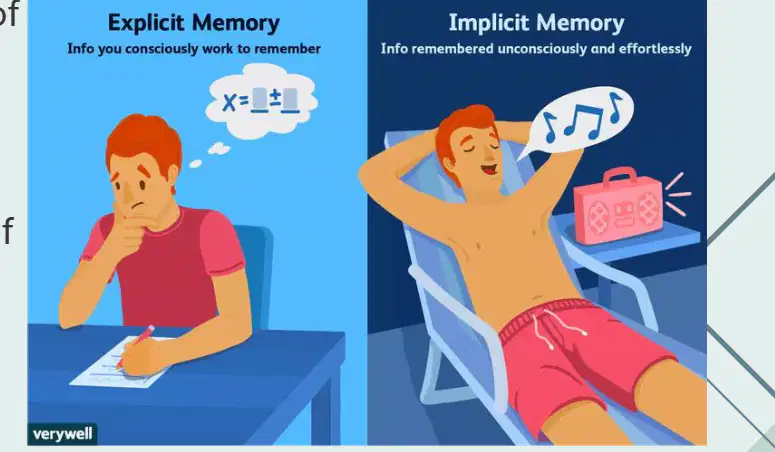
A student practices bike riding until it becomes effortless. Which memory type is primarily involved, and why?
Implicit memory, because it supports procedural skills
Explicit memory, because it needs conscious verbal recall
Implicit memory, because it relies on episodic details
Explicit memory, because it stores factual instructions

Iconic memory is best described as which type of sensory memory?
A brief visual snapshot lasting a short moment
A conscious analysis of spatial and time details
A long-term storage of practiced information
An extended echo of sounds for several minutes

A class tests short-term memory by showing a 15-word list for 45 seconds. Based on typical short-term memory capacity, how many items should most students recall without special strategies?
About seven items
About five to six items
About nine to ten items
About twelve to thirteen items
Which statement best defines chunking in memory strategies?
Repeating items aloud without organization
Grouping items into familiar, manageable units
Associating items with emotions only
Linking items to a rhyme without meaning
Which memory strategy involves grouping separate items into larger, meaningful units to improve recall?
Rehearsal loops with random order
Sensory priming with vivid images
Distributed practice without grouping
Chunking into meaningful units
Which is the most effective first step to encode a long list of numbers?
Search for meaningful patterns
Avoid connecting to prior knowledge
Read the list once silently
Write digits in random order
Which statement best contrasts chunking and rote memorization?
Both rely solely on speed of reading
Both prevent interference completely
Chunking avoids meaning; rote adds context
Chunking uses structure; rote uses repetition
What is the main purpose of creating categories in study notes?
To memorize in the original order
To connect items by shared meaning
To increase note length and detail
To avoid recognizing patterns
In memory terms, a "chunk" most closely equals what?
A list repeated verbatim
A single unrelated item
A grouped unit with meaning
A sensory stimulus flash
A key risk when chunking poorly is what?
Reducing interference efficiently
Improving retrieval speed only
Strengthening accurate recall
Overgeneralizing wrong patterns
Which statement about categories is accurate?
They serve as retrieval cues
They reduce meaningful links
They demand rote repetition
They block prior knowledge
When chunking, why prefer familiar units?
They erase previous knowledge
They connect to long-term memory
They slow down rehearsal rate
They overload working memory

