
 Worksheets
Ecology Test Review 2024
Total questions: 57
Worksheet time: 29mins
Name
Class
Date
1.
The role of decomposers in an ecosystem is to:
a)
convert the sun's energy into energy stored as food
b)
convert plant matter into matter that can be used by animals
c)
eat other living organisms for energy
d)
break down dead and waste matter
2.
A new species of fish has been introduced into Lake Hiawatha. This fish eats minnows, a smaller fish that already live in the lake.
What is the most likely to happen to the population of minnows in Lake Hiawatha?
a)
it will increase
b)
it will decrease
c)
it will stay the same
d)
it will first increase, then decrease
3.
A new species of fish has been introduced into Lake Hiawatha. This fish eats minnows, a smaller fish that already live in the lake.
What is most likely to happen to the population of the new species of fish in Lake Hiawatha?
a)
it will increase
b)
it will decrease
c)
it will stay the same
d)
it will first increase, then decrease
4.
A new species of fish has been introduced into Lake Hiawatha. This fish eats minnows, a smaller fish that already live in the lake.
The introduction of this new species of fish into Lake Hiawatha provides an example of :
a)
competition
b)
parasitism
c)
predation
d)
mutualism
5.
Not changing or resistant to change is the definition for what word?
a)
disruption
b)
unstable
c)
stable
d)
food web
6.
A disturbance that effects an ecosystem is the definition for what word?
a)
disruption
b)
unstable
c)
stable
d)
food web
7.
An organism that gets its food from dead organisms and wastes from living organisms is the definition for what word?
a)
decomposer
b)
consumer
c)
producer
d)
omnivore
8.
A diagram that models feeding relationships within an ecosystem is the definition for what word?
a)
energy pyramid
b)
unstable
c)
stable
d)
food web
9.
A simple model of energy flow within a food web is an?
a)
energy pyramid
b)
unstable
c)
consumer
d)
food web
10.
When an ecosystem does not return to its original state and it changes permanently it is said to be?
a)
disruption
b)
unstable
c)
stable
d)
food web
11.
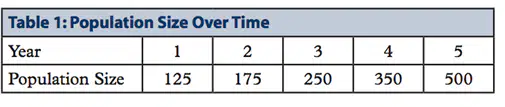
If you were to graph the data in the table, it would show:
a)
An increase in the population over time.
b)
A decrease in the population over time.
c)
The population staying the same over time.
d)
An increase in population at first, followed by a decrease over time.
12.
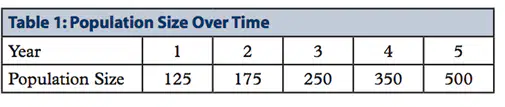
What might be causing the pattern in these data?
a)
the population's food resources became less abundant
b)
the population's Predators became less abundant
c)
the population's habitat became less abundant
d)
the population's competitors became more abundant
13.
Which of the following is an example of mutualism?
a)
a mosquito feeding on the blood of a bison
b)
a coneflower being pollinated by a bee
c)
a mushroom growing in the soil
d)
a mouse and a bird eating the same kind of seed
14.
A group of organisms of the same species living in the same habitat is the definition of what word?
a)
symbosis
b)
population
c)
mutualsim
d)
biotic
15.
The close and often long-term interaction between two species is the definition of what word?
a)
symbosis
b)
population
c)
biotic
d)
abiotic
16.
The relationship between two species where both species benefit is the definition of what word?
a)
competition
b)
commensalism
c)
parasitism
d)
mutualism
17.
The relationship between two species where one species benefits while the other species is neither harmed nor helped is the definition of what word?
a)
competition
b)
commensalism
c)
parasitism
d)
mutualism
18.
The relationship between two species where one species benefits while the other is harmed is the definition of what word?
a)
competition
b)
commensalism
c)
parasitism
d)
mutualism
19.
The situation when two organisms or two species compete for the same resources is the definition of what word?
a)
competition
b)
commensalism
c)
parasitism
d)
mutualism
20.
Which statement best describes an important difference between plants and animals?
a)
Plants get food from the soil while animals get food by eating other organisms.
b)
Animals are alive but plans are not.
c)
Plants use carbon dioxide from the air and water to make their own food while animals get food by eating other organisms.
d)
Animals use energy stored in food but plants do not.
21.
A food web shows the flow of __________ through an ecosystem and the cycling of ___________ within an ecosystem.
a)
matter, energy
b)
energy, matter
c)
food, waste products
d)
waste products, food
22.
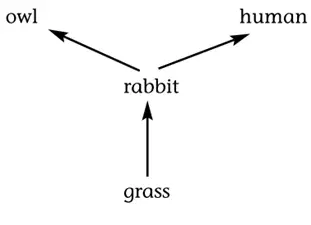
In the diagram, which of the following is a producer?
a)
rabbit
b)
owl
c)
human
d)
grass
23.
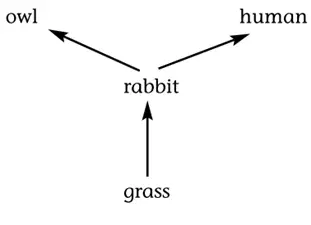
The original source of energy for this food web is:
a)
soil
b)
the sun
c)
water
d)
nutrients
24.
An organism that gets its food by eating other organisms is the definition of what word?
a)
food webs
b)
cellular respiration
c)
consumer
d)
producer
25.
A series of chemical reactions in a cell that break down sugars and release energy is the definition of what word?
a)
photosynthesis
b)
cellular respiration
c)
biotic
d)
abiotic
26.
The process by which plants convert water and carbon dioxide into sugars and oxygen is the definition of what word?
a)
cellular respiration
b)
photosynthesis
c)
population
d)
ecosystem
27.
An organism that produces its own food is the definition of what word?
a)
consumer
b)
photosynthesis
c)
biodiversity
d)
producer
28.
The word "ecosystem" refers to:
a)
the physical environment
b)
living organisms
c)
living organisms and the physical environment
d)
living organisms in the laboratory
29.
Solutions to problems caused by invasive species:
a)
require using every possible treatment regardless of the trade-offs
b)
are easy to develop
c)
are relatively inexpensive
d)
involve identifying criteria and constraints
30.
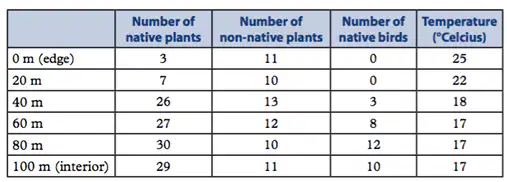
An ecologist used the transect method to investigate a forest. They ran a transect line from the edge of the forest towards the interior of the forest. The data they collected in the six quadrants spaced 20 m apart are as follows:
What pattern do you see in the number of native birds?
a)
The number of native birds increases from the interior to the edge of the forest.
b)
The number of native birds increases from The edge to the interior of the forest.
c)
The number of native birds shows no pattern.
d)
No pattern can be detected because there were no birds towards the edge of the forest.
31.
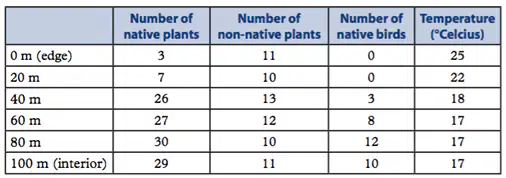
An ecologist used the transect method to investigate a forest. They ran a transect line from the edge of the forest towards the interior of the forest. The data they collected in the six quadrants space 20 M apart are as follows:
What pattern do you see in the plants along the transect from the edge to the interior?
a)
The number of native plants increases while the number of non-native plants decreases.
b)
The number of native plants remains the same while the number of non-native plants increases.
c)
The number of native plants increases while the number of non-native plants remains the same.
d)
The number of native plants and non-native plants both increase.
32.
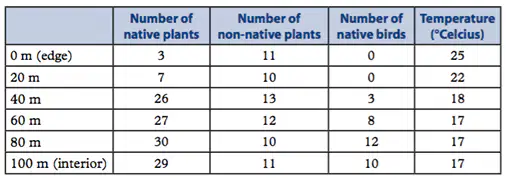
An ecologist used the transect method to investigate a forest. They ran a transect line from the edge of the forest towards the interior of the forest. The data they collected in the six quadrants space 20 M apart are as follows:
What might be causing the above patterns?
a)
Both native plants and birds prefer lower temperatures.
b)
Non-native plants prefer higher temperatures.
c)
Both native plants and non-native plants prefer lower temperatures.
d)
Native birds prefer non-native plants.
33.
The specific path or area, often marked with a rope or measuring tape showing where data should be collected is the definition of what word?
a)
quadrant
b)
transect
c)
biotic
d)
abiotic
34.
A square or rectangular plot of land marked off, to determine where to collect their samples is the definition of what word?
a)
quadrant
b)
transect
c)
biotic
d)
abiotic
35.
A location in an environment where an organism lives is the definition of what word?
a)
biotic
b)
habitat
c)
population
d)
ecosystem
36.
In ecology, the total of all the areas where a species lives is the definition of what word?
a)
habitat
b)
ecosystem
c)
biodiversity
d)
range
37.
All of the living and nonliving components, and all of the interactions among them is the definition of what word?
a)
habitat
b)
ecosystem
c)
biodiversity
d)
range
38.
The variety of life at every level, from genes to species to ecosystems is the definition of what word?
a)
habitat
b)
ecosystem
c)
biodiversity
d)
range
39.
The non-living components in an ecosystem in an ecosystem include water, temperature, and sunlight is the definition of what word?
a)
biotic
b)
ecosystem
c)
biodiversity
d)
abiotic
40.
Any factor that can be consumed or used by an organism is the definition of what word?
a)
biotic
b)
resource
c)
biodiversity
d)
abiotic
41.
The living components and an ecosystem are the organisms is the definition of what word?
a)
biotic
b)
resource
c)
biodiversity
d)
abiotic
42.
Which of the following statements about introduced species is TRUE?
a)
Most were introduced intentionally by people.
b)
Their impact on the local ecosystem is difficult to predict.
c)
They are more likely to cause problems in natural areas than in urban areas.
d)
They are unlikely to cause problem for people.
43.
What does ecologist mean?
a)
Scientists who study ecology.
b)
Species that exist outside of the species' normal range because of human activity.
c)
The study of the relationships of organisms to one another and to the physical environment.
d)
A person that makes rules that scientists must follow.
44.
What does introduced species mean?
a)
Scientists who study ecology.
b)
Species that exist outside of the species' normal range because of human activity.
c)
The study of the relationships of organisms to one another and to the physical environment.
d)
A group of organisms of the same species living in the same habitat.
45.
What is a desirable outcome given up to gain another desirable outcome called?
a)
Ecology
b)
Trade-off
c)
Variable
d)
Data
46.
Based on your reading in Activity 1, how did the amount of Nile perch caught in Lake Victoria change from the 1960s to 1990?
a)
The number of Nile perch caught increased quite a bit.
b)
The number of Nile perch caught decreased quite a bit.
c)
The number of Nile perch caught stayed the same over that time period.
d)
It depended on the year how much Nile perch was caught, but most years the numbers went down.
47.
In Activity 1, how did the introduction of Nile perch affect the people who lived near Lake Victoria?
a)
It provided income for the people who caught the fish.
b)
Some people were no longer able to catch fish because they did not have the right equipment.
c)
It may have provided food for some people in the area, but other people may not have had enough food to eat because they couldn't afford to buy the Nile perch and there were no longer enough cichlids to catch to eat.
d)
All of the answers are things that happened to the people that lived near Lake Victoria.
48.
In Activity 1, what effect did the introduction of Nile perch have on cichlids and other organisms that live in the lake?
a)
There was no change in the environment when they added the Nile perch.
b)
The number of cichlids and other types of fish went down. Some to extinction. This also lead to algae growth in the lake creating dead zones.
c)
The amount of cichlids in the lake increase and the Nile perch population went down.
d)
Nile perch could not survive in the lake and they went extinct.
49.
In Activity 2, what kinds of human activities seem to lead to problems with introduced species?
a)
People brought plants or animals with them to remind them of home or because they thought the species would solve a problem.
b)
Species were brought to other places on accident as stowaways in packages.
c)
People release pets that they no longer want into the wild.
d)
All of the answers are correct.
50.
Disruptions in ecosystems:
a)
can be caused by abiotic and biotic factors.
b)
can lead to short-term changes but not long-term changes.
c)
can lead to increased stability in the ecosystem.
d)
are usually caused by humans.
51.
The main reason some introduced species survive and overpopulate an area is that:
a)
there are few natural predators in the area.
b)
there is not enough food for other organisms.
c)
most organisms can survive in new habitats
d)
people feed them.
52.
Invasive species are usually:
a)
larger than native species
b)
smaller than native species
c)
the same size as native species
d)
none of the answers are correct.
53.
The observed phenomenon that is being measured is the definition of what term?
a)
dependent variable
b)
independent variable
c)
constraint
d)
criteria
54.
In engineering design, something that limits the solution to a problem is the definition of what term?
a)
dependent variable
b)
independent variable
c)
constraint
d)
criteria
55.
The controlled variable in an experiment is the definition of what term?
a)
dependent variable
b)
independent variable
c)
constraint
d)
criteria
56.
In engineering design, the goals and the desired features of the solution is the definition of what term?
a)
dependent variable
b)
independent variable
c)
constraint
d)
criteria
57.
Introduced species that cause or have the ability to cause harm to the environment of people is the definition of what term?
a)
introduced species
b)
independent variable
c)
constraint
d)
invasive species
100 %

