wayground logo

Free Printable Worksheets

Font size

S
M
L
XL
Worksheets

Cells Assessment

Total questions: 60

Worksheet time: 50mins

Name
Class
Date
1.
_____________ are considered to be the building blocks of life.
a)
atoms
b)
organelles
c)
tissues
d)
cells
2.
Which of the following is true regarding the cell nucleus?
a)
Only prokaryotic cells have nuclei.
b)
Only eukaryotic cells have nuclei.
c)
Both prokaryotic and eukaryotic cells have nuclei.
d)
Neither prokaryotic cells nor eukaryotic cells have nuclei.
3.
The nucleus is the ________ of the cell.
a)
"powerhouse"
b)
"builder"
c)
"brain"
d)
"protector"
4.
Which type of cells is specialized for movement of the body?
a)
muscle cells
b)
nerve cells
c)
bone cells
d)
skin cells
5.
Under a microscope, a student observed cells with a box-like shape and green organelles. What type of cells were these?
a)
animal cells
b)
plant cells
c)
prokaryotic cells
d)
fungal cells
6.
How are plant cells unlike animal cells?
a)
Plant cells have cell walls.
b)
Plant cells have cell membranes.
c)
Plant cells have mitochondria.
d)
Plant cells have vacuoles.
7.
Most organelles are __________________.
a)
suspended in the cytoplasm surrounded by a membrane
b)
suspended in the cytoplasm surrounded by a wall
c)
suspended in the cytoplasm free of any membrane
d)
suspended in the cytoplasm free of any wall
8.
Which organelle in a cell serves as a storage space for food, nutrients, air, water, and waste?
a)
golgi body
b)
ER
c)
lysosome
d)
vacuole
9.
Describe the location of the organelles in eukaryotic cells.
a)
They are attached to each other.
b)
They are suspended in air.
c)
They are suspended in cytoplasm.
d)
They are surrounded by walls.
10.
Which of the following is true regarding cell type and cytoplasm?
a)
Prokaryotic cells have cytoplasm and eukaryotic cells do not.
b)
Eukaryotic cells have cytoplasm and prokaryotic cells do not.
c)
Neither prokaryotic cells nor eukaryotic cells have cytoplasm.
d)
Prokaryotic and eukaryotic cells both have cytoplasm.
11.
The cytoplasm in all cells is separated from its surrounding environment by ____________.
a)
a cell wall
b)
a cell membrane
c)
a cell nuclues
d)
a cell capsule
12.
Plant cells have two parts that animal cells lack, the ____________.
a)
chloroplasts and cell membrane
b)
mitochondria and cell wall
c)
mitochondria and cell membrane
d)
chloroplasts and cell wall
13.
Which of the following is a prokaryotic cell?
a)
paramecium
b)
animal cell
c)
bacteria cell
d)
plant cell
14.
Which of the following is NOT a reason that cells divide?
a)
to replace damaged cells
b)
to obtain more organelles
c)
for organism growth
d)
to reproduce
15.
Who named cells in 1665?
a)
Thomas Edison
b)
Sir Isaac Newton
c)
Robert Hooke
d)
Albert Einstein
16.
True or False: Cellular Respiration is the process by which mitochondria break down food molecules to produce ATP.
a)
True
b)
False
17.
Classify the following as unicellular or multicellular: cat
a)
unicellular
b)
multicellular
18.
Classify the following as unicellular or multicellular: bacteria
a)
unicellular
b)
multicellular
19.
We talked about five basic functions of life. Which of the following is NOT one of those?
a)
use energy
b)
get rid of waste
c)
make their own food
d)
reproduce
20.
Which organelle of a plant cell carries out photosynthesis?
a)
cytoplasm
b)
chloroplasts
c)
cell wall
d)
mitochondria
21.
This cell organelle gathers simple molecules and sorts and packages them into more complex molecules. Hint: this is like the post office of the cell
a)
golgi body
b)
nucleus
c)
rough ER
d)
lysosome
22.
This cell organelle helps to build proteins for the cell.
a)
chloroplast
b)
ribosomes
c)
vacuoles
d)
centrioles
23.
Write the following in order from least complex to most complex. organ, organelle, tissue, organism, cell
a)
organelle, organ, organ system, tissue, cell
b)
organism, organ system, organ, tissue, cell
c)
cell, tissue, organ system, organ, organism
d)
cell, tissue, organ, organ system, organism
24.
The _________ helps to remove cell waste.
a)
lysosome
b)
golgi body
c)
vacuole
d)
nucleolus
25.
Fill in the blank to accurately complete the sentence. Cells control and maintain ______ life functions.
a)
no
b)
all
c)
some
26.
True or False: Both plant and animal cells require oxygen to get energy from food.
a)
True
b)
False
27.
True or False: The longest part of the cell cycle is interphase.
a)
True
b)
False
28.
True or False: The cycle cycle describes the process of reproduction and growth in living things.
a)
True
b)
False
29.
True or False: Animal Cells convert the Sun's energy into sugar.
a)
True
b)
False
30.
True or False: One part of the cell theory is that all cells come from pre-existing cells.
a)
True
b)
False
31.

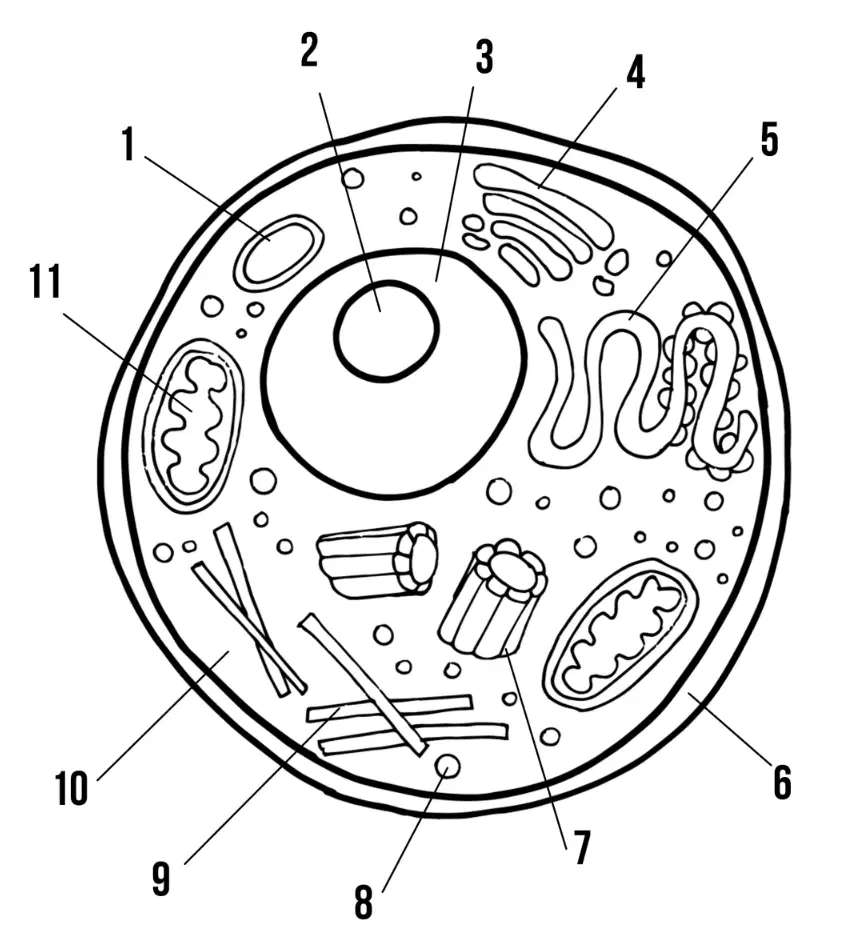
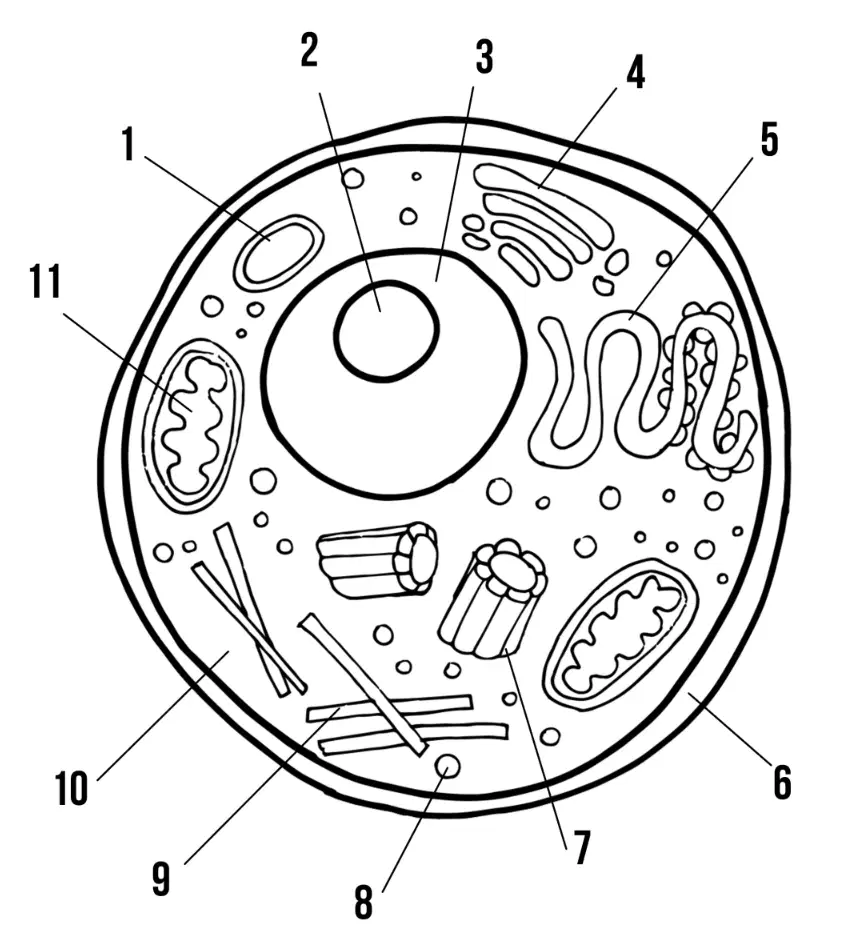
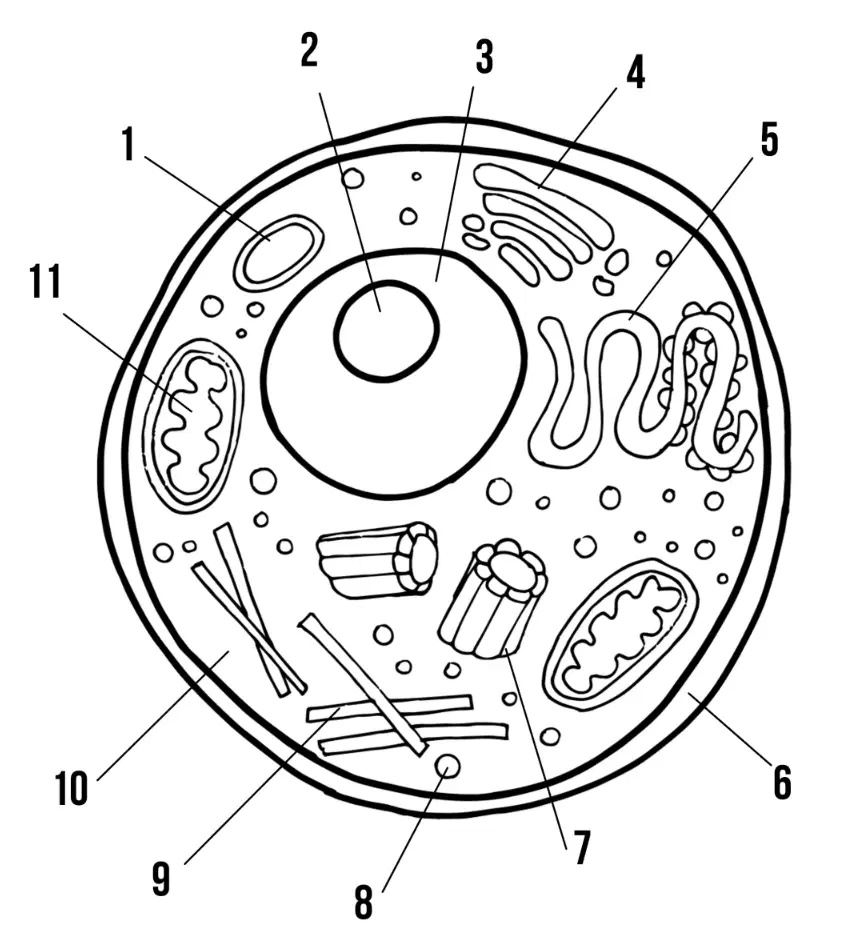
Which organelle in the diagram below is labeled 2?
a)
nucleolus
b)
brain
c)
mitochondria
d)
nucleus
32.
Which organelle in the diagram below is labeled 11?
a)
lysosome
b)
chloroplast
c)
mitochondria
d)
nucleus
33.

Which organelle in the diagram below is labeled 5?

a)
lysosome
b)
ribosome
c)
mitochondria
d)

ER

34.
Which organelle in the diagram below is labeled 6?
a)
cell wall
b)
cell membrane
c)
Golgi body
d)
mitochondria
35.
Directs all cell activities through the DNA located there.
a)
Lysosomes
b)
Nucleus
c)
ribosomes
d)
Mitochondria
36.
A rigid layer that lies outside the cell's  membrane is...
a)
Cytoskeleton
b)
Cilia
c)
Cell Wall
d)
Flagella
37.
I am the outer most layer of an animal cell. What am I?
a)
cell wall
b)
nucleus
c)
cell membrane 
d)
cell skin
38.
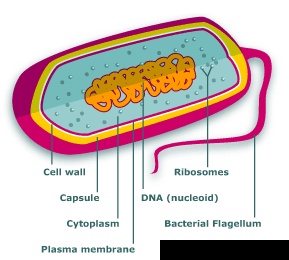
Which type of cell?
a)
Prokaryote
b)
Eukaryote
39.
Which part of the cell is often called "the brain of the cell"?
a)
nuclear membrane
b)
endoplasmic reticulum
c)
nucleus
d)
mitochondria
40.
I make proteins for the cell. What am I?
a)
ribosome
b)
mitochondria
c)
chloroplast
d)
lysosome
41.
The invention of the microscope made it possible for people to discover and learn about
a)
Plants
b)
Skin 
c)
Animals 
d)
Cells
42.
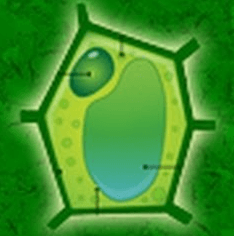
Using this image, what organelle is C?
a)
Cell Wall
b)
Mitochondria
c)
Large Cell Vacuole
d)
Chloroplast
43.

Identify the structure that is indicated by the arrow in the image.

a)

cell wall

b)

central vacuole

c)

chloroplast

d)

nucleus

44.

The arrow is showing the fluid inside the cell that surrounds the cell organelles. What is the arrow pointing to in the cell?

a)

cytoplasm

b)

mitochondria

c)

ribosomes

d)

nucleus

45.
Which type of cell?
a)
Prokaryote
b)
Eukaryote
46.

What is #1 in the diagram?

a)

nucleus

b)

cell wall

c)

cytoplasm

d)

mitochondrion

47.
Which organism is made up of cells that have both a cell membrane and a cell wall?
a)
desert mouse
b)
human 
c)
maple tree
d)
zebra
48.

The organelle that assembles proteins in the cytoplasm:

a)

Ribosome

b)

Nucleus

c)

Mitochondrion

d)

Rough Endoplasmic Reticulum

49.

The organelle that regulates materials entering and leaving the cell, as well as supporting and protecting it:

a)

Cell Wall

b)

Cell Membrane

c)

Centrioles

d)

Cytoskeleton

50.

In what organelle is the genetic material found inside?

a)

Nucleus

b)

endoplasmic reticulum

c)

Mitochondria

d)

Lysosome

51.
Directs all cell activities through the DNA located there.
a)
Lysosomes
b)
Nucleus
c)
ribosomes
d)
Mitochondria
52.

This image of a cell is often found in textbooks.  It is one of the first images to appear when searching for cell models.  However, this model may be misleading and could lead to misconceptions about cell structure.  

Which of the following would be a reason that this cell model would lead to misconceptions? 

a)

Not all cells have cell membranes like this model does.

b)

All cells have a specific structure that carries out a specific function--so they aren't all shaped like this

c)

It will not mislead because all cells look exactly the same.

d)

all cells can change structure based on a function that is needed by the body

53.

I was one of the first people to observe cells by examining a cork under a microscope.

a)

Hooke

b)

Schleiden

c)

Virchow

d)

Leeuwenhoek

e)

Schwann

54.
Michael looked at a cell through a microscope.  He identified a nucleus, chloroplast, and cytoplasm.  What kind of cell did Michael observe?
a)
animal
b)
plant
c)
vertebrate
d)
bacteria
55.

A plant's green color is due to the presence of which organelle?

a)

Nucleus

b)

Chloroplast

c)

Vacuole

d)

Mitochondrion

56.

A group of organs work together to create:

a)

cells

b)

organs

c)

organ system

d)

organism

57.
Every living organism is made up of one or more cells
a)
True
b)
False
58.

What is one way in which all living things on Earth are alike?

a)

All living things have hair.

b)

All living things are made of cells.

c)

The cells of all living things have chloroplast.

d)

All living things can move.

59.

An organ system works together to create a (an):

a)

cells

b)

organs

c)

organ system

d)

organism

60.

Which of the following best describes the function of the mitochondria?

a)

They store energy from food molecules.

b)

They convert energy from food molecules into energy the cell can use.

c)

They store energy from sunlight.

d)

They produce nucleic acids that release energy.