
 Worksheets
US Imperialism and WWI
Total questions: 41
Worksheet time: 29mins
What best describes the significance of the frontier, according to Frederick Jackson Turner’s “Frontier Thesis?”
The frontier was a place of equal opportunity for all people regardless of race, class or gender
There would never be a “closing” of the frontier because Americans would always look for new land
The frontier was more of a curse than a blessing as it inevitably led to increased conflict
The existence of an area of free land gave Americans an opportunity to move West for new opportunities
All the following were major economic activities in the West during the late 19th century EXCEPT:
Mining
Textile Production
Agricultural Production
Ranching
How did Chief Joseph feel about the treatment of natives?
The US government cannot expect Native Americans to thrive if they are forced to stay on one piece of land
The Native American chiefs are preparing to band together to fight against injustices toward their people
The US government has treated Native Americans fairly and provided new opportunities
The Native Americans should receive preferential treatment over white Americans as they were the first people to inhabit the continent
What was the cause that divided Native American tribal lands into individual plots
The Sodbusters
The Homestead Act
The Dawes Severalty Act
The Ghost Dance
The treatment of Native Americans and conquered people during the Age of Imperialism are similar in that …
Americans tried to mix the native culture into their own cultural practices to show respect
Americans assumed they had cultural and racial superiority over the people whose land they took
Both people petitioned to be annexed by the United States to enjoy the benefits of democracy
Both people did not resist being taken over by America as they knew resistance was impossible
All the following were motives for American Imperialism in the late 19th & early 20th century EXCEPT:
The desire to find larger markets to export goods
The end of imperialistic ambitions in Europe created a power vacuum
Ideas of Social Darwinism and a “White Man’s Burden”
The “closing” of the frontier and desire for new opportunities
Which of the following areas was annexed by the US in 1898 and was the site of large sugar plantations?
Panama
The Philippines
Hawaii
Cuba

What best describes the message of this cartoon?
America is justified in fighting due to actions taken by the country controlling Cuba
The war in Cuba has led to much destruction and suffering among the Cubans
Uncle Sam is creating more problems than solutions in Cuba
America should stop fighting foreign wars and focus on domestic issues
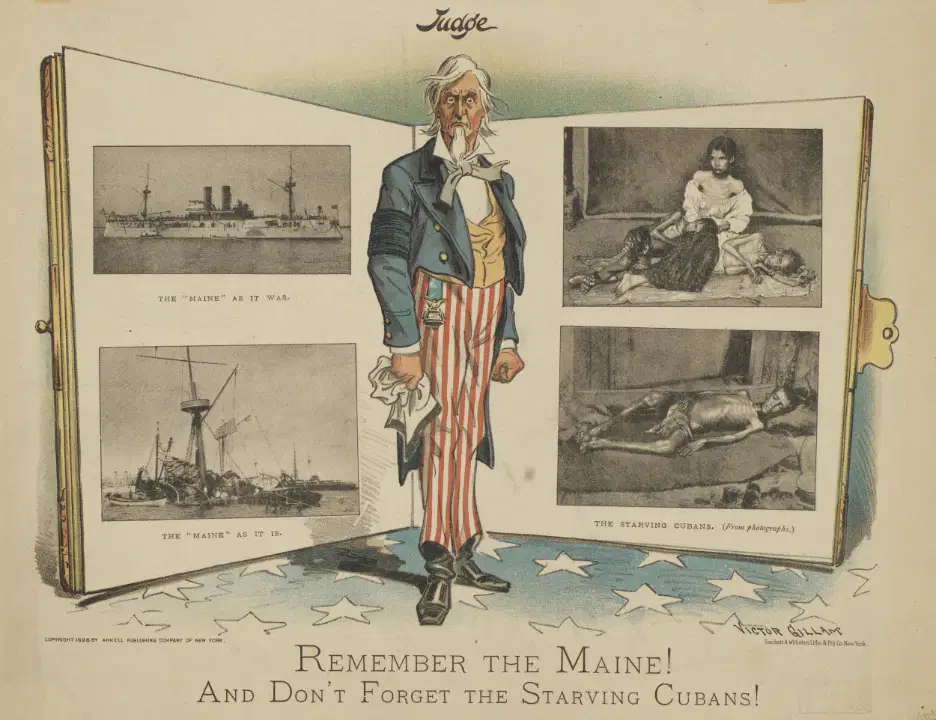
The cartoon most directly alludes to the causes of the…
Creation of the Anti-Imperialist League
Spanish-American War
Cuban Revolution
Gentleman’s Agreement
What best describes the Open Door Policy?
The European powers and America should all be able to trade freely with and in China
The policy was implemented at the request of the Chinese people who wanted more trade opportunities
America would allow immigrants from all countries to enter the US with no limitations or requirements
The policy of negotiating treaties publicly without any secret agreements
Teddy Roosevelt’s “Big Stick Diplomacy” was used to push forward the creation of the…
McKinley Tariff
Suez Canal
Teller Amendment
Panama Canal
Anti-imperialists made all the following arguments against acquiring colonies like the Philippines EXCEPT:
It would violate the “consent of the governed” philosophy of the Declaration of Independence.
Annexation would draw the United States into additional political and military issues in the Far East.
The Philippines' system of government was actually superior to American democracy.
It was hypocritical to force American systems upon a people who did not want to accept them.
When World War I broke out in 1914, America…
Joined the Allies immediately
Adopted a policy of neutrality
Tried to join the war but it was vetoed by Congress
Made secret deals with both the Allies and Central Powers

Which of the following inferences about the WWI Draft poster is most accurate?
Pacifists and conscientious objectors would likely oppose it
It was not necessary since the volunteer army was huge
It included women in combat roles for the first time
Four minute men would give speeches opposing it

All of the following were objectives of propaganda posters during WWI EXCEPT:
To recruit soldiers, either through a draft or voluntary enlistment
To finance the war effort through the sale of war bonds—loans from citizens to the government—or new taxes
To eliminate dissent and unify Americans behind the war
To encourage voters to support Wilson for re-election
Which of the following characterized fighting in WWI?
Stealth bombers
Cavalry raids
Trench warfare and gas attacks
Long marches and intermittent fighting
Which of these did NOT occur for African Americans during World War I?
Changing settling patterns led to racial tensions and riots.
Many African Americans moved north for jobs.
The army completely integrated their units.
Community leaders disagreed about whether or not to support the war
The Selective Service Act of 1917 created conscription, which means it…
created a military draft
required rationing of food
allowed women to serve as non-commissioned officers (NCOs)
limited free speech
Which of the following best describes the Committee on Public Information during WWI?
a government agency led by George Creel to promote pro-war propaganda to the American public
a civilian institution which protested the lack of accurate information presented by the government in regards to the war effort
a government agency committed to allowing the freedom of information during the war
a civilian institution which worked against any instances of anti-American articles published by the press
America joined WWI most directly in response to…
the sinking of the Lusitania
The Zimmerman Telegram
the pro-war speeches of Woodrow Wilson
the impassioned pleas for help from the Allies
All of the following are true about The Espionage Sedition Acts EXCEPT:
They reflected fears about Germans and Anti-War Americans
They targeted Socialists and members of the Industrial Workers of the World (Wobblies)
They represented a curtailing of rights during times of war
They were ruled unconstitutional by the Supreme Court in Schenck v. United States
Which was NOT part of Wilson’s 14 Points?
Making Germany pay reparations
Creating a League of Nations
Ensuring freedom of the seas
Using the principle of Self-Determination to redraw national boundaries
What was the ultimate fate of the Treaty of Versailles in the United States?
President Wilson vetoed it due to pressure from irreconcilables.
It was declared unconstitutional by the Supreme Court.
It was supported by Irreconcilables but rejected by Reservationists.
It was rejected by Congress due to the opposition by Reservationists and Irreconcilables.
What was Henry Cabot Lodge’s argument for why the US should not join the League of Nations?
He believed the US should not get involved in European affairs.
He believed that liberty was an ideal that was possible only in America.
He believed that conservative economic policies were flawed.
He believed that the world needed to be made safe for democracy.
What was the dominant view on foreign policy in America in the 2 decades after World War I?
Interventionism – they believed war would help economic development
Interventionism – they believed it was the United States’ obligation to fight the spread of Communism
Isolationism – they did not want to get pulled into another war
Isolationism – WWI had devastated the US economy
In 1914, when the war first broke out in Europe, president Wilson asked Americans to... (LT 1A)
Adopt a policy of neutrality.
Make the world safe for democracy.
Offer loans and sell supplies to our allies.
Compete for trade and territory with our enemies.
How did President Wilson respond to the sinking of the Lusitania in 1915? (LT 1A)
By calling congress to approve a declaration of war against Germany.
By demanding that Germany stop unrestricted submarine warfare.
By sending navy ships to patrol Atlantic waters and sink any u-boats they found.
By warning American citizens that they traveled on foreign ships at their own risks.
In the Zimmerman Telegram, what did Germany promise Mexico in return for its support during WWI? (LT 1A)
Germany would cede territory in Africa to Mexico.
Germany would not attack Mexican merchant ships.
Germany would become allies and help Mexico regain territory in the United States
Germany would loan Mexico money to jumpstart its economy.
How did the U.S. government build the large fighting force it would need to enter WWI? (LT 3C)
It encouraged women to enlist as well as men.
It allowed black soldiers to train and fight alongside whites.
It offered high wages to anyone who volunteered to fight.
It established a national draft for young men aged 21-30 by passing the Selective Service Act
Why did the reservationists like Henry Cabot Lodge refuse to support ratification of the treaty? (LT 5D)
They were opposed to the idea of decreasing American military power.
They did not want the nation to be pulled into another international war.
They felt that the treaty did not place a large enough penalty on Germany.
They supported a larger colonial presence in developing foreign continents.
During the Great Migration which occurred during World War I...
African Americans moved north for opportunities in munition plants and other factories
Race was no longer a major source of conflict
Women moved into new lines of work such as welding and manufacturing
Many immigrants entered the United States
This is the belief in regards to imperialism that it must be done so as to lead "backwards" people towards the light of democracy...
White Man's Burden
Open Door Policy
Self-determination
Sphere of Influence
What event led to the start of the Spanish-American War?
sinking of the USS Maine
sinking of the USS Lusitania
attack on southern Florida by Cuba
the coronation of Liliuokalani
Which of the following foreign policies was used to acquire the land necessary to build a canal in Panama?
Big Stick Policy
Dollar Diplomacy
Moral Diplomacy
Treaty of Paris
The Homestead Act of 1862 helped the development of the West by
providing free land to settlers
granting land for construction of transcontinental railroads
allowing slavery to spread to the territories
placing Native American Indians on reservations
Which event was the most significant in ending traditional Native American life on the plains?
invention of barbed wire
the destruction of the buffalo
the discovery of gold
the building of railroads
Which of the following best describes the impact of the Treaty of Versailles on Germany?
It led to economic prosperity and growth
It imposed heavy reparations and territorial losses
It resulted in Germany gaining new colonies
It allowed Germany to maintain its military strength
What was the main goal of the League of Nations?
To promote global trade
To prevent future wars through collective security
To establish a global currency
To expand colonial empires
What was the primary reason for the U.S. Senate's rejection of the Treaty of Versailles?
Concerns over economic impacts on the U.S.
Fear of entanglement in future European conflicts
Desire to maintain isolationist policies
Opposition to the League of Nations
Which of the following was a significant effect of the Great Migration during World War I?
Increased racial tensions in Northern cities
Decrease in agricultural production in the South
Expansion of the U.S. military forces
Improved diplomatic relations with European countries
What was the main purpose of the Espionage Act of 1917?
To promote freedom of speech during wartime
To prevent support of U.S. enemies during wartime
To encourage enlistment in the U.S. military
To regulate the economy during wartime

