wayground logo

Free Printable Worksheets

Font size

S
M
L
XL
Worksheets

Pre-Calc Review: Domain, Range, Interval Notation etc.

Total questions: 51

Worksheet time: 31mins
Name
Class
Date
1.
All of the x values or inputs are called what?
a)
Domain
b)
Range
c)
Relation
d)
Function
2.
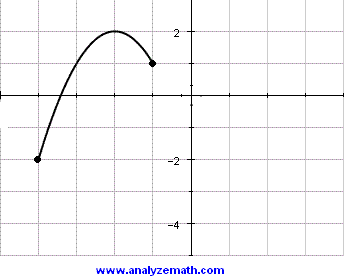
What is the range?
a)
[-7,6]
b)
(-7,6)
c)
(-8, 2)
d)
[-8,2]
3.
Which graphs have a range of (-∞, 3]
a)
I and II
b)
I and III
c)
II and III
d)
I , II and III
4.
What is the domain of the graph?
a)
[1,∞)
b)
(-∞,1]
c)
(-∞,∞)
d)
[-∞,∞]
5.
What is the range of the graph?
a)
[-2,2]
b)
[-2,1]
c)
[-4,-1]
d)
(-∞,∞)
6.
What is the domain of the function?
a)
(3, ∞)
b)
[-3, ∞)
c)
(-∞, 4]
d)
(-∞, 4)
7.

In interval notation, ∞ and -∞ gets what symbol?

a)

( ) Parentheses

b)

[ ] Square Brackets

c)

{ } Curly Bracket

8.
All of the y values or outputs are called what?
a)
Domain
b)
Range
c)
Relation
d)
Function
9.
What is the range of the graph?
a)
(-∞,∞)
b)
[0,∞)
c)
(0,5)
d)
[-1,∞)
10.

What has been your favorite part of math class?

a)

Warmups on Whiteboards

b)

Thinking Zones

c)

Small Group Work at Desks

d)

Online Math, such as Delta Math

11.
What is the domain of the function?
a)
(3, ∞)
b)
[-3, ∞)
c)
(-∞, 4]
d)
(-∞, 4)
12.
What is the definition of function?
a)
Has inputs and outputs
b)
Every input has only ONE output
c)
Inputs have different outputs every time
d)
x-values and y-values
13.

RANGE is found by reading the ends of a graph from ___ to ___.

a)

Right to left

b)

Left to right

c)

Bottom to top

d)

Top to bottom

14.

DOMAIN is found by reading the ends of a graph from ___ to ___.

a)

Right to left

b)

Left to right

c)

Bottom to top

d)

Top to bottom

15.

What is the range of the graph?

a)

[-7, 5)

b)

(-3, 1]

c)

[-3, 1)

d)

(-7, 5]

16.

What is the domain?

a)

[-2, 3]

b)

[-2, 3)

c)

(-2, 3]

d)

[-3, 4]

e)

(-3, 4]

17.
Express the following in Interval Notation
 -8 ≤ x < 8 
a)
[-8, 8]
b)
[-8,8)
c)
(-8, 8]
d)
(-8, 8)
18.

What is the increasing interval for the function below?

a)

(,)\left(-\infty,\infty\right)

b)

(,2]\left(-\infty,2\right]

c)

(,6]\left(-\infty,6\right]

d)

(6,6)\left(-6,6\right)

19.

What is/are the increasing interval(s) for the function shown?

a)

(3, 1)\left(-3,\ 1\right)

b)

(4, 8)\left(4,\ 8\right)

c)

(,1) and (3, 1)\left(-\infty,1\right)\ and\ \left(-3,\ 1\right)

20.

What is/are the decreasing interval(s) for the function shown?

a)

(2, 4) and (8, )\left(2,\ 4\right)\ and\ \left(8,\ \infty\right)

b)

(, 1) and (8, )\left(-\infty,\ 1\right)\ and\ \left(8,\ \infty\right)

c)

(,1), (3, 1) and (8, )\left(-\infty,1\right),\ \left(-3,\ 1\right)\ and\ \left(8,\ \infty\right)

d)

(, 1), (2, 4) and (8, )\left(-\infty,\ 1\right),\ \left(2,\ 4\right)\ and\ \left(8,\ \infty\right)

21.

What is the decreasing interval(s) on the function shown?

a)

(7, 6) and (2, 4)\left(-7,\ -6\right)\ and\ \left(-2,\ 4\right)

b)

(7, 0) and (2, 4)\left(-7,\ 0\right)\ and\ \left(-2,\ 4\right)

c)

(7, 6) and (2, 0)\left(-7,\ -6\right)\ and\ \left(-2,\ 0\right)

d)

(7, 0) and (4, 5)\left(-7,\ 0\right)\ and\ \left(4,\ 5\right)

22.

What is the increasing interval on the function shown?

a)

(, 1)\left(-\infty,\ 1\right)

b)

(, 2)\left(-\infty,\ 2\right)

c)

(2, )\left(2,\ \infty\right)

d)

(1, )\left(1,\ \infty\right)

23.

What is the decreasing interval on the function shown?

a)

(, 1)\left(-\infty,\ 1\right)

b)

(, 2)\left(-\infty,\ 2\right)

c)

(2, )\left(2,\ \infty\right)

d)

(1, )\left(1,\ \infty\right)

24.

What is the decreasing interval on the function shown?

a)

(, 3)\left(-\infty,\ -3\right)

b)

(, 4)\left(-\infty,\ -4\right)

c)

(4, )\left(-4,\ \infty\right)

d)

(3, )\left(-3,\ \infty\right)

25.

What is the increasing interval on the function shown?

a)

(, 3)\left(-\infty,\ -3\right)

b)

(, 4)\left(-\infty,\ -4\right)

c)

(4, )\left(-4,\ \infty\right)

d)

(3, )\left(-3,\ \infty\right)

26.

What is the increasing interval(s) on the function shown?

a)

(, 15) and (9, 15)\left(-\infty,\ -15\right)\ and\ \left(9,\ -15\right)

b)

(2, 9) and (2, )\left(-2,\ 9\right)\ and\ \left(2,\ \infty\right)

c)

(, 2) and (0, 2)\left(-\infty,\ -2\right)\ and\ \left(0,\ 2\right)

d)

(2, 0) and (2, )\left(-2,\ 0\right)\ and\ \left(2,\ \infty\right)

27.

What is the decreasing interval(s) on the function shown?

a)

(, 15) and (9, 15)\left(-\infty,\ -15\right)\ and\ \left(9,\ -15\right)

b)

(2, 9) and (2, )\left(-2,\ 9\right)\ and\ \left(2,\ \infty\right)

c)

(, 2) and (0, 2)\left(-\infty,\ -2\right)\ and\ \left(0,\ 2\right)

d)

(2, 0) and (2, )\left(-2,\ 0\right)\ and\ \left(2,\ \infty\right)

28.
The function shown in the graph is:
a)
even
b)
odd
c)
neither even nor odd
29.
The function in the graph is:
a)
even
b)
odd
c)
neither even nor odd
30.
Is the graph an even, odd, or neither function.
a)
Even
b)
Odd
c)
Neither
31.
Is the graph an even, odd, or neither function
a)
Even
b)
Odd
c)
Neither
32.
Is the graph an even, odd, or neither function?
a)
Even
b)
Odd
c)
Neither
33.
The function shown in the graph is:
a)
even
b)
odd
c)
neither odd nor even
34.
a)

Even Function

b)

Odd Function

c)

Function - Neither Even Nor Odd

d)

Both Even and Odd Function

e)

Not a Function

35.

Is the table even, odd or neither?

a)

Even

b)

Odd

c)

Neither

36.

The function of the graph shown is

a)

Odd

b)

Even

c)

Neither

d)

Sine

e)

Cosine

37.

The function of the graph shown is (select all that apply)

a)

Odd

b)

Even

c)

Neither

d)

Sine

e)

Cosine

38.

Is the following function even, odd, or neither?
f(x)=sin(x)+1f\left(x\right)=\sin\left(x\right)+1  

a)

Even

b)

Odd

c)

Neither

39.

Is the following function even, odd, or neither?
f(x)=cos(x)+1f\left(x\right)=\cos\left(x\right)+1  

a)

Even

b)

Odd

c)

Neither

40.

What is a full revolution around the unit circle?

a)

π\pi

b)

π2\frac{\pi}{2}

c)

2π2\pi

d)

4π4\pi

41.
What is sin 45°?
a)

1

b)

√3/2

c)

½

d)

√2/2

42.

Find the EXACT value: cos(π6)\cos\left(\frac{\pi}{6}\right)  

a)

12-\frac{1}{2}

b)

32\frac{\sqrt[]{3}}{2}

c)

  12\frac{1}{2}

d)

  32-\frac{\sqrt[]{3}}{2}

43.

sin π6\sin\ \frac{\pi}{6}  =

a)

1/2

b)

22-\frac{\sqrt{2}}{2}  

c)

-1

d)

1

44.

cosπ\cos\pi  

a)

1

b)

1/2

c)

0

d)

-1

45.

sin π\sin\ \pi  

a)

1

b)

1/2

c)

0

d)

-1

46.
Based on your unit circle cos(0o)=
a)
1
b)
0
c)
-1
d)
1/2
47.

sin 135º

a)

12\frac{1}{2}

b)

32\frac{\sqrt{3}}{2}

c)

22\frac{\sqrt{2}}{2}

d)

22-\frac{\sqrt{2}}{2}

48.

Find the exact value of cos(3π2)\cos\left(\frac{3\pi}{2}\right) .

(a)  

49.

Convert 60°60\degree to radians.

a)

π3\frac{\pi}{3}

b)

π4\frac{\pi}{4}

c)

π6\frac{\pi}{6}

d)

π2\frac{\pi}{2}

50.

Based on the unit circle, what is the value of cos?

a)

y

b)

x

c)

x/y

d)

y/x

51.

Given h(x) = 5 - 9x, find h(8).