wayground logo

Free Printable Worksheets

Font size

S
M
L
XL
Worksheets

Polynomial functions, graphs and composition

Total questions: 50

Worksheet time: 57mins

Name
Class
Date
1.

Which steps describe how to evaluate a polynomial?

a)

Substitute the given number in the place of the variable

b)

Simplify using the order of operations

c)

Replace f(x) with y

d)

Multiply by the coefficient

2.

Which statements are true?

a)

A polynomial is an expression composed of variables, constants, and exponents

b)

While f is the most common letter used to represents functions, any letter can be used.

c)

Polynomial functions are used to approximate data.

d)

Functions allow us to predict what might happen.

3.

The operations of addition, subtraction, multiplication and division are defined for functions.

a)

True

b)

False

4.

Which is equivalent to    (f+g)(x) \left(f+g\right)\left(x\right)\   

a)

 f(x)+g(x)f\left(x\right)+g\left(x\right)  

b)

 x(f)+x(g)x\left(f\right)+x\left(g\right)  

c)

 (f+g)x\left(f+g\right)\cdot x  

d)

 x+yx+y  

5.

Which is equivalent to    (fg)(x) \left(f-g\right)\left(x\right)\   

a)

 f(x)g(x)f\left(x\right)-g\left(x\right)  

b)

 x(f)x(g)x\left(f\right)-x\left(g\right)  

c)

 (fg)x\left(f-g\right)\cdot x  

d)

 xyx-y  

6.

 f(x) is read asf\left(x\right)\ is\ read\ as  

a)

 f times the value of xf\ times\ the\ value\ of\ x  

b)

 f of xf\ of\ x  

c)

 x times the value of fx\ times\ the\ value\ of\ f  

d)

 x of fx\ of\ f  

7.

 f(x) meansf\left(x\right)\ means  

a)

 f times the value of xf\ times\ the\ value\ of\ x  

b)

 f evaluated at the value of xf\ evaluated\ at\ the\ value\ of\ x  

c)

 x times the value of fx\ times\ the\ value\ of\ f  

d)

 x evaluated at the value of fx\ evaluated\ at\ the\ value\ of\ f  

8.

Which is equivalent to    (fg)(x) \left(f\cdot g\right)\left(x\right)\   

a)

 f(x)g(x)f\left(x\right)\cdot g\left(x\right)  

b)

 x(f)x(g)x\left(f\right)\cdot x\left(g\right)  

c)

 (fg)x\left(f\cdot g\right)\cdot x  

d)

 xyx\cdot y  

9.

Which is equivalent to    (fg)(x) \left(\frac{f}{g}\right)\left(x\right)\   

a)

 f(x)g(x)\frac{f\left(x\right)}{g\left(x\right)}  

b)

 x(f)x(g)\frac{x\left(f\right)}{x\left(g\right)}  

c)

 (fg)x\left(\frac{f}{g}\right)\cdot x  

d)

 xy\frac{x}{y}  

10.

How do you know when the difference of functions will be a constant?

a)

When the given is a constant Example find f(2) - g(2)

b)

When the given is a variable. Example Find f(x) - g(x)

11.

How do you know when the sum of functions will be an expression?

a)

When the given is a constant Example find f(2) + g(2)

b)

When the given is a variable. Example Find f(x) + g(x)

12.

 (fg)(x)\left(f\cdot g\right)\left(x\right)  is the same as (fg)(x)\left(f\circ g\right)\left(x\right)  

a)

True

b)

False

13.

 f(g(x))f\left(g\left(x\right)\right)  is the same as (fg)(x)\left(f\circ g\right)\left(x\right)  

a)

True

b)

False

14.

 (fg)(x)\left(f\circ g\right)\left(x\right)  means........

a)

g(x) is used as the input for function f

b)

you replace x in function f with the function g

c)

substitute g(x) into function f every where there is an x

d)

you replace x in function g with the function f

15.

 When composing   (fg)(2)\left(f\circ g\right)\left(2\right)  


a)

evaluate g(2) first then use that value in f(x) 

b)

evaluate f(2) first then use that value in g(x)

c)

evaluate g(2) first , evaluate f(2), find the product of the two values

d)

evaluate f(2) first, evaluate g(2), find the product of the two values

16.

In the expression f(g(x))f\left(g\left(x\right)\right)  

a)

g(x) is the inside function

b)

f(x) is the inside function

c)

f(x) is the outside function

d)

g(x) is the outside function

17.

 (fg)(x) = (gf)(x)\left(f\circ g\right)\left(x\right)\ =\ \left(g\circ f\right)\left(x\right)  

a)

true; order does not matter in compositions

b)

false; compositions are not commutative

18.

The simplest polynomial function is the

_________ ________.

(a)  

19.

The identity function f(x) = x is a (a)   function.

20.

Which is equivalent to f(x) = x ?

a)

y = x

b)

f(x) = y

c)

f(y) = x

21.

Identify the graph

a)

Linear Identity Function

b)

Quadratic Function

c)

Cubic Function

d)

Constant Function

22.

Which function is graphed?

a)

y=xy=x

b)

y=xy=\sqrt{x}

c)

y=xy=\lfloor x\rfloor

d)

y=x2y=x^2

23.

Identify the graph

a)

constant

b)

linear

c)

cubic

d)

quadratic

24.

Which function is graphed?

a)

y=xy=x

b)

y=xy=\sqrt{x}

c)

y=cy=c

d)

y=bx, b>1y=b^x,\ b>1

25.

Which is the equation of the graph?

a)

y=xy=x

b)

y=x2y=x^2

c)

y=cy=c

d)

x = cx\ =\ c

26.

 identify the graphidentify\ the\ graph  

a)

linear

b)

quadratic

c)

absolute value

d)

inverse

27.

The graph of the squaring function is called a (a)  

28.

Which function is graphed?

a)

y=xy=x

b)

y=xy=\sqrt{x}

c)

y=x2y=x^2

d)

y=xy=\left|x\right|

29.

Identify the graph

a)

cube root

b)

cubic

c)

quadratic

d)

logarithmic

30.

Which function is graphed?

a)

y=x3y=x^3

b)
c)

y=1xy=\frac{1}{x}

d)

y=bx , b>1y=b^x\ ,\ b>1

31.

If  f(x) = x1f\left(x\right)\ =\ x-1 and g(x)=5x2g\left(x\right)=5x-2 , then  (f+g)(x)=\left(f+g\right)\left(x\right)= 

a)

 5x2+15x^2+1  

b)

 5x235x^2-3  

c)

 6x+16x+1  

d)

 6x36x-3  

32.

If  f(x) = x1f\left(x\right)\ =\ x-1 and g(x)=5x2g\left(x\right)=5x-2 , then  (fg)(x)=\left(f-g\right)\left(x\right)= 

a)

-4x - 3

b)

-4x +1

c)

6x + 1

d)

6x - 3

33.

If  f(x) = x1f\left(x\right)\ =\ x-1 and g(x)=5x2g\left(x\right)=5x-2 , then  (fg)(x)=\left(f\cdot g\right)\left(x\right)= 

a)

 5x35x-3  

b)

 5x2+25x^2+2  

c)

 5x27x+25x^2-7x+2  

d)

 5x75x-7  

34.

If  f(x) = x1f\left(x\right)\ =\ x-1 and g(x)=5x2g\left(x\right)=5x-2 , then  (fg)(x)\left(\frac{f}{g}\right)\left(x\right) 

a)

 x15x2\frac{x-1}{5x-2}  

b)

 5x2x1\frac{5x-2}{x-1}  

c)

 13\frac{-1}{3}  

d)

 3-3  

35.

If  f(x) = x+5f\left(x\right)\ =\ x+5 and g(x)=3x7g\left(x\right)=3x-7 , then  (fg)(x)=\left(f\circ g\right)\left(x\right)= 

a)

 3x23x-2 

b)

 3x+83x+8  

c)

 3x2+8x353x^2+8x-35  

d)

 3x123x-12  

36.

If f(x)=5xf\left(x\right)=5x  g(x)=2x+1g\left(x\right)=-2x+1 , find  f(g(2))f\left(g\left(-2\right)\right) 


(a)  

37.

Find (fg)(2)(f-g)(2) if  f(x)=4x+10f(x)=4x+10   and  g(x)=3x7g(x)=3x-7  

(a)  

38.

 f(t) = t5; f\left(t\right)\ =\ -t-5;\   g(t) = 2t33t2g\left(t\right)\ =\ -2t^3-3t^2  
 find  (fg)(2)\left(f\cdot g\right)\left(-2\right)  

a)

-80

b)

0

c)

-54

d)

-12

39.

 f(x) =2xf\left(x\right)\ =2x  ;  g(x)=2x7g\left(x\right)=2x-7  

find (f+g)(2)\left(f+g\right)\left(2\right)  

a)

-7

b)

1

c)

-1

d)

8

40.

Given f(x)=x2+5f(x)=x^2+5   and  g(x)=2x31g(x)=2x^3-1  ,

 find (fg)(3)\left(\frac{f}{g}\right)\left(-3\right) .

a)

 1455-\frac{14}{55}  

b)

 1455\frac{14}{55} 

c)

2

d)

-2

41.

What is the domain of the graph?

a)

x ≥ -6

b)

-7 ≤ x ≤ 3

c)

-8 ≤ x ≤ 4

d)

x ≤ -6

e)

All real numbers

42.

What is the range of the graph?

a)

y ≥ -6

b)

-7 ≤ y ≤ 3

c)

-8 ≤ y ≤ 4

d)

y ≤ -6

e)

All real numbers

43.
What is the domain?
a)
x = 2
b)
−∞ < x < ∞
c)
y = 2
d)
none of these
44.
What is the range?
a)
x = 2
b)
−∞ < x < ∞
c)
y = 2
d)
none of these
45.
Describe the transformation of the graph  y = (x)3  + 6
a)
Right 6
b)
Left 6
c)
Up 6
d)
Down 6
46.
What is the Domain of ALL Cube Root Functions in interval notation?
a)
(−∞,∞)
b)
−∞<x<∞
c)
(−∞,0]
d)
All Cube Root Functions are different.
47.
What is the Range of ALL Cube Root Functions in interval notation?
a)
(−∞,∞)
b)
−∞<y<∞
c)
(−∞,0]
d)
All Cube Root Functions are different.
48.
What is the range of ALL cubic functions expressed as an inequality?
a)
[-∞, ∞]
b)
(-∞,∞)
c)
-∞≤y≤∞
d)
-∞<y< ∞
49.
What is the domain ALL cubic functions expressed as an inequality?
a)
(-∞,∞)
b)
-∞<x< ∞
c)
(-∞, 0]
d)
-∞<y< ∞
50.
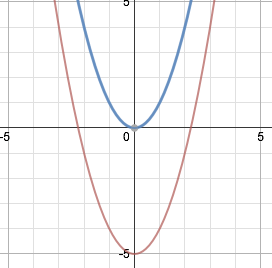
If the blue is f(x)=x2, then the red must be
a)
g(x)=x2-5
b)
g(x)=x2+5
c)
g(x)=(x-5)2
d)
g(x)=(x+5)2