
Font size
 Worksheets
EFFECTS OF DISSOLUTION PRACTICE TEST : REVIEW
Total questions: 55
Worksheet time: 4hrs 35mins
In Michael's science experiment with salt water, NaCl (salt) would be considered the ______.
Solution
Solute
Solvent
Solvation
You can make a solution more concentrated by adding more __________.
solution
Avery is conducting a science experiment. When water is added to a solution it is called a ______________
dilution
concentration
heterogeneous solution
dissociation
Luna and Daniel are conducting an experiment to see how much __________ can dissolve in a solvent to create saturated, unsaturated, and supersaturated solutions.
sugar
liquid
solution
solute
A solution that contains all of the solute that it can hold at a given temperature.
unsaturated solution
homogeneous solution
In a science experiment, Avery dissolved sugar in water. What is the substance in which the sugar is dissolved?
sands
solvent
alloy
negative particles
Emma is making a sugar solution for her science experiment. What is the substance being dissolved in the solution?
sands
solute
solvent
alloy

Aria is making lemonade. She adds sugar to the water. The sugar is a
solute
solution
science

solvent
solute

solvent
solution
solute

solute
solvent

solvent
solute

solvent
solute
The smaller the particle size the faster the rate of dissolution (rate of dissolving).
True
False
True or False
The rate of dissolving of a solute in a solvent is faster when the solute and solvent are stirred.
True
False
Jackson is making dinner and is trying to dissolve salt into a pot of water. The salt is dissolving slowly. What should Jackson do to speed up the rate of dissolving?
He should put larger salt particles in the water.
He should heat the water to a higher temperature.
He should completely stop stirring the pot of water.
He should slow down the speed he is stirring the pot.
What combination would dissolve a solid solute the fastest?
high temperature, no stirring
no heat, no stirring
sugar cube, no heat
high temperature, stirring
Stirring the solution increases the rate of dissolution (rate of dissolving).
True
False
The sugar cubes are called the
solute
solvent
The water is called the
solvent
solute
In which cup will the salt dissolve more slowly?
A solution with high amount of solute
concentrated
saturated
unsaturated
diluted

What kind of mixture is shown in the picture?
Homogeneous
Heterogeneous

What kind of mixture is shown in the picture?
Homogeneous
Heterogeneous


What are the 3 factors that affect rate of dissolution (how fast things dissolve)?
temperature, wind, surface area
temperature, agitation, surface area
emotions, attitude, language
temperature, sound, surface area
What is the definition of temperature?
The measure of hotness or coldness
A homogeneous mixture
stirring
the area of the chemical components used in a reaction
What is the definition of agitation?
The measure of hotness or coldness
A homogeneous mixture
stirring, shaking, mixing
the area of the chemical components used in a reaction
What is the definition of surface area?
The measure of hotness or coldness
A homogeneous mixture
stirring, shaking, mixing
the area of the chemical components used in a reaction

How does temperature affect rate of dissolution?
high (hot) temperature dissolves slowly
high (hot) temperature dissolves faster
low (cold) temperature dissolves faster

How does agitation affect rate of dissolution?
It does not affect it
agitation increases the rate of dissolution (dissolves faster)
agitation decreases the rate of dissolution (dissolves slower)

How does surface area affect rate of dissolution?
It does NOT affect rate of dissolution
higher surface area (more little pieces) dissolves faster
lower surface area (more big pieces) dissolves faster
Observe the four graduated cylinders containing a solution. Which solution is the most dilute?
Some water is added to an empty glass. A sugar cube is then dropped in and dissolved. The water is the (a) and the sugar is the (b) .
Give an example of a homogeneous mixture.
Oil and water
Sand and water
Salty water
Iron filings and sulfur


Concentration is
the amount of solute in the solvent
the amount of solvent in the solute
density
particle size
The amount of area covered by the surface (outside) of an object.
Rate of Dissolution
Surface Area
Concentration
Agitiation
Joe set up an experiment to determine if the temperature of the solvent has an affect on the rate of dissolution. Identify the trial that will dissolve the quickest.
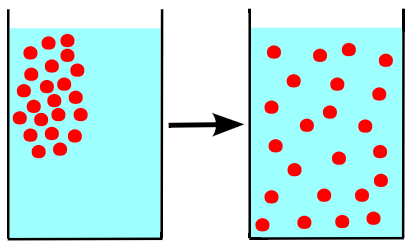
Investigate how increasing the surface area of a solid solute affects its rate of dissolution in water.
It decreases the rate of dissolution.
It has no effect on the rate of dissolution.
It increases the rate of dissolution.
It stops the dissolution process.

