
Font size
 Worksheets
Review Quiz: Introduction to Electronics Communications
Total questions: 25
Worksheet time: 15mins
In a communications system, noise is most likely to affect the signal
at the transmitter
in the channel
in the information source
at the destination
Indicate the FALSE statement. Fourier analysis shows that a sawtooth wave consist of
fundamental and subharmonic sine waves
a fundamental sine wave and an infinite number of harmonics
fundamental and harmonic sine waves whose amplitude decreases with the harmonic number
sinusoidal voltages, some of which are small enough to ignore in practice
Indicate the true statement. The process of sending and receiving started as early as
the middle 1930s
1850
the beginning of the twentieth century
the 1840s
Communication is the process of
Keeping in touch.
Broadcasting.
Exchanging information.
Entertainment by electronics.
Two (2) key barriers to human communication are (check that applies)
Language
Distance
Cost
Standards
Electronic communications was discovered in which century?
16th
18th
19th
20th
Random interference to transmitted signals is called
Adjacent channel overlap.
Cross talk.
Garbage-in-garbage out.
Noise.
The communication medium causes the signal to be
Amplified.
Modulated.
Attenuated.
Interfered with.
One-way communication is called
Half duplex
Full duplex
Bicomm
Simplex
Simultaneous two-way communication is called
Half duplex
Full duplex
Bicomm
Simplex
The process of transmitting two or more information signals simultaneously over the same channel is called
Multiplexing
Telemetry
Mixing
Modulation
Continuous voice or video signals are referred to as being
Baseband
Analog
Digital
Continuous waves
Transmission of graphical information over the telephone network is accomplished by
Television
CATV
Videotext
Facsimile
Measuring physical conditions at some remote location and transmitting this data for analysis is the process of
Telemetry
Modulation
Instrumentation
Multiplexing
A frequency of 27 MHz has a wavelength of approximately
11 m
27 m
30 m
81 m
The voice frequency range is
30 to 300 Hz
300 to 3000 Hz
20 Hz to 20 kHz
0 Hz to 15 kHz
Another name for signals in the HF range is
Microwaves
RF waves
Shortwaves
Millimeter waves
Television broadcasting occurs in which ranges?
HF
EHF
VHF
UHF
Electromagnetic waves produced primarily by heat are called
Infrared rays
Microwaves
Shortwaves
X-rays
A micron is
One-millionth of a foot
One-millionth of a meter
One-thousandth of a meter
One ten-thousandth of an inch
A signal occupies the spectrum space from 1.115 GHz to 1.122 GHz. The bandwidth is?
0.007 MHz.
7MHz.
237 MHz
70MHz
In the United States, the electromagnetic spectrum is regulated and managed by
NTC
ITU
FCC
The United Nations
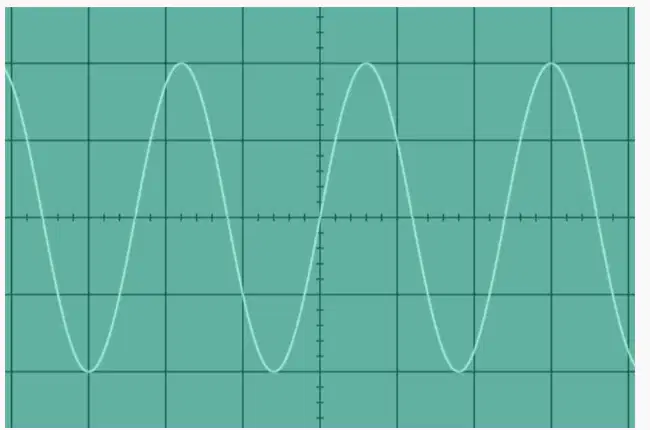
If this oscilloscope's Volts/div setting is 10, what is the amplitude of the wave shown in the image below?
10
2
20
5
If this oscilloscope's time base is set to 1ms/div, what is the wave frequency shown in the image below?
100 Hz
250 Hz
500 Hz
1000 Hz
A sine wave whose frequency is some integer multiple of a fundamental sine wave is called?
Harmonics
Square Wave
Complex Wave
Digital Pulses

