
 Worksheets
Circuits Quiz
Total questions: 15
Worksheet time: 15mins
Name
Class
Date
1.
In a series circuit, if one componeneet is removed or fails, what happens to the other components?
a)
They continue to work
b)
They become brighter
c)
They stop working
d)
They operate at reduced power
2.
In a parallel circuit, how does the voltage across each branch compare?
a)
It is shared equaaly among all branches
b)
It is the same across each branch
c)
It doubles for each branch
d)
It decreases with each added branch
3.
What is the primary characteristic of a parallel circuit?
a)
Current can flow through multiple paths
b)
Current flows through a single path
c)
Voltage is divided among components
d)
Resistance is always the same in all branches
4.
In a series circuit with 3 identical resistors, how does the total resistance compare to the resistance of each individual resistor?
a)
Total resistance is less than one resistor
b)
Total resistance is equal to one resistor
c)
Total resistance is the sum of all resistance
d)
Total resistance is greater than the sum of all resistances
5.
How does adding more resistors in series affect the total resistance of the circuit?
a)
Total resistance increases
b)
Total resistance decreases
c)
Total resistance stays the same
d)
It depends on the type of resistors
6.
If one branch of a parallel circuit containing a light bulb is disconnected, what happens to the brightness of the remaining bulbs?
a)
All the bulbs turn off
b)
The brightness remains unchanged
c)
The brightness decreases
d)
The brightness increases
7.
Which of the following is an advantage of using parallel circuits in home wiring?
a)
If one appliance fails, others are unaffected
b)
The total voltage is divided among all devices
c)
It uses less wiring than a series circuit
d)
It reduces energy consumption
8.
What happens to the total current in a parallel curcuit when more branches are added?
a)
The total current decreases
b)
The total current remains the same
c)
The total current drops to zero
d)
The total current increases
9.
In a parallel circuit, how does the total resistance compare to the individual resistances of each branch?
a)
Total resistance is equal to the largest branch resistance
b)
Total resistance is less than the smallest branch resistance
c)
Total resistance is greater than the resistance of any branch
d)
Total resistance equals the sum of all branch resistances
10.
What is the main reason series circuits are not used in household wiring?
a)
Series circuits are too complicated to install
b)
Adding too many devices would cause them all to fail if one stops working
c)
Voltage is too high in series circuits for home use
d)
Series circuits consume more energy than parallel circuits
11.
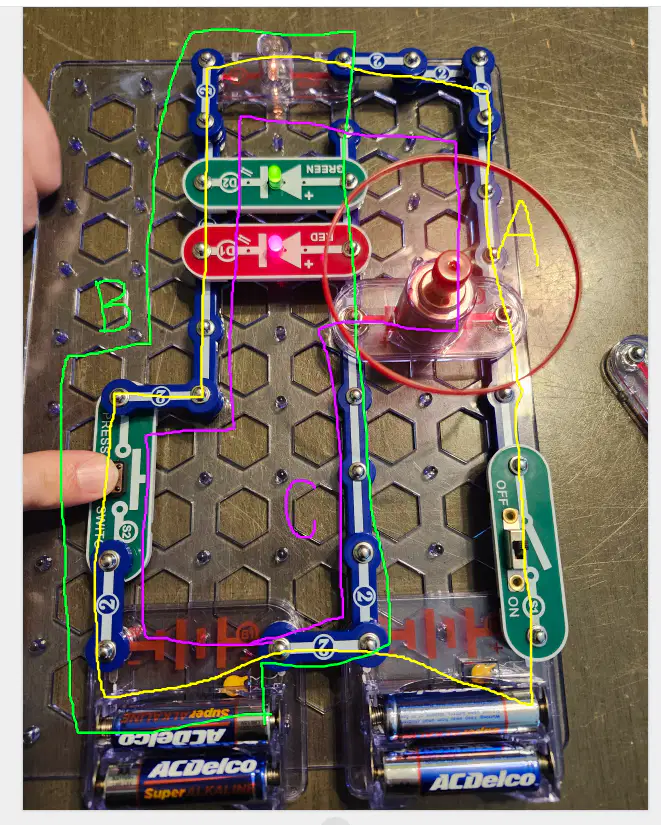
If I turn on the S1 switch while still holding the S2 switch, which items will stay on? Check all that apply.
a)
Incandescent bulb
b)
Red LED
c)
Green LED
d)
Fan
12.
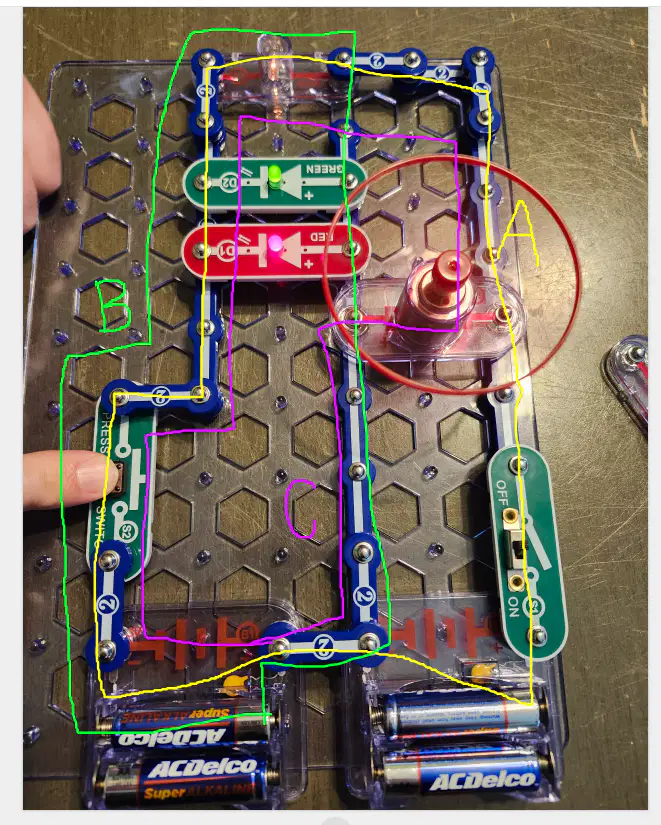
Why does the fan spin in the opposite direction when the switch S1 is off?
a)
Because Path A is a series circuit
b)
Because Path B is a parallel circuit
c)
Because Path C is a parallel circuit
d)
Because Path C reverses the flow of the current through the fan
13.
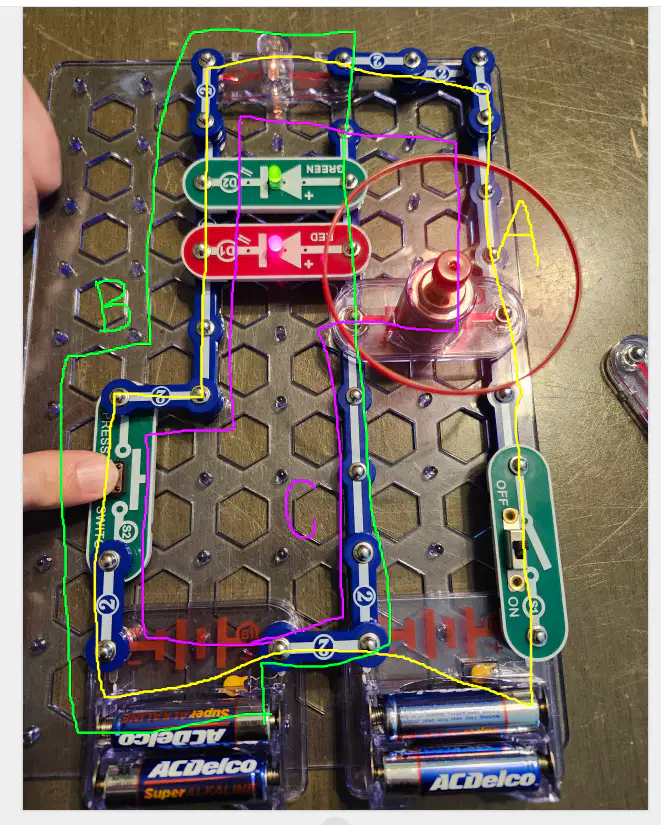
Why do both of the LED lights stay on when the switches are off?
a)
The LED lights need very minimal current to flow
b)
The LED lights are always on
c)
The LED lights are always off
14.
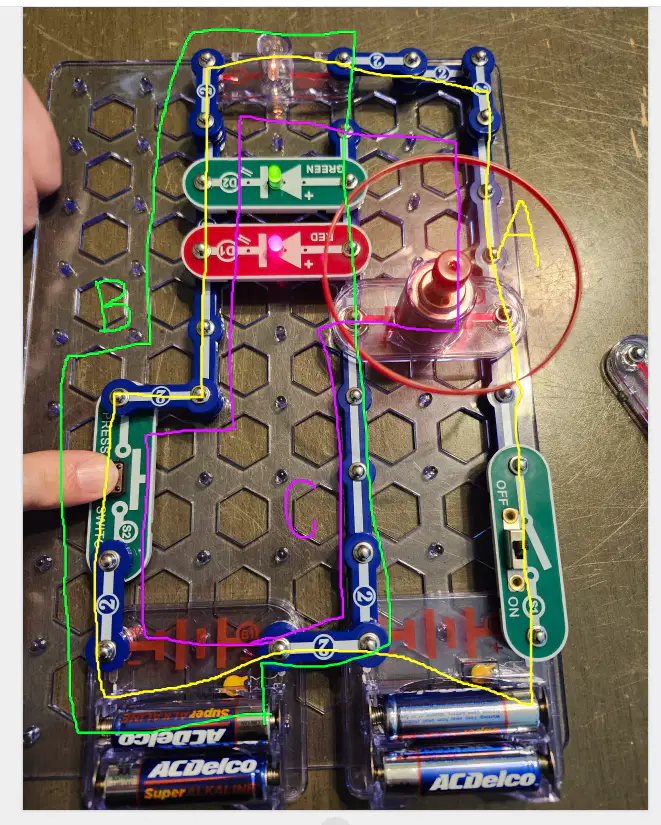
Through which path does the most voltage flow?
a)
Path A
b)
Path B
c)
Path C
15.

Current needs to flow in which path does the incandescent light burn the brightest?
a)
Path A
b)
Path B
c)
Path C
100 %

