
 Worksheets
1st Quarter Comprehensive
Total questions: 70
Worksheet time: 23mins
Name
Class
Date
1.
Which of the following terms refers to a rebirth and great change in many areas - political, social, economic, and cultural?
a)
Humanism
b)
Renaissance
c)
Machiavelli
d)
Theocracy
2.
Which of the following terms refers to the study of subjects such as grammar, rhetoric, poetry and history, that were taught in ancient Greece and Rome?
a)
Humanism
b)
Cultural Diffusion
c)
Humanities
d)
Reformation
3.
Which of the following terms refers to the spread of ideas, customs, and technologies from one people to another other time?
a)
Cultural Diffusion
b)
City-states
c)
Humanism
d)
Theocracy
4.
Which of the following terms refers to a political unit that includes a city and its surrounding lands and villages?
a)
Theocracy
b)
Oligarchy
c)
City-states
d)
Reformation
5.
Which of the following terms refers to a movement by Northern Europeans for church reform that would eventually unleash forces that would shatter Christian unity?
a)
Reformation
b)
Divine right
c)
Theocracy
d)
Renaissance
6.
Which of the following terms refers to a type of government ran by religious leaders?
a)
Democracy
b)
Oligarchy
c)
Monarchy
d)
Theocracy
7.
Which of the following people painted the Mona Lisa and The Last Supper?
a)
Raphael
b)
Leonardo Da Vinci
c)
Michelangelo
d)
Machiavelli
8.
Which of the following people painted The School of Athens?
a)
Raphael
b)
Leonardo Da Vinci
c)
Michelangelo
d)
Machiavelli
9.
Which of the following people was the inventor of the printing press?
a)
Henry VIII
b)
Machiavelli
c)
Johannes Gutenberg
d)
Thomas More
10.
Which of the following people is responsible for writing the 95 theses and was a German monk?
a)
John Calvin
b)
Henry VIII
c)
Martin Luther
d)
Charles V
11.
Which of the following people was made the “only supreme head on Earth of the Church of England”?
a)
Charles V
b)
Martin Luther
c)
Henry VIII
d)
John Calvin
12.
Which of the following people was the daughter of Henry VIII and Anne Boleyn, serving as England’s Virgin Queen?
a)
Elizabeth I
b)
Jane Seymour
c)
Mary Queen of Scots
d)
Katherine Parr
13.
During the Renaissance, there was a revival of interest in
a)
Perspective
b)
Individual achievement
c)
Humanism
d)
Supernaturalism
14.
Who sculpted David and painted the Sistine Chapel?
a)
Raphael
b)
Leonardo Da Vinci
c)
Michelangelo
d)
Cosimo de'Medici
15.
In The Prince, Machiavelli advises rulers to
a)
Support the arts
b)
Learn poetry, music, and sports
c)
Be ruthless in achieving goals
d)
Learn courtly manners
16.
The printing revolution meant that
a)
The arts lost many patrons
b)
The Bible could be read for the first time
c)
An end to illiteracy in Europe
d)
Exposed educated readers to new ideas and places
17.
Which of the following was a factor leading to the Reformation?
a)
The belief that the Pope would support the Renaissance
b)
Anger at the worldliness of the Church
c)
A desire to set up a theocracy in Wittenberg
d)
The hope that the Church would sell more indulgences
18.
Which of the following best describes the Catholic Reformation?
a)
Protestant views were adopted
b)
Calvin became a Catholic
c)
Many began to doubt their faith
d)
Church abuses were reduced
19.
Why did scientists begin to repeat their experiments?
a)
To express their doubt about the outcomes
b)
To refine and improve their hypotheses
c)
To disprove the mistakes of classical scientists
d)
To prove that gravity was the building block of all life
20.
One of Newton’s contributions was his
a)
Invention of the microscope
b)
Description of how muscles and blood vessels work
c)
Explanation of the movement of planets
d)
Analysis of the composition of matter
21.
What was the Line of Demarcation?
a)
A line drawn by Prince Henry that divided the non-European world
b)
The disputed border between Spain and Portugal
c)
A line that divided Europe from Africa at the Straits of Gibraltar
d)
A line drawn by the pope that divided the non-European world
22.
The first European explorer to reach India was?
a)
Ferdinand Magellan
b)
Christopher Columbus
c)
Vasco da Gama
d)
Dias
23.
What critical mistake did Columbus make when he left Spain in 1492?
a)
He greatly overestimated Earth's size
b)
He believed the earth was flat
c)
He greatly underestimated Earth's size
d)
He had not planned for bad weather
24.
Which statement best describes Ferdinand Magellan?
a)
He discovered the Spice Islands
b)
North and South America are named after him
c)
The expedition he commanded was the first to reach India
d)
The expedition he commanded circled the globe
25.
Which of the following terms refers to someone who goas all the way around the world?
a)
Cartographer
b)
Circumnavigate
c)
Line of Demarcation
d)
Moluccas
26.
Which of the following terms refers to a large farming estate?
a)
Monopoly
b)
Missionary
c)
Plantation
d)
Mombasa
27.
Which of the following terms refers to a person who wants to convert others to a religion?
a)
Missionary
b)
Monopoly
c)
Cape Town
d)
Plantation
28.
Which of the following terms refers to exclusive control of a business or industry?
a)
Integration
b)
Monopoly
c)
Boers
d)
Slaves
29.
How did Europeans usually obtain slaves?
a)
They exchanged European goods for slaves
b)
They went on raids into Africa and captured them
c)
They bought them from Arabs in Mombasa and Malindi
d)
They established a monopoly and exchanged gold for them
30.
The Boers were
a)
British farmers
b)
Portuguese traders
c)
Dutch farmers
d)
African warriors
31.
Because the natives were not united, the Spanish easily conquered and turned what place into a key link in their overseas trade?
a)
Goa
b)
Cape Town
c)
Ormuz
d)
The Philippines
32.
How did the Dutch East India Company come to dominate Asian trade?
a)
It was tightly controlled by government
b)
It had sovereign powers
c)
It tried to convert natives to Christianity
d)
It was interested in trading for spices
33.
Which statement describes the Mughal empire before 1700?
a)
It was weak compared to European countries
b)
It controlled all the sea trade between Europe and India
c)
It was larger and richer than any country in Europe
d)
It built forts and warehouses on the European coast
34.
In the early 1600s, Ming China was conquered by
a)
The Koreans
b)
The Portuguese
c)
The Japanese
d)
The Manchus
35.
Unlike China and Korea, Japan at first
a)
Rejected any contact with Europeans
b)
Became a Christian nation
c)
Welcomed European traders
d)
Defeated European invaders
36.
Which of the following terms refers to the conquerors who arrived in the Americas?
a)
Immunity
b)
Civil war
c)
Conquistador
d)
Malinche
37.
What was one way in which Native Americans resisted the Spanish conquest of South America?
a)
They made an alliance with England
b)
They successfully defeated the Spanish
c)
They set up their own kingdoms in the Andes
d)
They preserved many aspects of their own cultures
38.
Which of the following people was the emperor of the Aztecs?
a)
Hernan Cortes
b)
Malinche
c)
Moctezuma
d)
Francisco Pizzaro
39.
Which of the following people conquered the Aztecs?
a)
Malinche
b)
Hernan Cortes
c)
Francisco Pizzaro
d)
Moctezuma
40.
What was the attitude of the Spanish towards the Aztec religion?
a)
They did not like it and tried to convert the Aztecs to Christianity
b)
They respected it and allowed the Aztecs to practice their religion
c)
They did not care about it
d)
They felt it had similarities to Christianity, so allowed it to continue
41.
Francisco Pizzaro was the conquistador who defeated
a)
Cortes
b)
The Maya
c)
The Inca
d)
The Taino
42.
Which of the following terms refers to American-born descendants of Spanish settlers?
a)
Peninsulares
b)
Creoles
c)
Mulatto
d)
Mestizos
43.
Which of the following terms refers to Spanish-born people, and were at the top of the social ladder in colonial society?
a)
Creoles
b)
Mulatto
c)
Peninsulares
d)
Mestizos
44.
Which of the following terms refers to a group of people of Native American and European descent?
a)
Mulatto
b)
Peninsulares
c)
Mestizos
d)
Creoles
45.
Which of the following terms refers to income from taxes?
a)
Income
b)
Taxes
c)
Revenues
d)
Capital
46.
What was the purpose of the Mayflower Compact?
a)
It started a Parliament in New England
b)
It set guidelines for governing the Plymouth colony
c)
It set guidelines for governing the Jamestown colony
d)
It divided North America into English and French zones
47.
Compared with the French and Spanish colonists, the English colonists
a)
Had better relations with Native Americans
b)
Were overseen by royal governors
c)
Grew crops especially suited to their climates
d)
Enjoyed more self-government
48.
What was one result of the French and Indian War?
a)
Britain gained important sugar-producing islands
b)
The slave trade was outlawed in North America
c)
It ensured French dominance in North America
d)
It ensured British dominance in North America
49.
The ______________________ linked Europe, Africa, and the Americas.
a)
Middle Passage
b)
Floating Coffins
c)
Triangular Trade
d)
Slave Ships
50.
What did cities such as Bristol, England; Nantes, France; and Newport, Rhode Island have in common?
a)
They grew prosperous because of triangular trade
b)
They had large shipbuilding industries
c)
They were all stops on the Middle Passage
d)
They shipped sugar and molasses to North America
51.
Which of the following terms refers to the part of the triangular trade where slaves are transported from Africa to the Americas?
a)
Middle Passage
b)
Triangular Trade
c)
Last Passage
d)
First Passage
52.
What was the effect of the Atlantic slave trade?
a)
It provided stability in Africa
b)
Most transported slaves died
c)
It helped colonial economies
d)
It kept wages low
53.
Which of the following terms refers to an economic policy aimed at strengthening national economies?
a)
Capitalism
b)
Mercantilism
c)
Tariff
d)
Inflation
54.
The Columbian Exchange refers to the
a)
Spread of deadly diseases around the world
b)
Flow around the world of new plants, animals, and people
c)
Transporting of slaves to the Americas
d)
Trade of land between Spain and Portugal in the Americas
55.
Which was a cause of the global population explosion?
a)
The decrease in conflicts resulting in war
b)
A decrease in the spread of diseases
c)
The entry of entrepreneurs into health care
d)
The dispersal of new crops from the Americas
56.
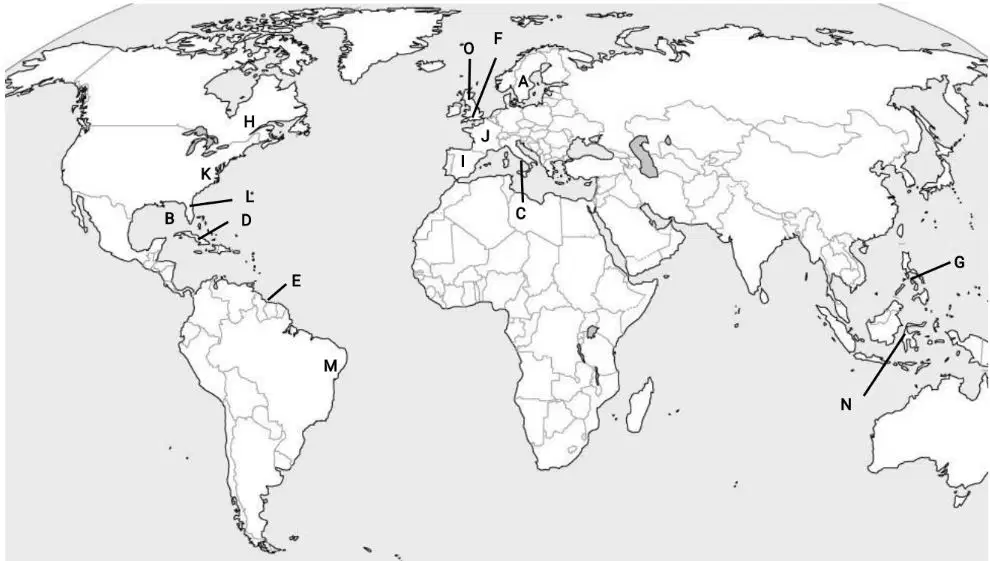
Which of the following locations corresponds to Location A?
a)
England
b)
France
c)
Spain
d)
Norway and Sweden
57.
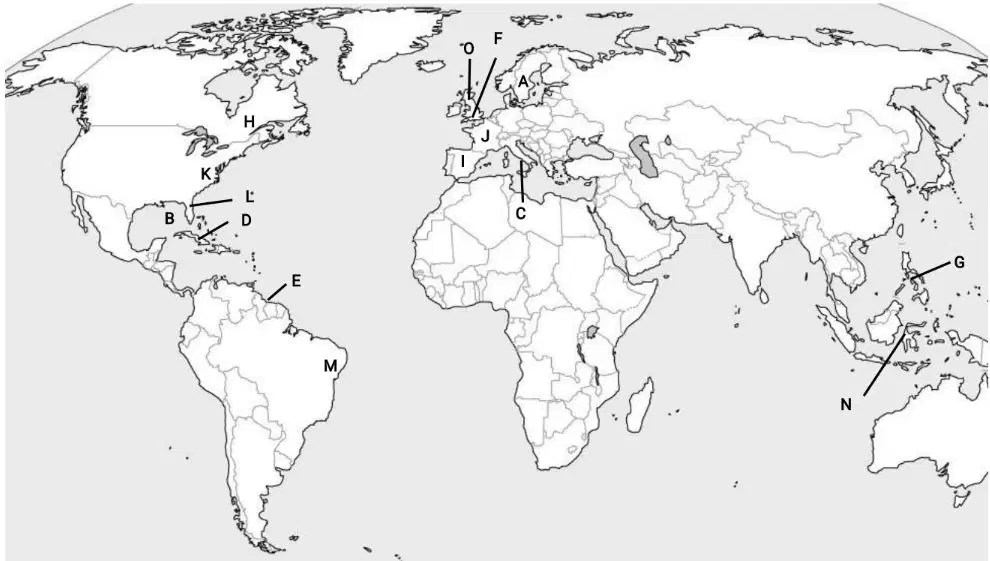
Which of the following locations corresponds to Location B?
a)
Gulf of Mexico
b)
Atlantic Ocean
c)
Pacific Ocean
d)
Cuba
58.
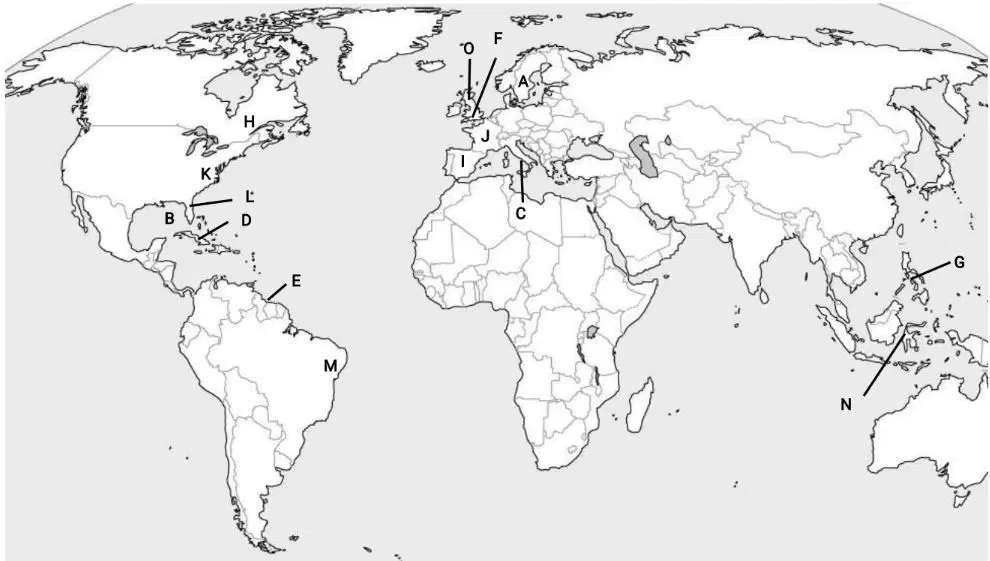
Which of the following locations corresponds to Location C?
a)
Spanish Florida
b)
Italy
c)
France
d)
Guiana
59.
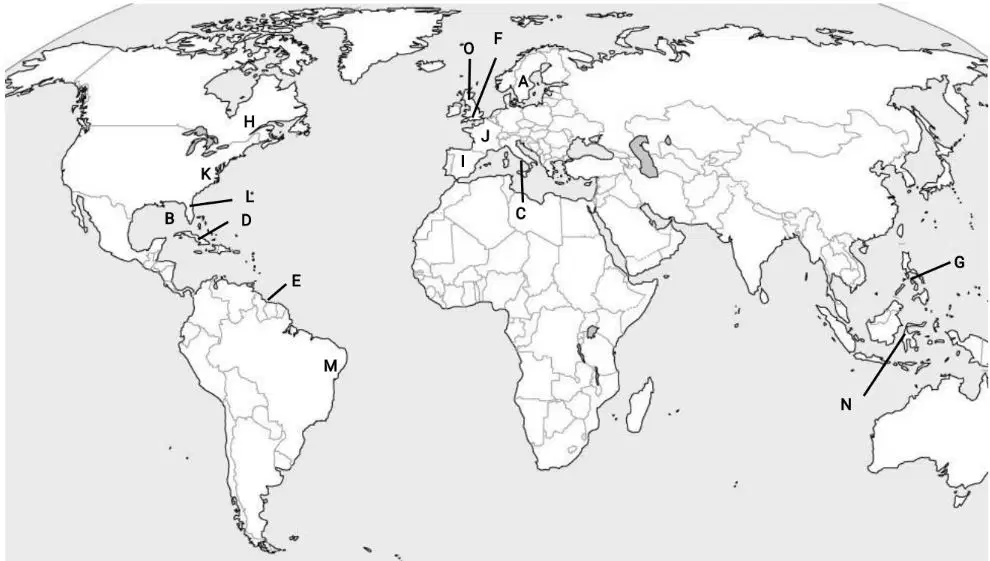
Which of the following locations corresponds to Location D?
a)
Philippines
b)
Moluccas
c)
Cuba
d)
Canada
60.
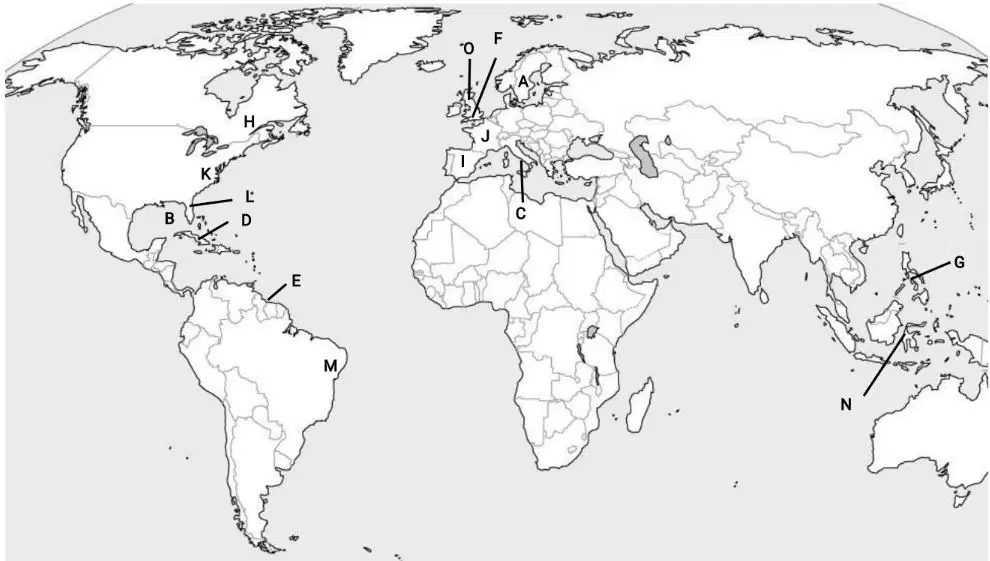
Which of the following locations corresponds to Location E?
a)
British Colonies of North America
b)
Moluccas
c)
Brazil
d)
Guiana
61.
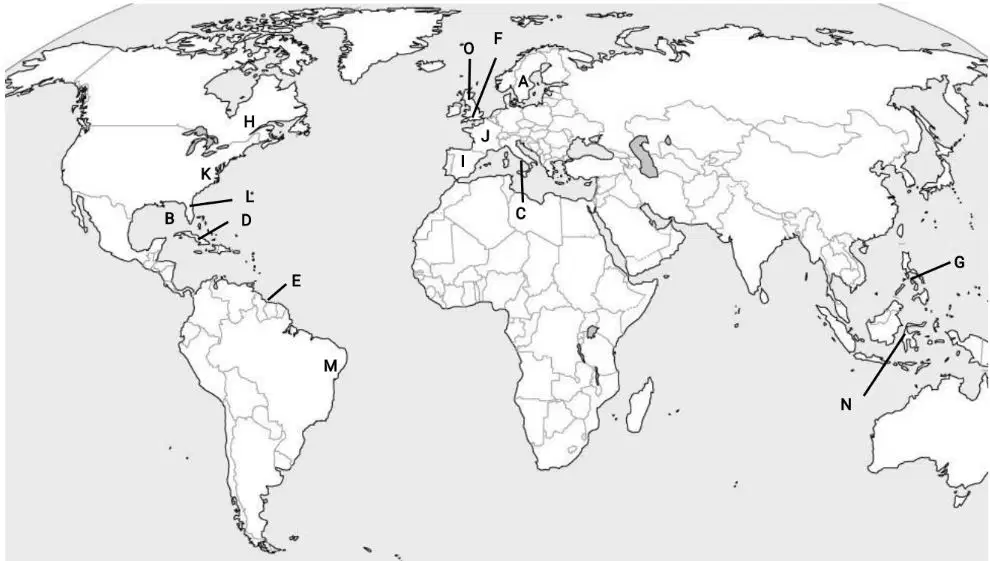
Which of the following locations corresponds to Location F?
a)
Spain
b)
England
c)
France
d)
Scotland
62.
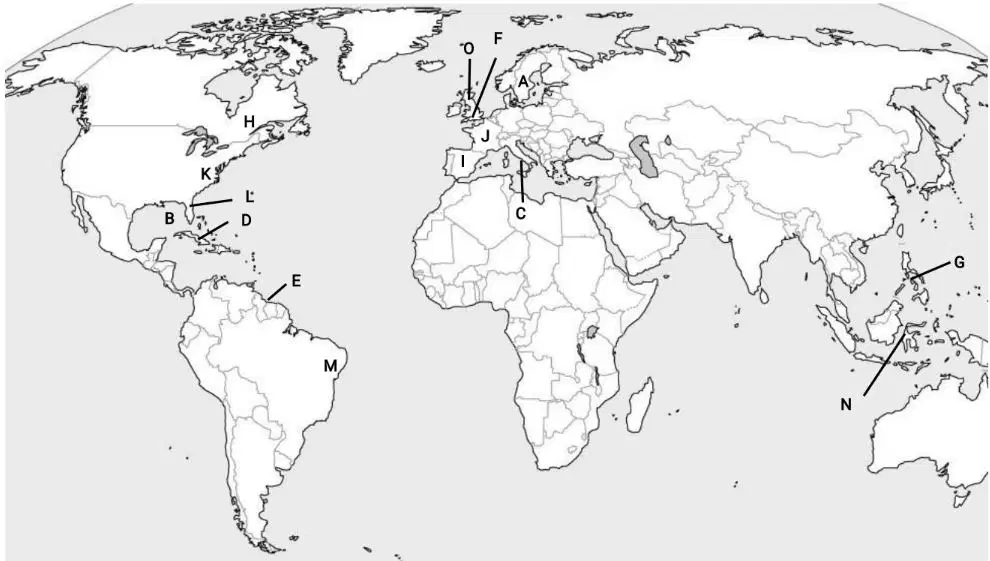
Which of the following locations corresponds to Location G?
a)
Moluccas
b)
Philippines
c)
Cuba
d)
Italy
63.
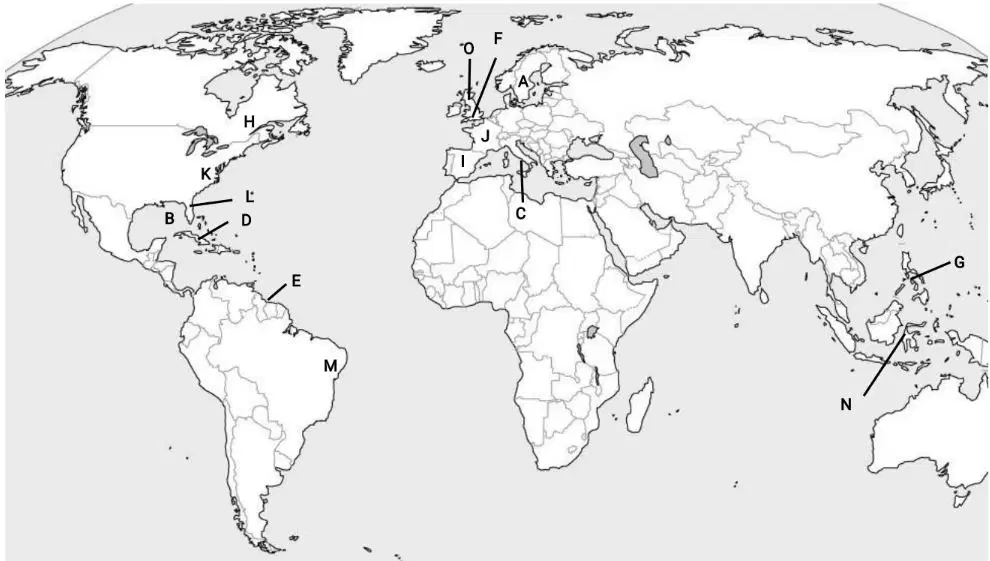
Which of the following locations corresponds to Location H?
a)
Canada
b)
British Colonies of North America
c)
Gulf of Mexico
d)
Spanish Florida
64.
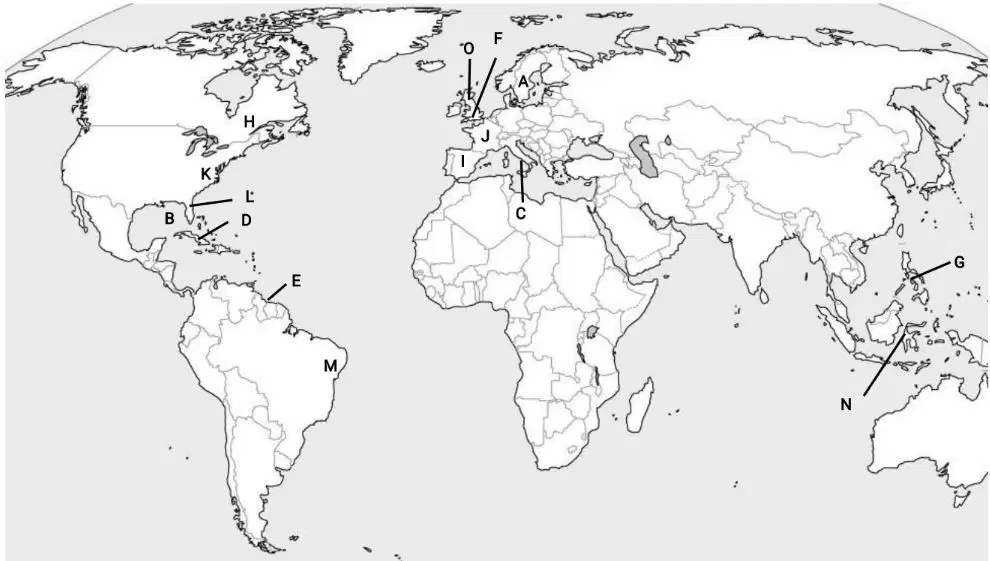
Which of the following locations corresponds to Location I?
a)
Spanish Florida
b)
Italy
c)
Spain
d)
Moluccas
65.
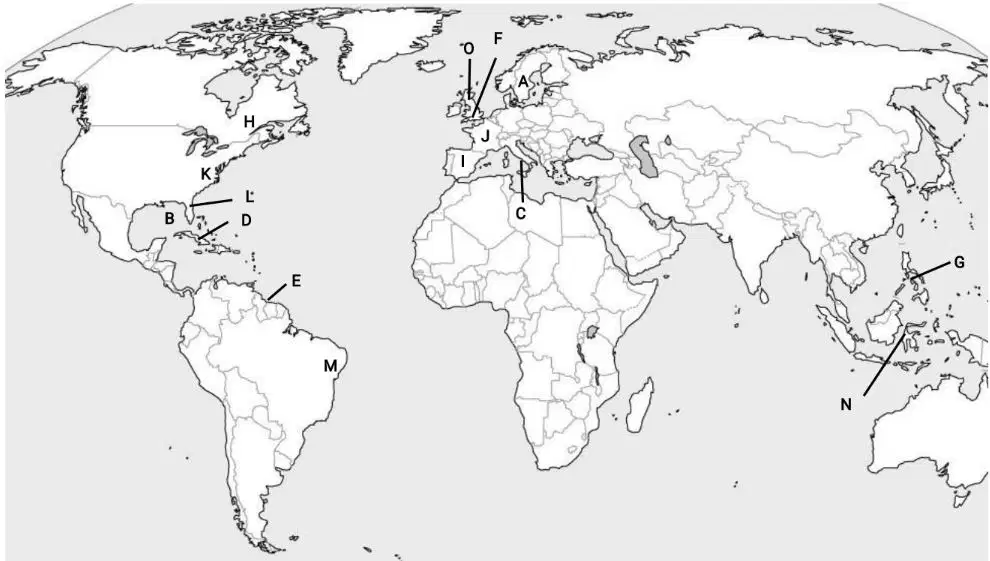
Which of the following locations corresponds to Location J?
a)
France
b)
Philippines
c)
Scotland
d)
Cuba
66.
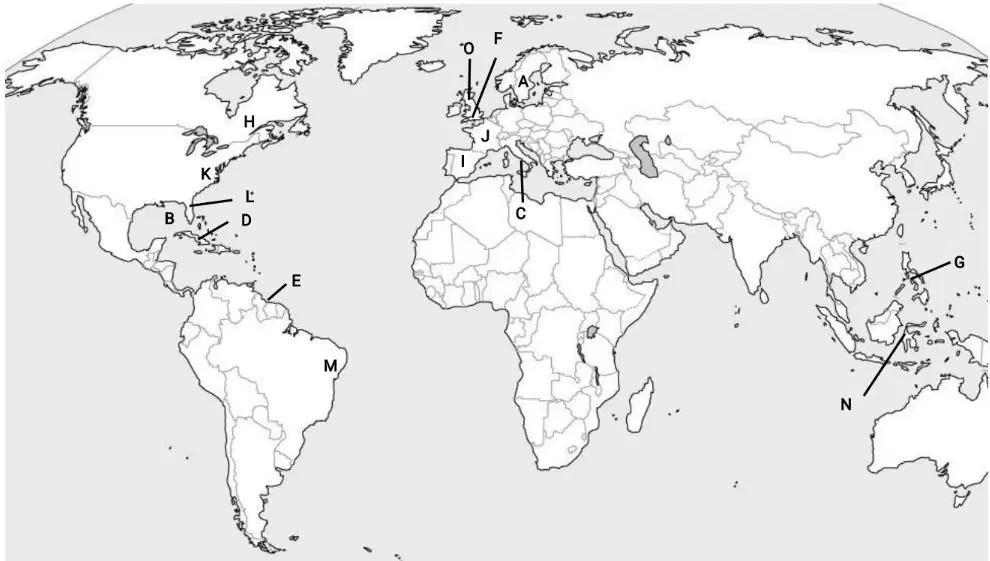
Which of the following locations corresponds to Location K?
a)
Canada
b)
England
c)
British Colonies of North America
d)
Norway and Sweden
67.
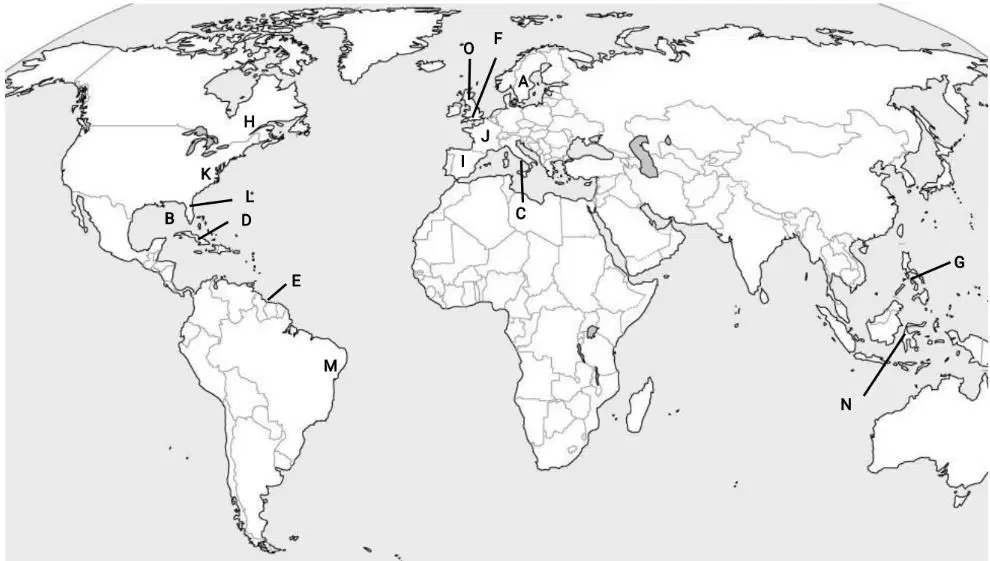
Which of the following locations corresponds to Location L?
a)
Spanish Florida
b)
Cuba
c)
Gulf of Mexico
d)
Italy
68.
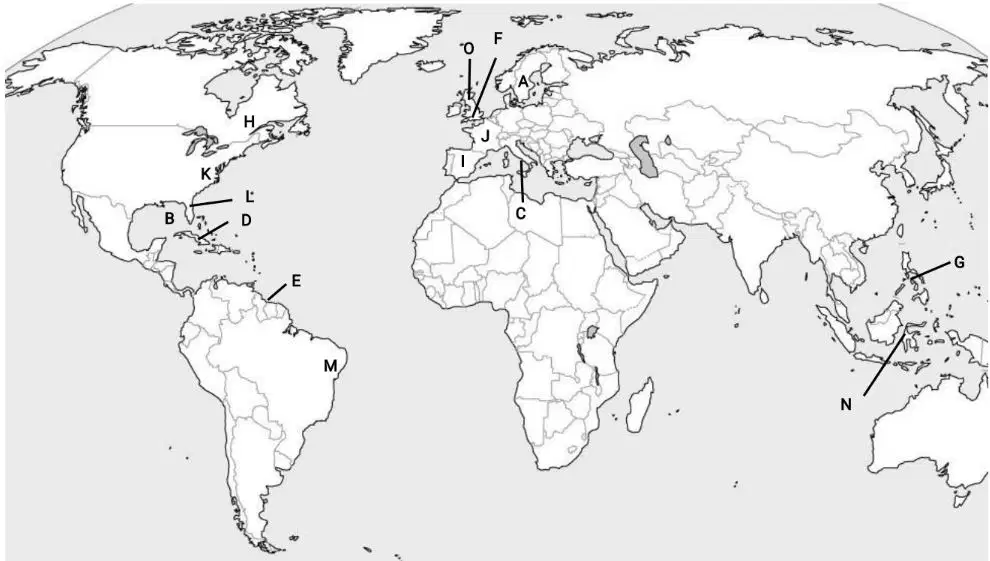
Which of the following locations corresponds to Location M?
a)
Brazil
b)
Guiana
c)
Moluccas
d)
Spain
69.
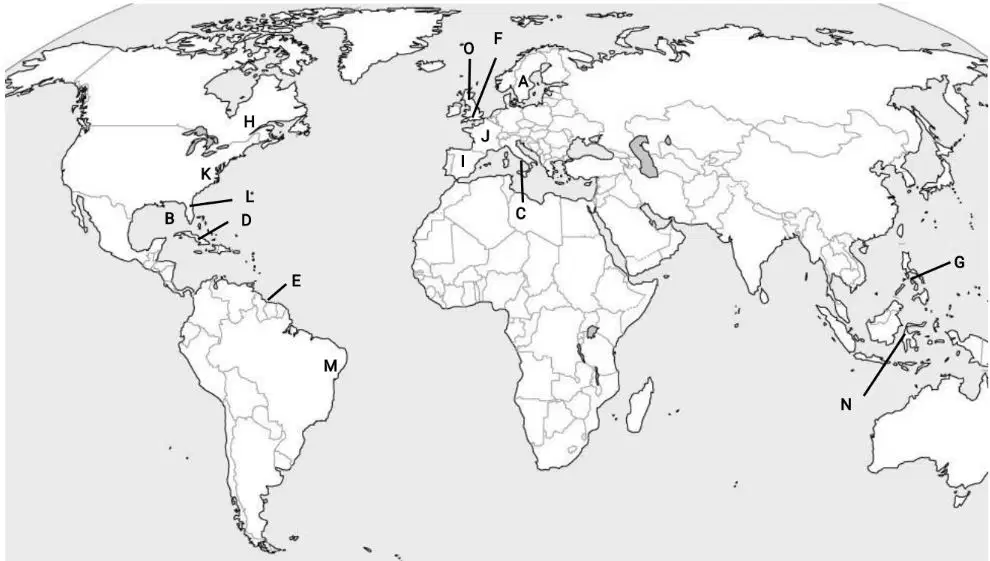
Which of the following locations corresponds to Location N?
a)
Philippines
b)
Moluccas
c)
Cuba
d)
Gulf of Mexico
70.
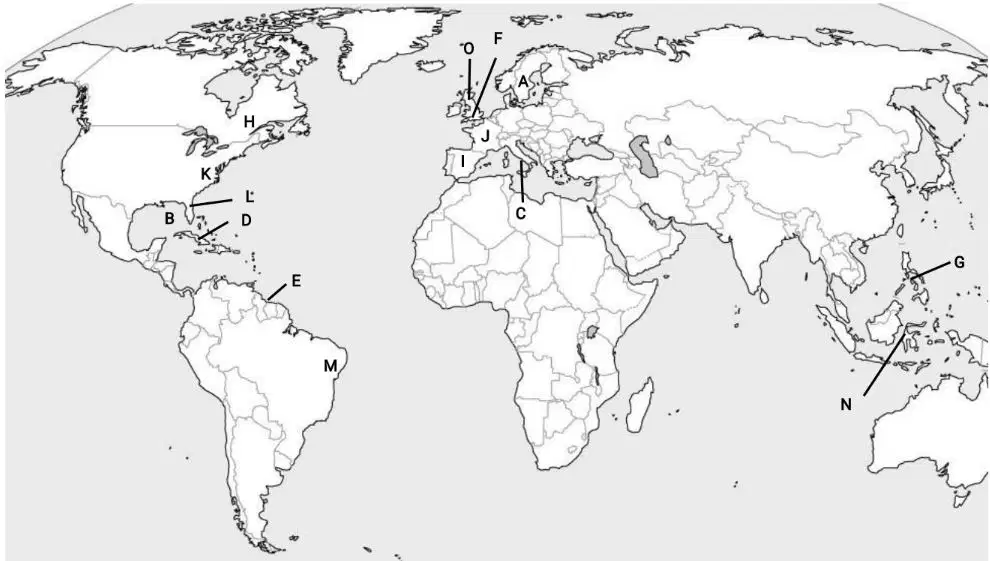
Which of the following locations corresponds to Location O?
a)
Scotland
b)
England
c)
France
d)
Spain
100 %

