
 Worksheets
Unit 4 Pre-Test (SSUSH8-SSUSH10)
Total questions: 71
Worksheet time: 1hrs 12mins
Match the words with the correct definition.
a person who has escaped from a place or is in hiding, especially to avoid arrest
fugitive
the idea that the people in a territory should vote to allow slavery
popular sovereignty
an agreement or a settlement of a dispute that is reached by each side making concessions
compromise
to formally discuss an issue
debate
a war between opposing groups of citizens from the same country
civil war
(a) planned to raid (b) in order to capture the federal (c) to arm slaves and start a (d) .
Label the Union and the Confederacy.

The Missouri Compromise tried to maintain the balance between slave states and free states.
True
False

Which of these were punishments for breaking the Fugitive Slave Law?
$1000 fine
6 months in prison
12 months in prison
death

Who was a violent opponent of slavery?
Abraham Lincoln
John Brown
Frederick Douglass
John C Calhoun

The (a) was designed to squeeze the Confederates into submission.

(a) was the aggressive Union General who won the Siege of Vicksburg.
Label The Seige of Vicksburg
Important Transportation→
Confederates
Union besiegers

Vicksburg surrendered because
The Union Army invaded and controlled the town.
The Confederates were starving and being killed by shells.
It was not important enough to defend.
The Spanish attacked with a huge army.
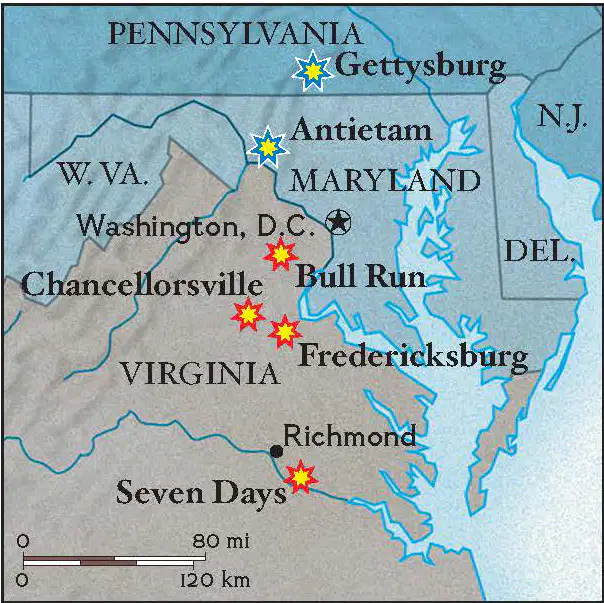
Robert E. Lee invaded the North twice. The Battle of (a) happened in 1862. The Battle of (b) happened in 1863.
Label these Civil War Battles
←Battle of Atlanta
←Lots of Battles→
←Vicksburg
Antietam→
Gettysburg→
Use the map to locate Sherman's March to the Sea.
Sherman's March to the Sea→
←Battle of Atlanta
A Civil War is a war between two factions (or groups) within the same country.
True
False
Most of the battles during the American Civil War were fought in the (a) part of the country.
True or False?
In the end of the Civil War, slavery was not abolished and continued in the United States.
False
True
Where did General Robert E. Lee surrender at the end of the Civil War?
Appomattox Court House
Ft. Sumter
Battle of Gettysburg
Atlanta
Who was the President of the South during the Civil War?
Andrew Jackson
George Washington
Abraham Licnoln
Jefferson Davis
This man was the Commander of the Confederate Army (South) of Virginia during the Civil War.
Ulysses S. Grant
George Washington
Robert E. Lee
Abraham Lincoln
How long did the Civil War last?
4 years
12 years
a couple of months
3 days
This man was the 18th President of the United States and the lead general of the Union during the Civil War
Robert E. Lee
Abraham Lincoln
Jefferson Davis
Ulysses S. Grant
This man led the country during the Civil War and was the 16th President of the United States
Abraham Lincoln
Jefferson Davis
William Sherman
Robert E Lee
This battle marked the BEGINNING of the Civil War.
Battle of Gettysburg
Ft. Sumter
Atlanta Campaign
Battle of Lexington and Concord
Who was the General of the Confederate Army
Stonewall Jackson
George Washington
Jefferson Davis
Robert E. Lee
Who led the Atlanta Campaign in May 1864
Abraham Lincoln
Robert E. Lee
George Washington
William Sherman
This battle took place over 3 days in July of 1863. This battle marked a huge turning point in the war in favor of the Union side.
Sherman's March to the Sea
Battle of Atlanta
Battle of Gettysburg
Battle of Fort Sumter
True or False
Abraham Lincoln and Jefferson Davis were allies (friends) during the Civil War and wanted the same things for the United States.
True
False
After capturing Atlanta, Sherman and his Union troops headed to Savannah, Georgia. They stole food, killed animals, wrecked railroads, and burned houses. What was the event called?
Sherman's March to the Sea
Sherman's March to Georgia
Sherman's March to the Appomattox Court House
Lincoln's March to the Sea
Union general who captured Atlanta, Georgia and led a destructive march to the sea that cut the Confederacy in two.
Andrew Jackson
William Sherman
Abraham Lincoln
Robert E. Lee
True or False
Abraham Lincoln wanted to keep slavery in the United States.
True
False
True or False? Abraham Lincoln and Ulysses S. Grant were both on the Union side of the Civil War.
True
False

One important (a) group that moved to California during the Gold Rush was the Chinese.
John O'Sullivan said that the United states had a (b) to spread across the continent of North America.
The (c) resulted in a major gain of territory for the United States in 1848.
President Thomas Jefferson sent Lewis and Clark to explore the land gained from the (d)
The (e) spelled out how the areas of the Northwest Territory (Ohio) could become states. Westw
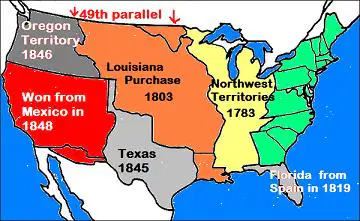
Reorder the following territorial acquisitions according to the year they occured.
Louisiana Purchase (1803)
Adams-Onis Treaty (Florida Cession) (1819)
Annexation of Texas (1845)
Oregon Treaty (1846)
Mexican Cession (1848)
Reorder the following territorial acquisitions according to the year they occured.
Northwest Ordinance (1787)
Louisiana Purchase (1803)
Acquisition of California and New Mexico (1848)
Gadsen Purchase (1854)
Purchase of Alaska (1867)
Label the map with the correct territorial acquisitions.

Match each acquired piece of land with its correct location as represented by the letter on the map.
Oregon Country
Letter E on the map
Texas
Letter I on the map
The Gadsen Purchase
Letter F on the map
The Mexican Cession
Letter H on the map

Immigration from Ireland was prompted by a (a) in that region.
The territory the United States won from Mexico in the U.S.-Mexican War is referred to as the Mexican (b) .
(c) expansion by Anglo (white) Americans resulted in American Indians losing their land.
The (d) of 1850 was a set of laws that tried to settle the question of whether lands gained from Mexico could have slavery or not.


By what name was General Scott's strategy known?
Considered the turning point of the war, (a) is when the North started winning.
General Robert E. Lee led the (a) army.
Why did Congress want to impeach President Andrew Johnson?
He favored more lenient Reconstruction policies than those favored by Radical Republicans.
He favored military occupation to ensure Southern governments enforced Reconstruction policies.
He favored the creation of the Freedmen's Bureau to assist freedmen and freedwomen in the South.
In what TWO ways did the assassination of President Abraham Lincoln affect Reconstruction policies?
Former slaves were denied citizenship until they could prove their literacy.
Confederate supporters received harsher punishments than they would have otherwise.
Plantation owners were given back land that had been confiscated from them.
The readmission of Southern states to the Union became more difficult and drawn-out.
States governments determined whether to extend suffrage to African Americans.
Which of the following higher-education facilities was established in the Reconstruction-era South in order educate African Americans?
Fisk College
Florida College
Bennett College
Morehouse College
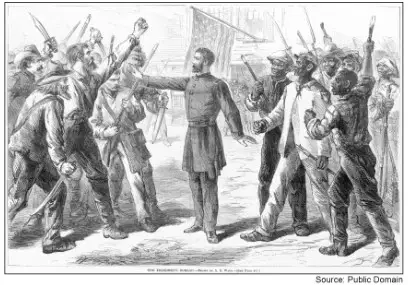
The Freedmen's Bureau was a federal agency founded to help freedmen and freedwomen in the South acquire food, shelter, employment, and medical treatment. Based on this illustration, what was a main purpose of the Freedmen's Bureau?
to seize plantation owners' land and redistribute it to freed slaves
to prevent violence between Confederate veterans and freed slaves
to make sure that segregated public facilities in the South were equal
to establish and run integrated state governments in the South
1865 - Agency set up to aid former slaves in adjusting themselves to freedom. It furnished food and clothing to needy blacks and helped them get jobs.
Black Codes
Freedmen's Bureau
Congressional Reconstruction
Presidential Reconstruction
1865 - Freed all slaves, abolished slavery.
Thirteenth Amendment
Fourteenth Amendment
Civil Rights Act of 1866
Fifteenth Amendment
Match the following terms with their correct definitions related to crimes involving public figures.
Assasssination
Murder of a public figure, usually for political reasons.
Treason
Betrayal of one's country, especially by attempting to overthrow the government.
Execution
Carrying out a death sentence on a person as a legal penalty.
Flogging
Beating a person with a whip or stick as a form of punishment.
Southern laws designed to restrict the rights of the newly freed black slaves.
Poll Tax
Grandfather Clause
Black Codes
Literacy Test
Made "all persons born or naturalized in the United States" citizens of the country.
Thirteenth Amendment
Civil Rights Act of 1866
Fourteenth Amendment
Fifteenth Amendment
The constitutional amendment adopted in 1870 to extend suffrage to African Americans.
Thirteenth Amendment
Civil Rights Act of 1866
Fourteenth Amendment
Fifteenth Amendment
A process led by the Radical Republicans that led to the usage of military force to protect blacks' rights.
Presidential Reconstruction
Congressional Reconstruction
Lincoln's Plan of Reconstruction
Hayes' Plan of Reconstruction
President's idea of reconstruction : all states had to end slavery, states had to declare that their secession was illegal, and men had to pledge their loyalty to the U.S.
Presidential Reconstruction
Congressional Reconstruction
Lincoln's Plan of Reconstruction
Grant's Plan of Reconstruction
After the Civil War, a group that believed the South should be harshly punished and thought that Lincoln was sometimes too compassionate towards the South.
Radical Republicans
Radical Democrats
Radical Whigs
Radical Free-Soilers
A secret society created by white southerners in 1866 that used terror and violence to keep African Americans from obtaining their civil rights.
Ku Klux Klan
Knights of the White Camellia
Order of the Pale Faces
Grand Wizard
(a) was the 19th president of the United States, famous for being part of the Hayes-Tilden election in which electoral votes were contested in 4 states, the most corrupt election in US history.

