
 Worksheets
U2 L1 Electric Forces Act on Charged Objects
Total questions: 24
Worksheet time: 30mins
Electric charge is a physical property that leads to electric and __ interactions.
magnetic
thermal
gravitational
nuclear
Static electricity occurs when electric charges are __.
not moving
moving rapidly
flowing in a circuit
oscillating
A positively charged object has more __ charges than negative charges.
positive
negative
neutral
zero
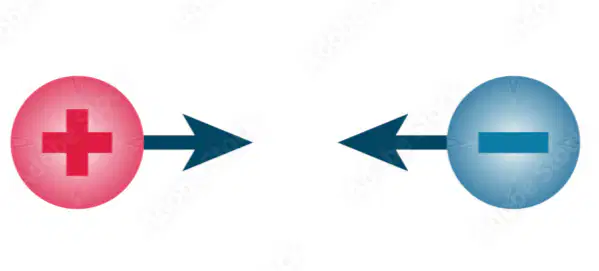
Opposite charges are __ to each other.
attracted
repelled
neutral
unaffected
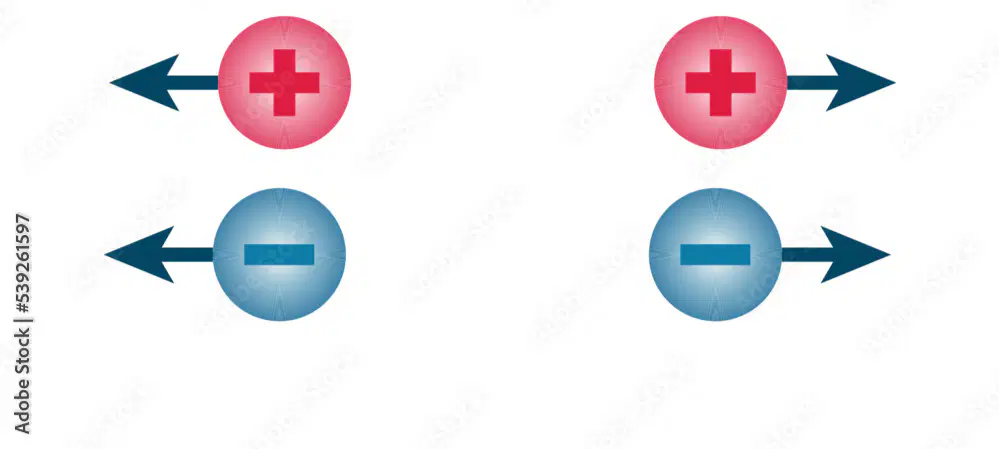
Like charges are __ to each other.
attracted
repelled
neutral
unaffected
In most objects, positive and negative charges are __ spread out.
evenly
randomly
unevenly
concentrated
What happens to a neutral object when it gains negative charges?
It becomes positively charged
It becomes negatively charged
It remains neutral
It loses its positive charges
How can charges in a neutral object move?
By remaining still
By being exposed to outside forces
By staying neutral
By gaining positive charges
What causes a spark when you touch a doorknob?
Friction
Static electricity
Magnetism
Heat
When an object becomes charged, it is usually because ____.
it has gained or lost electrons
it has changed its shape
it has been heated
it has been compressed
An object becomes charged when the atoms in the object gain or lose ____.
electrons
protons
neutrons
photons
An object becomes negatively charged by gaining ____.
electrons
protons
neutrons
photons
An object becomes positively charged by losing ____.
electrons
protons
neutrons
photons
When an object becomes charged, its charges are rearranged ____.
randomly
in a specific pattern
equally
uniformly
The net charge of an object that has equal numbers of protons and electrons is
(a)
Which of the following is true about the conservation of charge?
Charges can be created
Charges can be destroyed
Charges are transferred between objects
Charges remain unchanged.

When a neutral object comes into contact with a negatively charged object, what happens to the charges in the neutral object?
The charges in the neutral object remain unchanged.
The neutral object's negative charges move away from, but its positive charges remain close.
The neutral object loses all its charges.
The charges in the neutral object become evenly distributed.

What happens when the charged balloon is removed from the neutral wall?
The neutral wall remains charged.
The neutral wall becomes charged.
The neutral wall charges return to their original state.
The neutral wall gains electrons.
Most objects tend to have a net neutral charge because:
They have an equal number of protons and electrons.
They have more protons than electrons.
They have more electrons than protons.
They have no protons or electrons.
Which charge has a greater magnitude?
0 has a greater magnitude.
+2 has a greater magnitude.
-3 has a greater magnitude.
+5 has a greater magnitude.
Which charge has a greater magnitude?
-6 has a greater magnitude.
+4 has a greater magnitude.
+2 has a greater magnitude.
-2 has a greater magnitude.
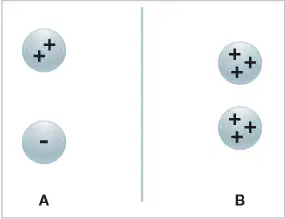
The diagram shows two pairs of charged objects.
The number of signs in each object represents the
magnitude of the charge.
Compare the two pairs of charged objects.
Which pair of objects, A or B, has a stronger
electric force between the two objects?
Pair A
Pair B

Water molecules are neutral. Even though the electric
charges are balanced in each molecule, one side of
the molecule is slightly positive, and the other side is
slightly negative. Why does the stream of water bend
toward the negatively charged balloon in the bottom
photo?
The electric force of the
balloon pushes the negative part of the water molecules
away, and that the positive part is attracted to the balloon.

Which statements describe how the electric force affects the
balloons? Choose all that apply.
The balloons are pulled together by the electric force.
The balloons are pushed apart by the electric force.
The balloons stick together once they are touching because
they need to be in contact to be affected by the electric force.
If the balloons move closer together, the electric force acting
on them increases.
If one of the balloons becomes positively charged, the electric
force increases.

